


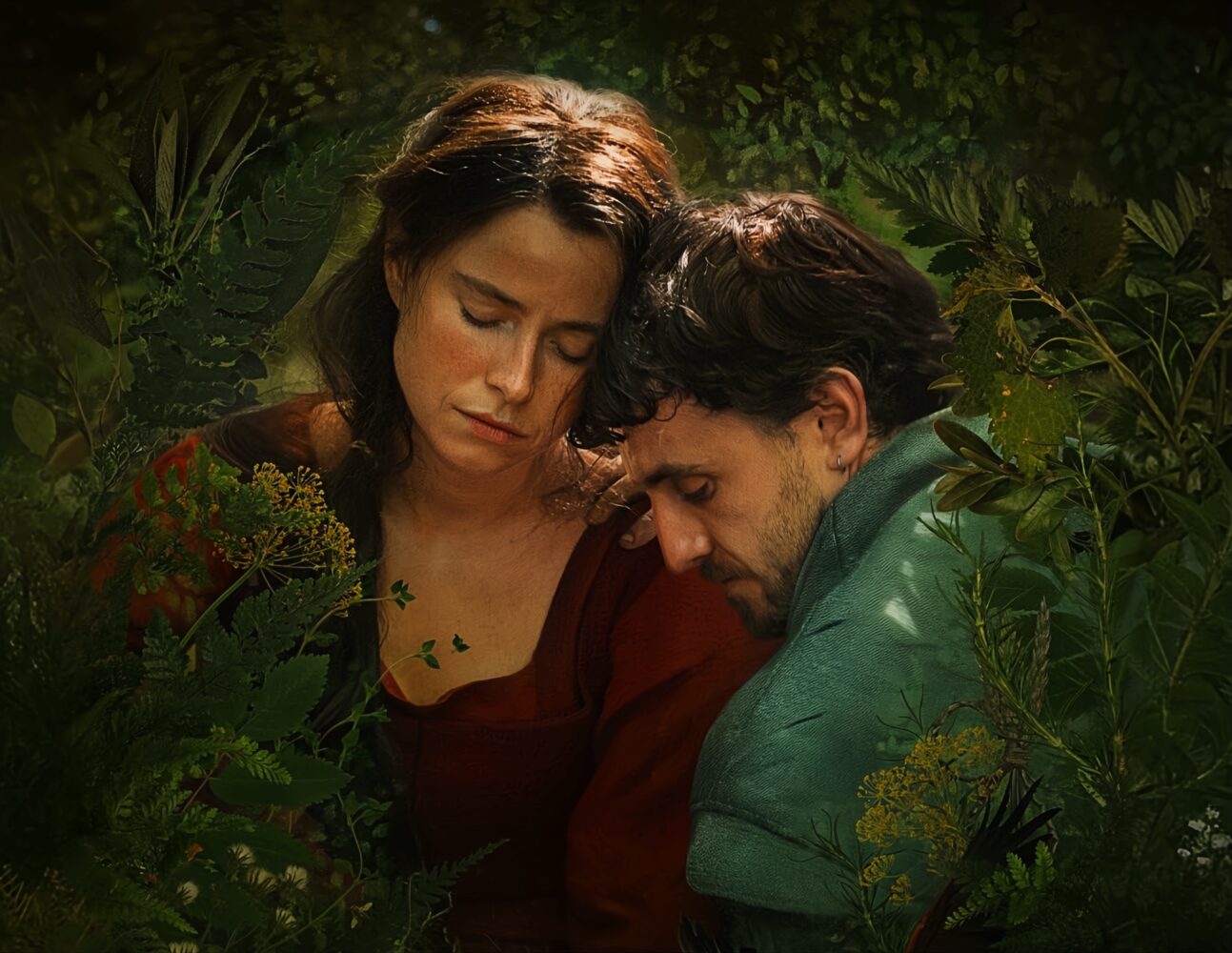
TL;DR: Hamnet is a beautifully restrained, emotionally devastating meditation on grief, love, and artistic creation. Chloé Zhao strips away Shakespearean myth to reveal the fragile human story beneath, anchored by extraordinary performances from Jessie Buckley and Paul Mescal and some of the most tranquil cinematography of the year.
Hamnet
I walked into Hamnet expecting prestige cinema in the most obvious sense: tasteful lighting, hushed performances, and a respectful distance from the myth of William Shakespeare. What I didn’t expect was to walk out feeling like I’d just watched someone gently crack open the ribcage of Western literature, reach in with trembling hands, and remind me that before the canon, before the GCSE essays and IMDb trivia, there was a family trying to survive unbearable loss.
Directed by Chloé Zhao, Hamnet is the kind of film that doesn’t announce its importance. It doesn’t posture. It doesn’t grandstand. It drifts. It listens. It breathes. And in doing so, it becomes one of the most emotionally disarming literary adaptations I’ve seen in years, not because it worships Shakespeare the icon, but because it insists on seeing Shakespeare the human.
This is not a biopic in the conventional sense. There’s no Greatest Hits structure, no wink-wink moments about legacy, no smug reassurance that we’re watching Great Art Being Born. Instead, Zhao frames Hamnet as a memory poem rendered in light and silence, a story about marriage, grief, and the strange alchemy that turns personal devastation into cultural immortality.
Paul Mescal plays William Shakespeare, and Jessie Buckley plays Agnes, his wife. Their son Hamnet, portrayed with aching fragility by Jacobi Jupe, is the quiet gravitational centre of the film. If that sounds like a strange way to describe a story that eventually stages Hamlet itself, that’s exactly the point.
This is a film about absence. About the echo left behind when someone vanishes from your life. And Zhao structures the entire experience around that idea.
What struck me first wasn’t the performances, or even the writing. It was the sheer calm of the film’s visual language. Zhao reunites with a deeply observational style here, but filtered through the eye of cinematographer Łukasz Żal, whose work turns the English countryside into something halfway between a Renaissance painting and a dream you’re not sure you had. The camera doesn’t rush. It glides, often lingering on empty rooms, candle smoke, grass moving in the wind. The world feels alive even when the characters are barely speaking.
Zhao and Żal shoot the film in a 1.66:1 aspect ratio, a choice that immediately signals intimacy. The frame feels taller, narrower, more enclosed. Interiors are bathed in candlelight, with deep shadows that swallow the corners of rooms. Faces emerge and disappear within the darkness, as if memory itself is deciding what it wants to hold onto. Exterior shots, by contrast, open upward. Trees stretch into the sky. The natural world looms larger than the people inside it, indifferent and serene.
That serenity becomes almost cruel in the second act, when the film turns toward grief. Zhao doesn’t dramatize tragedy with swelling strings or overwrought monologues. She lets it arrive quietly, then refuses to look away. Jessie Buckley’s performance here is devastating, not because it’s showy, but because it feels utterly unfiltered. There is a scream, yes, but it’s not cinematic. It’s primal. It’s the sound of something breaking that cannot be repaired.
Buckley’s Agnes is the emotional anchor of the film. She is not framed as a muse or a supporting figure to Shakespeare’s genius. She is the axis around which everything turns. Zhao gives her interiority, agency, and rage. Grief does not make her small. It makes her elemental. Watching Buckley process loss through silence, posture, and raw physicality is like watching weather roll in. You can’t stop it. You can only brace yourself.
Mescal, meanwhile, does something fascinating with Shakespeare. He resists the urge to mythologize him. This William is impulsive, prickly, occasionally insufferable. Mescal plays him like a man whose thoughts are always running faster than his mouth, someone capable of immense tenderness and sudden cruelty in the same breath. When anger flares, it’s sharp and disorienting. When sorrow hits, it folds inward, turning creative energy into something corrosive.
The chemistry between Mescal and Buckley feels lived-in. Their marriage is not idealized. It’s negotiated moment by moment. Zhao understands that intimacy isn’t built on grand declarations, but on shared routines, shared spaces, shared silences. When those routines are shattered, the film doesn’t rush to rebuild them.
The structure of Hamnet is quietly daring. The film unfolds in three temporal movements: courtship and early family life, the aftermath of Hamnet’s death, and finally, the staging of Hamlet itself. Zhao intercuts these periods with increasing fluidity, allowing memory and imagination to bleed into one another. Time becomes elastic. The past intrudes on the present. Futures are imagined and mourned simultaneously.
The third act is where Zhao fully commits to the film’s metatextual ambitions. We watch Shakespeare’s Hamlet being staged within the world of the film, while Agnes travels to London to see it performed. The effect is almost hallucinatory. The play becomes both confession and exorcism. Art is no longer separate from life. It is life, refracted through language and performance.
One of my favourite moments comes when Mescal’s Shakespeare attempts to direct his actors and, dissatisfied, steps in to perform the lines himself. It’s a deliciously layered scene: an actor playing Shakespeare performing Shakespeare, frustrated by the inadequacy of others to express what he himself can barely articulate. It’s clever without being smug, intellectually playful without sacrificing emotional weight. In an era where self-reference usually means winking at the camera, this feels refreshingly sincere.
The final act, set at the Globe Theatre, is where everything clicks into place. Watching Noah Jupe perform Hamlet on stage while Buckley’s Agnes reacts in the audience is one of the most quietly powerful sequences of the year. Jupe brings a raw, unpolished intensity to the role, making Hamlet feel less like a literary monument and more like a grieving son flailing for meaning.
Zhao cross-cuts between the performance and Agnes’s face, allowing us to see recognition, pain, and release flicker across her expression. Theatre becomes ritual. Cinema becomes witness. The boundaries between audience, performer, and subject dissolve. By the time the curtain falls, the film has achieved something rare: it has transformed grief into communion.
The score by Max Richter is used sparingly, often drifting in like a half-remembered melody. It never dictates emotion. It accompanies it. Richter’s compositions feel less like music cues and more like emotional residue, lingering after scenes end.
What makes Hamnet so effective is Zhao’s refusal to impose meaning. She trusts the audience to sit with ambiguity, to feel without being told what to feel. The film understands that grief is not a problem to be solved or a lesson to be learned. It is something you carry. Sometimes art makes it lighter. Sometimes it just gives it shape.
By the end, I realized Hamnet isn’t really about the creation of Hamlet. It’s about the cost of creation. About what it takes from you. About what it gives back, if you’re lucky. Zhao doesn’t offer easy answers, but she does offer something rarer: compassion.
This is not a loud film. It will not dominate discourse with shock value or controversy. But it will linger. Like a memory you didn’t realize you were still holding.