

TL;DR: The Foundation Season 3 finale is a brutal, operatic, game-changing hour of television that topples dynasties, unmasks the Mule, and sets the stage for Earth’s return. It’s not perfect, but it’s unforgettable.
Foundation Season 3
I should probably start with a confession: I didn’t expect Foundation to make it this far. When the show premiered on Apple TV+, all slick visuals and moody monologues, I thought it might be another beautiful misfire — a streaming-service flex that would vanish into the algorithmic ether alongside See and Invasion. But somehow, against all odds, David S. Goyer and his team have pulled together one of the most audacious, frustrating, gorgeous, and utterly captivating sci-fi sagas currently running. And with Season 3’s finale, “The Darkness,” Foundation proves that it is no longer playing by the rules of prestige television.
This finale doesn’t tie a neat bow around its story arcs. It doesn’t settle into safe setups for the next season. Instead, it rips apart the very foundation (pun fully intended) of the show’s central mythology: the Genetic Dynasty. It kills off major characters with the kind of gleeful brutality you’d expect from a Greek tragedy, not a glossy Apple Original. It reveals betrayals so sharp they sting days later. And then — because why not — it dangles Earth itself as the ultimate tease.
Watching “The Darkness” feels like standing on the edge of a collapsing star. It’s dazzling. It’s terrifying. It’s overwhelming. And it’s one of the most unforgettable hours of science fiction television I’ve seen in years.
But before I spiral into my philosophical tangents (and oh, there will be tangents), let’s walk through the wreckage together.
The Fall of the Genetic Dynasty: Dusk’s Last Spite
If you’d told me three years ago that one of the most haunting sequences in Foundation would involve an old man gleefully smashing his own clone backups like piñatas filled with blood and viscera, I would’ve laughed. Yet here we are.
Terrence Mann’s Dusk, hours away from death, decides that if he has to go, he’s taking the whole Dynasty with him. And I have to admit: it’s kind of metal. There’s a sick poetry to the image of tanks shattering, limbs spilling, and the future of the Cleonic line collapsing in a tide of gore. This isn’t just character assassination; it’s species assassination — a deliberate extinction event disguised as one man’s petty vendetta.
I couldn’t help but think of guild implosions in MMOs I’ve played. You know the kind: one bitter leader decides they’re done, so they torch everything they’ve built, dragging everyone down with them. Dusk is that guild leader, only instead of digital loot, he’s annihilating centuries of genetic programming. His act isn’t noble. It’s not even logical. It’s pure, distilled spite — and it lands with shocking weight.
What makes this sequence sing is its grotesque joy. Dusk giggles, sings nonsense, practically skips through the carnage. It’s not just destruction — it’s liberation. And in that moment, the Dynasty shifts from eternal empire to fragile construct, a house of cards finally collapsing.
Demerzel: The Tragic Robot Queen
If Dusk is chaos, Demerzel is tragedy. And oh, what a tragedy it is.
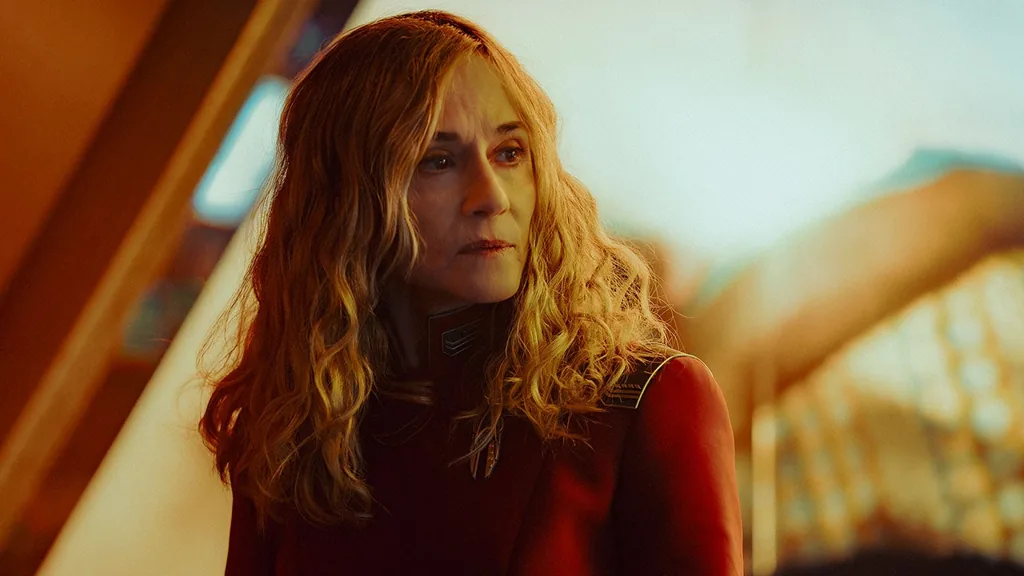
Laura Birn has been quietly delivering one of the best performances in modern sci-fi, and in this finale, she finally gets the spotlight she deserves. When Day presents her with the Brazen Head, she trembles, she weeps, she dares to hope. And then, moments later, she sacrifices herself in one of the most gut-wrenching deaths I’ve seen on TV.
The disintegration beam sequence is harrowing. Demerzel throws herself over the infant Cleon, determined to save at least one life, only to watch that life erased before her eyes. And then she melts. Slowly. Painfully. Staring at Day the entire time. It’s like watching Spock in Wrath of Khan, only crueler — because her sacrifice is meaningless.
What makes Demerzel’s arc so devastating is the futility. She’s a robot bound by programming, a creature capable of love and grief and longing, yet shackled to the will of men who never saw her as more than a tool. Her final act should be heroic, but the universe twists the knife by making it pointless. It’s tragic irony in its purest form.
I found myself flashing back to Asimov’s original conception of robots — logical, bounded by the Three Laws. And here we are, in 2024, watching a robot who embodies the failure of those laws. Demerzel isn’t safe. She isn’t logical. She isn’t bound by benevolence. She’s bound by trauma. And it destroys her.
Day vs. Dusk: Brothers in Ruin
The throne room showdown between Day and Dusk feels like the Dynasty’s last gasp. Two brothers, drenched in blood and grief, grappling not just with each other but with the weight of centuries.
Lee Pace has always played Day with that intoxicating blend of arrogance and vulnerability. Here, he finally cracks. His grief over Demerzel, his rage at Dusk’s betrayal — it all pours out in a flurry of punches. For a moment, it feels like catharsis. Like maybe, just maybe, Day will claw something back from the abyss.
But of course, he doesn’t. Dusk laughs in his face, reminding him that his nanites are intact, that he can’t be killed. And then he shoots his younger brother, sealing the Dynasty’s fate. It’s cruel, but it’s also inevitable. The Dynasty was never going to end with dignity. It was always going to collapse under the weight of its own contradictions.
Watching this, I thought about the fall of Rome, the collapse of the Soviet Union, even the recent political chaos in the U.S. Empires don’t fall neatly. They fall with blood, with betrayal, with men who care more about their own spite than their people. Foundation gets that. And it dramatizes it with a brutality that feels uncomfortably real.
Gaal Dornick vs. The Mule: A Battle of Minds
If the Dynasty’s collapse is the show’s political tragedy, Gaal’s confrontation with the Mule is its mythic showdown.
Lou Llobell has grown so much since Season 1. Watching Gaal step into her power here is immensely satisfying. She faces down the Mule — a psychic tyrant whose power borders on godlike — and refuses to break.
The duel is as much philosophical as it is physical. The Mule tries to overwhelm her with brute psychic force. Gaal responds with psychological insight, dragging him into the core wound he can never heal: the primal insecurity that drove him to conquer. It’s a moment that reminded me of Paul Atreides facing down the Reverend Mother in Dune, or Luke Skywalker refusing to kill his father in Return of the Jedi. It’s not about strength. It’s about understanding the weakness of power itself.
And then comes the twist: Bayta is the Mule.
Reader, I screamed.
It’s one of those reveals that retroactively makes sense of everything, while also hitting like a truck. Bayta, calm, collected, hiding her true power all along — it’s Shakespearean in its betrayal. And it reframes everything we thought we knew about the Mule as a figure of terror.
Earth, At Last
The final reveal — robots on Earth — is pure Asimov fan service, but in the best way. For years, Earth has been the ghost haunting Foundation. The planet abandoned, the origin forgotten, the myth obscured. To end the season with the revelation that Earth still matters, that robots are gathering there, is genius. It connects the show back to the deep roots of Asimov’s universe, while also setting the stage for a robot revolution that could redefine everything.
It’s also thematically perfect. The Dynasty collapses. The Mule rises. The galaxy teeters on the brink. And in the background, the forgotten homeworld waits. Because no matter how far humanity spreads, no matter how much it changes, Earth is always there — the foundation beneath the Foundation.
My Verdict
“The Darkness” is not an easy watch. It’s brutal, messy, and often heartbreaking. But it’s also thrilling, ambitious, and unforgettable. It burns down everything we thought was stable and dares us to imagine what could possibly rise from the ashes.
For me, that’s what great science fiction should do. It should unsettle. It should challenge. It should make you stare into the void and wonder what comes next.
And so, with all my caveats and quibbles, I give Foundation Season 3’s finale: