
TL;DR: Fallout Season 2 Episode 6 is a dense, unsettling, and emotionally rich hour that finally brings the show’s biggest ideas into direct conflict. With standout performances, chilling moral dilemmas, and lore-shifting reveals, The Other Player proves Fallout isn’t just adapting a game world — it’s interrogating it.
Fallout Season 2
I’ve been thinking a lot about how Fallout Season 2 keeps asking the same dangerous question from different angles: is control the same thing as safety, or just fascism with better lighting and a smiling mascot? Episode 6, ominously titled The Other Player, is the hour where that question stops being theoretical and starts bleeding all over the Wasteland. This is the episode where the show finally pulls its narrative threads tight enough that you can hear them creak. Old friends reappear, new monsters step out of the irradiated shadows, and moral compromises stop being subtext and become text, underlined twice and highlighted in radioactive green.
From a pure structural standpoint, this is one of the densest episodes Fallout has delivered so far. It’s juggling corporate flashbacks, body horror survivalism, philosophical hostage-taking, and Vault sitcom absurdity without ever feeling like it’s spinning plates just to show off. Everything feeds into the same central idea: the apocalypse didn’t create monsters. It just gave them permission.
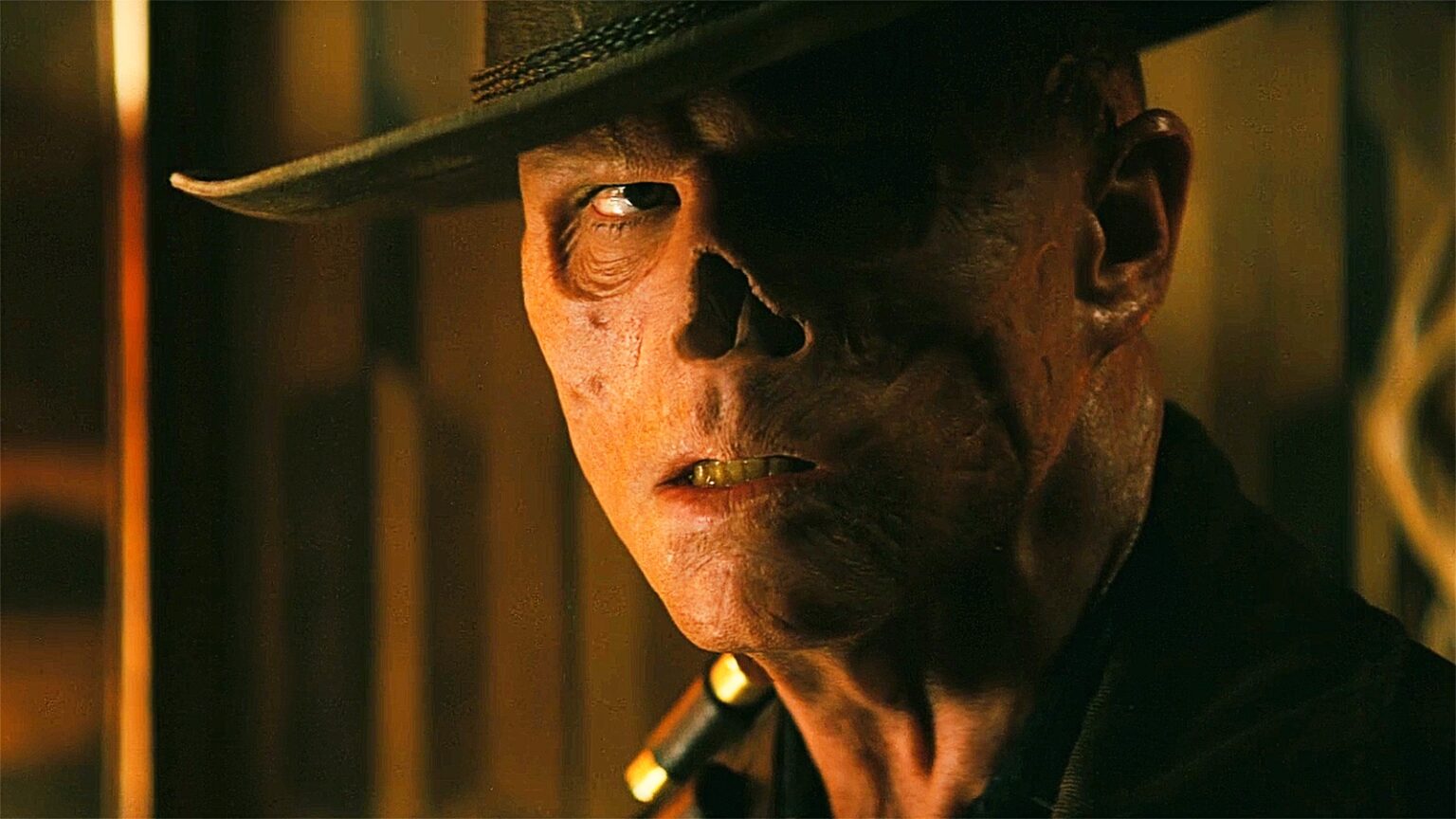
Let’s start with the beating, irradiated heart of the episode: the Ghoul. Walton Goggins continues to give one of the most fascinating performances on television right now, and Episode 6 might be his quietest and most brutal hour yet. We pick up with him literally impaled, rotting, and muttering his own name like a spell he’s afraid will stop working if he doesn’t keep saying it. Cooper Howard. Not the Ghoul. Cooper. A father. A man who once mattered.
There’s a specific kind of horror in watching someone fight not just death, but identity loss. Fallout has always understood that becoming a ghoul isn’t just about radiation; it’s about time, regret, and the slow erosion of who you were. When Cooper whispers about his daughter still being alive, it doesn’t feel like hope. It feels like defiance. The kind that keeps you moving even when your body has no business cooperating.
The introduction of the supermutant, played with gravelly menace by Ron Perlman, is one of those moments where longtime fans of the games probably sat up a little straighter. This isn’t just a cameo or a lore checkbox. This is Fallout saying, very clearly, that the bigger mythology is no longer waiting offscreen. The Enclave, supermutants, ancient grudges — it’s all here now, and it’s personal.
What I love most about this interaction is that it refuses easy alliances. The supermutant offers camaraderie, shared suffering, a common enemy. The Ghoul refuses all of it. Not because it’s a bad deal, but because connection is dangerous. Friends get used against you. Movements get corrupted. Staying alone is the only control he has left. It’s tragic, and it’s very Fallout.
If the Wasteland shows us the physical cost of survival, the Vault-Tec flashbacks show us the moral cost of planning for it. Frances Turner’s Barb continues to be one of the most quietly terrifying characters in the series, not because she enjoys cruelty, but because she’s very good at compartmentalizing it.
The opening sequence of corporate presentations is almost satirical in its calm efficiency. Which Vaults lose water. Which highways get priority. Which customers get comfort as the world ends. It’s apocalypse logistics presented with the same tone as a quarterly earnings call. This is where Fallout’s satire really sinks its teeth in. The end of the world isn’t chaotic here. It’s curated.
Barb’s interactions with Robert House and the Rob-Co technology underline something deeply unsettling: Vault-Tec isn’t reacting to the apocalypse. They’re designing it. The revelation that entire Vault experiments are bargaining chips in corporate power plays reframes everything we’ve seen so far. These aren’t mistakes. They’re features.
The flashbacks between Barb and Cooper are devastating precisely because they’re so human. The argument about whether you’d kill millions to save your child doesn’t feel like melodrama. It feels like the kind of question history keeps answering the same way, over and over again. Barb doesn’t see herself as a villain. She sees herself as a mother making hard choices in a rigged system. Cooper, increasingly, sees her as someone who chose the system over her soul.
And the moment with Siggi Wilzig in the elevator is pure horror without a single jump scare. Being told you’re replaceable, that your family’s safety is conditional, that obedience is the only currency that matters — it’s corporate hell distilled. When Barb later pushes the idea that Vault-Tec should drop the bomb themselves, it’s not ambition. It’s surrender.
Ella Purnell continues to anchor the emotional spine of the show as Lucy, and Episode 6 gives her one of her most complex moral tests yet. Waking up inside a lovingly recreated Vault-Tec simulation of her home is deeply unsettling in a way that sneaks up on you. The Sugar Bombs. The polite smiles. The sense that everything is wrong, but designed to feel right.
Kyle MacLachlan’s Hank is at his most dangerous here because he’s so reasonable. He doesn’t rant. He doesn’t threaten. He explains. He reframes violence as protection, mind control as rehabilitation. The scene with the workers cheerfully describing their former lives as murderers and cannibals before praising their new, docile roles is one of the most chilling sequences Fallout has ever done.
Lucy’s attempt to free them feels like a victory until it very much isn’t. Watching her forced to activate the control devices to stop immediate violence is the moment where her idealism fractures. Hank doesn’t gloat. He just stands there, proven right in the worst possible way. Control works. That’s the problem.
This episode does something incredibly smart by not giving Lucy an easy out. There’s no magical third option where everyone learns a lesson and walks away. She’s confronted with the same dilemma that broke Barb, that defines the Ghoul, that powers Vault-Tec. Do you accept a lesser evil if it prevents a greater one? And who gets to decide?
Meanwhile, back in the Vaults, Fallout reminds us that horror doesn’t always wear power armor. Sometimes it’s bureaucracy. The Inbreeding Support Group subplot is played with dark humor, but it’s also doing important world-building work. Scarcity, favoritism, inherited privilege — it’s all there, wrapped in snack budgets and musical fantasies.
The reveal of Chet’s engagement poster without his knowledge is funny in a bleak, Kafkaesque way, but it also reinforces how little agency people truly have in these controlled environments. Whether it’s Vault 31 or Vault 33, choice is an illusion curated by someone else.
After feeling absent for a few episodes, Maximus and Thaddeus return to remind us that Fallout is still very much about people trying to decide what kind of heroes they want to be. Their debate over selling the cold fusion versus finding a “good person” to give it to feels almost naive compared to the machinations we’ve just witnessed — and that’s intentional.
Maximus remembering Shady Sands as a place of genuinely good people matters. It’s proof that the world Hank dismisses as irredeemable once existed, and could again. The reunion with the Ghoul, facilitated by Dogmeat and that iconic hat, is awkward, unresolved, and full of potential. These are not people who trust easily. Which makes them exactly the kind of uneasy alliance Fallout thrives on.
The Other Player doesn’t just move the plot forward. It reframes the entire board. By the end of the episode, every major character is staring at the same truth from a different angle: the systems that promised safety are the ones that destroyed the world, and escaping them might require becoming something you hate.
As a long-time Fallout fan, this is the episode where I stopped watching week to week and started bracing for impact. The Enclave is looming. Supermutants are active. Vault-Tec’s sins are no longer theoretical. And every character we care about is compromised in some way that feels painfully human.