
TL;DR: Doctor Who Series 15, Episode 6, “The Interstellar Song Contest,” tries to mash Eurovision absurdity with space opera stakes. It mostly succeeds in visual spectacle and flamboyant flair, but collapses under its own tonal whiplash and heavy-handed lore reveals. Still, the Doctor gets his glitter cannon moment, and there are sparks of fun and emotional beats.
Doctor Who season 15
Rhythm and Whiplash: A Pop Song with Too Many Key Changes
Sometimes, an episode of Doctor Who feels like it’s been dared into existence by a group chat at 2 a.m. That’s very much the vibe with “The Interstellar Song Contest.” Imagine if Russell T Davies woke up from a fever dream shouting, “EUROVISION IN SPACE!” and then handed that idea to Juno Dawson with a sticky note that said “Also, Die Hard??”
You can practically see the seams as the script tries to hold itself together under the weight of glitter, horns, genocidal aliens, and a surprise cameo from a character who hasn’t shown up in canon since 1983. It’s not so much that this episode is bad. It’s more that it feels like three very different episodes trying to stage dive off the same platform—and the crowd’s not sure who to catch first.
We open on the Harmony Arena, hosting the 803rd Interstellar Song Contest. Rylan, perfectly preserved in cryo-sleep and now defrosted for his annual hosting gig, sets the tone immediately: high camp, pop glitter, and Eurovision satire turned up to eleven. There’s joy in that, truly. Doctor Who has always thrived when it stops apologizing for being weird and goes full throttle into its own lunacy.
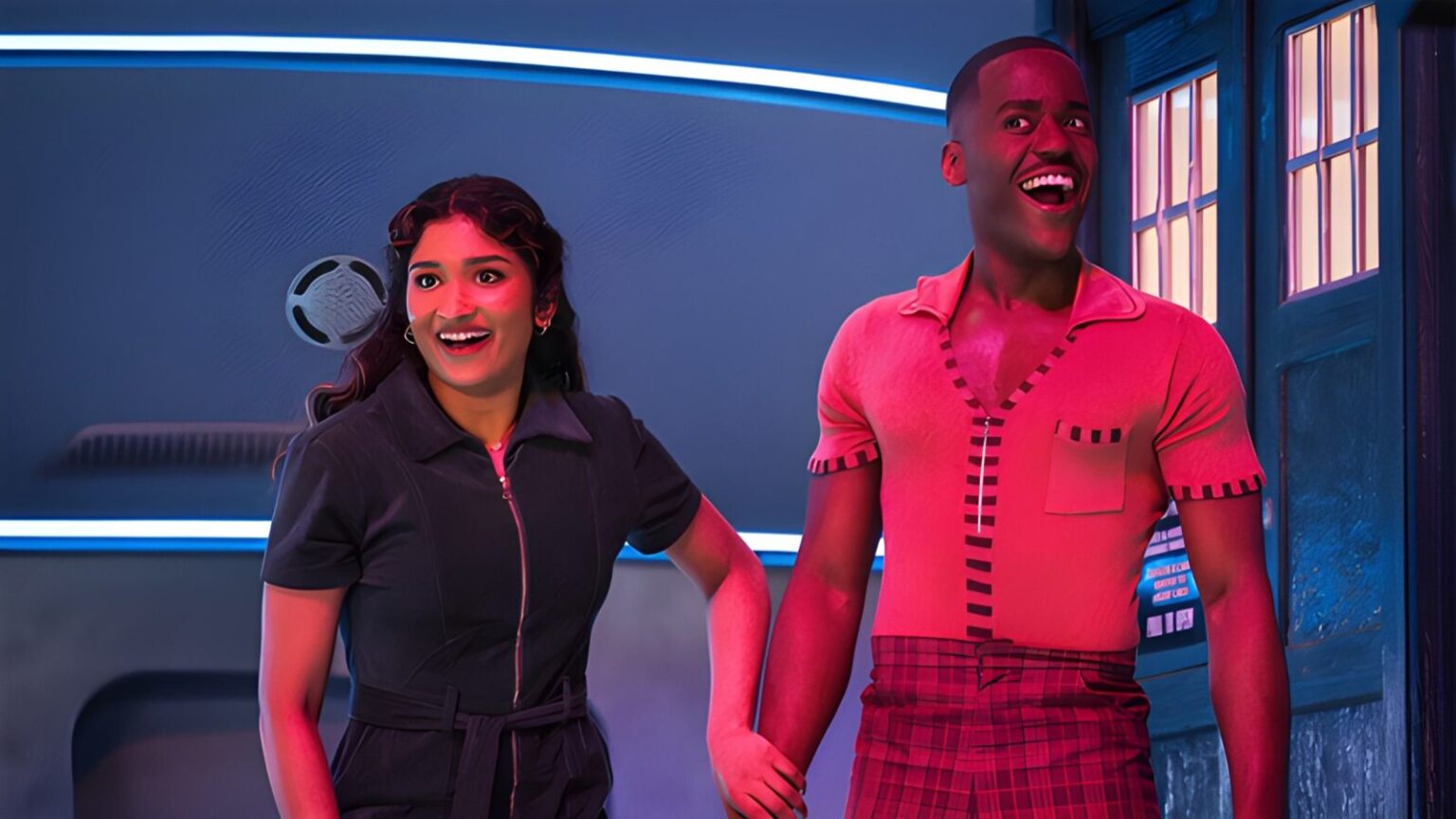
Ncuti Gatwa’s Doctor is luminous in these opening scenes. He’s a chaos god in tartan, gleeful and giddy, bouncing off Belinda (Varada Sethu), who is still criminally underused. Their shared enthusiasm for the song contest feels like a real bonding moment, and it’s sweet to see the Doctor being a fanboy instead of a godlike exposition engine.
But the party can’t last. It never does.
Space Politics and Trauma Triggers: The Mood Swing of It All
Just when the glitter settles, horned aliens crash the party and hijack the space station. Enter the Hellions, a race with a tragic backstory that’s far more interesting than the screen time they’re given. Kid, played by Freddie Fox, is our villain, and unfortunately, he’s more Hot Topic than high threat. He’s got cheekbones and eyeliner, but he doesn’t feel dangerous—just bratty.
This is where the episode veers hard into its Die Hard DNA. There are hostages. A slow-boiling space crisis. The Doctor flying through zero gravity via a confetti cannon (okay, that part rules). But instead of suspense building, we get emotional short-circuiting. Suddenly, the Doctor is seeing visions of his long-lost granddaughter Susan Foreman, played again by Carol Anne Ford. For longtime fans, this is seismic. For newcomers, it’s like a ghost wandered in from a completely different show.
The problem isn’t that Susan appears. The problem is why here? Why now? There’s no narrative scaffolding for this vision. It lands like an anvil in an otherwise zany romp, dragging the emotional tone into a different hemisphere without warning. It’s not intrigue—it’s whiplash.
And then there’s the rage.
The Doctor has raged before. We’ve seen Tennant go cold-eyed and cruel, Eccleston seethe with trauma, Capaldi burn with ancient fury. But here, Gatwa’s Doctor snaps into a torture-happy, contempt-dripping executioner mode so fast it feels like we missed a few pages of the script. He doesn’t believe Belinda is dead. He knows the people can still be saved. So what triggers this sudden moral detour into vengeance?
Apparently it’s the genocide of Gallifrey, dredged up again for the thousandth time. And yes, trauma triggers are real. But this felt less like emotional depth and more like a plot contrivance. Worse still, the line about “ice in my heart” makes it sound like the Doctor’s mad about being frozen in space for thirty seconds, which is unintentionally hilarious.
Meanwhile, Back at the Pop Contest…
All of this is intercut with musical performances that range from passably catchy to bafflingly Earth-sounding for an interstellar broadcast. The songs aren’t bad, but they aren’t alien enough. Eurovision already exists; this needed to be weirder.
Cora’s final ballad is beautiful, though. It carries real emotional heft, and it’s easy to see why the Doctor and others are moved by it. But again, the tonal dissonance is jarring. We just watched people float frozen in space like silent fireworks, and now we’re cheering a resistance ballad? Pick a lane, show.
The supporting characters—especially Gary and Mike, the adorable technicians with a thing for each other—are a delight. There’s a groundedness to their reactions that makes the absurdity work. Their crushes on the Doctor are charming, and their competence under pressure is refreshing. I’d watch a spin-off.
Belinda, however, still feels like a sidekick-in-waiting. She’s smart, capable, and played with real warmth by Sethu, but the show keeps sidelining her emotionally. Three episodes in a row now, and we’re still not sure what makes her tick.
The Curtain Call: Setting the Stage for the Finale
The episode ends with the Cloister Bell tolling, the TARDIS bathed in red, and the doors blown inward by some unseen force. It’s pure Doctor Who portent, and it works. Whatever’s coming next—”Wish World” and the two-part finale—it’s going to be big. Maybe even worthy of the emotional noise this episode tried to sneak in.
The Interstellar Song Contest is not a disaster. It’s just a hot mess—ambitious, glitter-covered, emotionally incoherent, and occasionally brilliant. It’s an episode that shoots for the moon and lands in the audience pit. But hey, it puts on a hell of a show.
Verdict:
A wildly entertaining but thematically confused hour of television. Come for the Eurovision-in-space lunacy, stay for the emotional whiplash and flying Doctor. Just don’t ask too many questions about the granddaughter thing—yet.