
TL;DR: Bugonia has all the right ingredients — Emma Stone, Yorgos Lanthimos, a wild premise — but somehow ends up less than the sum of its parts. Gorgeous, eerie, and impeccably acted, sure, but also frustratingly inert. Think Poor Things without the heart or The Favourite without the fun.
Bugonia
You can tell a lot about a filmmaker from the worlds they build. Kubrick had his sterile nightmares. Lynch had his twisted Americana. And Yorgos Lanthimos? The man builds cinematic terrariums where the weirdest possible bugs of human behavior are trapped under glass, squirming for our delight. It’s a beautiful, grotesque thing to watch. But Bugonia, the latest entry in his ongoing collaboration with Emma Stone, feels like the first time that glass cracked — and instead of fascination, all that leaks out is frustration.
Yes, it’s another black comedy dripping with Lanthimos’ signature absurdity, all skewed power dynamics and grotesque humor. But for a film that literally centers on bees, Bugonia is strangely devoid of buzz.
Let’s get this out of the way: Emma Stone and Yorgos Lanthimos are now a cinematic organism. They’ve evolved together, from The Favourite’s lascivious court games to Poor Things’ Frankenstein feminism. Each time, they’ve delivered something bold, deranged, and oddly heartfelt — films that make you laugh, wince, and Google “is Yorgos Lanthimos okay?” halfway through.
Bugonia should’ve been the next great mutation in that creative DNA. Instead, it’s like the genetic experiment went slightly wrong. Not catastrophically — just enough that you stare at it, intrigued but uneasy, wondering, “Was this supposed to move like that?”
Bugonia is a remake of Save the Green Planet!, the 2003 South Korean cult classic that mashed up sci-fi, torture horror, and manic social satire like a cinematic Molotov cocktail. That movie was weird in the way Oldboy is weird — bold, manic, unapologetically tragic.
Here, screenwriter Will Tracy (The Menu, The Regime) reworks it for a post-Reddit, post-conspiracy, post-Manosphere America. Jesse Plemons plays Teddy, a deranged beekeeper and self-proclaimed eco-warrior who believes the world is being invaded by aliens. His target? Michelle Fuller (Emma Stone), a pharma CEO who, in Teddy’s feverish imagination, is one of the extraterrestrial overlords enslaving humanity.
If that sounds like American Psycho meets Ancient Aliens, you’re halfway there.
Plemons — who might be Hollywood’s most quietly dangerous actor — plays Teddy like Travis Bickle went off his meds and took up apiculture. His home is a decaying hive of conspiracy charts and flickering CRTs. His worldview is a buzzing chaos of online paranoia, toxic masculinity, and mommy issues that could fill several seasons of prestige television.
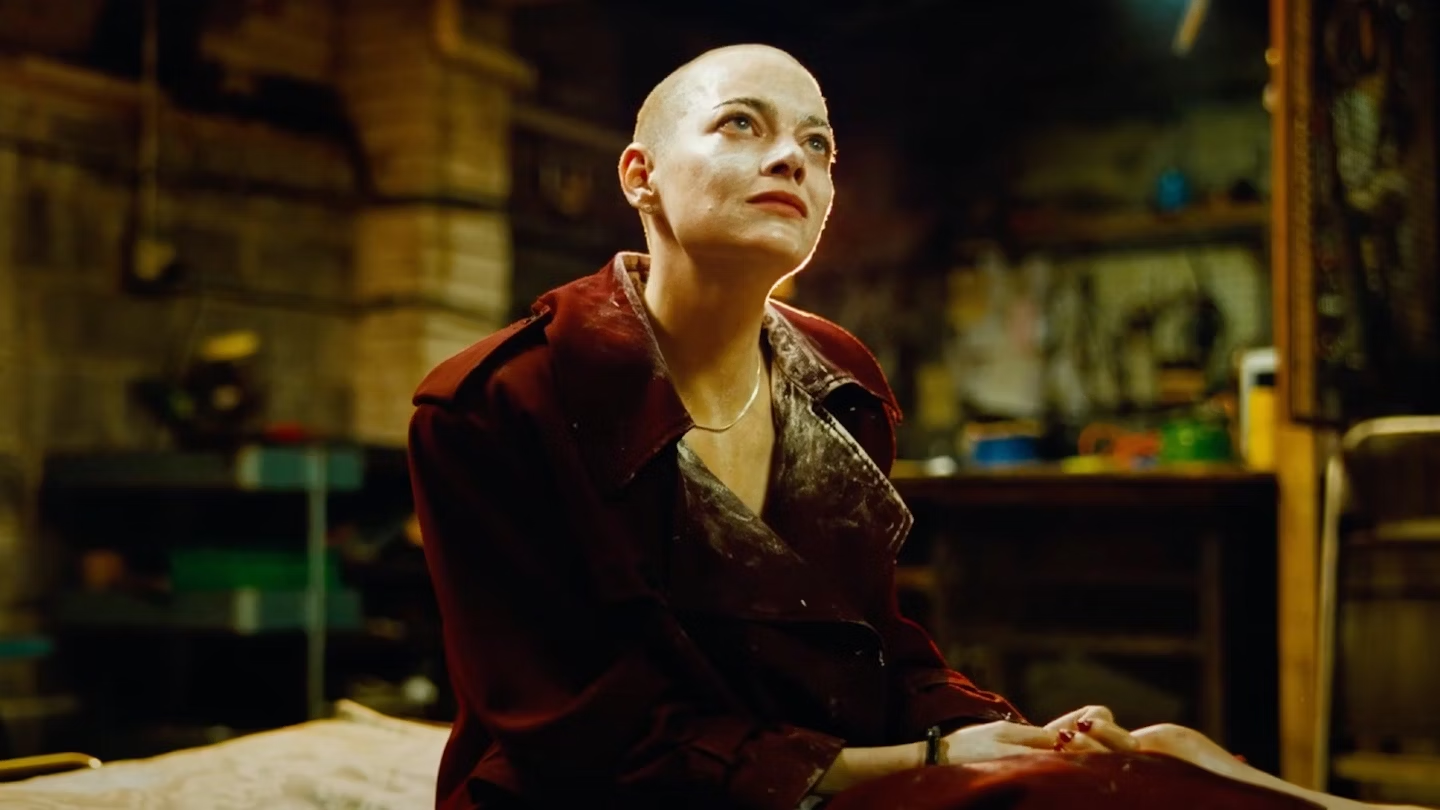
His mother (a delightfully eerie Alicia Silverstone) lies comatose upstairs, literally hovering between life and death — the perfect metaphor for Teddy’s own half-dead empathy. When he kidnaps Michelle, shaves her head “so she can’t communicate with the mothership,” and dresses her in his mother’s clothes, the horror is both comic and tragic. It’s what Lanthimos does best: grotesque intimacy that makes you recoil even as you laugh.
But here, that tension never quite pays off. Teddy’s madness is too predictable, his spiral too familiar. We’ve seen this guy before — in every think-piece about “men driven mad by the algorithm.” Plemons plays him perfectly, but the movie gives him nowhere to go.
You can’t out-weird Emma Stone anymore. The woman literally won an Oscar for playing a resurrected Victorian corpse (Poor Things), and still managed to make it feel human. Here, she plays Michelle with unnerving poise — a corporate queen who faces abduction with the kind of icy composure that suggests she’s survived way worse meetings at Davos.
When Teddy rants about “alien elites,” she listens like she’s on a bad investor call. Her calmness is armor, her manipulation weaponized empathy. It’s a fantastic performance — layered, ironic, and precise — but Lanthimos doesn’t give it enough oxygen. Michelle feels like a concept more than a person, and the movie’s refusal to dig deeper into her psyche makes her less a character than a symbol of power to be tortured or pitied.
Visually, Bugonia is unmistakably Lanthimos. The production design is grotesquely gorgeous — a rot-and-gold palette that makes every scene feel like it’s fermenting. The sickly yellows and browns of Teddy’s world bleed into Michelle’s once-pristine aura until both characters are swallowed by the same diseased glow. It’s like The Favourite’s powdered wigs collided with Se7en’s color grading.
Even the camera feels trapped — long takes that linger too long, wide shots that make human suffering feel like an anthropological exhibit. There’s no comfort, no catharsis, just slow-motion decay.
And that’s the thing: Lanthimos used to make discomfort exhilarating. Here, it’s just… tiring.
Thematically, Bugonia wants to bite off everything: climate collapse, capitalism, incel culture, medical greed, alienation (literal and metaphorical). But instead of a sharp, cohesive sting, it ends up buzzing in circles. The film flirts with big ideas — how conspiracy theories become religion, how the powerful weaponize empathy, how rage curdles into self-destruction — but it never lands a blow.
By the time the third act collapses into a chaotic cocktail of blood, bees, and half-baked revelations, the movie’s message feels less profound than perfunctory. Lanthimos, once the master of macabre subversion, seems oddly content to color within the lines of arthouse bleakness.
Even the humor — usually his secret weapon — fizzles. There are moments of deadpan absurdity (a bee funeral! a motivational kidnapping monologue!) that hint at the Lanthimos of old, but they’re scattered like pollen in a windstorm.
Maybe that’s the real tragedy of Bugonia. It’s not bad — not even close. It’s just fine. And for a director who made Dogtooth and Poor Things, “fine” feels like failure.
If you’ve followed Lanthimos from his early Greek Weird Wave days, you know his greatest strength has always been daring you to hate his movies. But here, he’s daring us to feel something, and I’m not sure he succeeds. The film ends not with shock or awe, but with the dull ache of indifference. It’s like watching a magician perform the same trick again — technically perfect, emotionally inert.
Verdict
Bugonia is a beautifully shot, impeccably acted, thematically ambitious… slog. Emma Stone and Jesse Plemons are electric, but their energy never ignites into fire. The satire flutters without landing, and Lanthimos’ sting — that wicked, painful, exhilarating bite — has dulled.
It’s a film about madness that never goes mad enough, a film about delusion that feels oddly calculated. For a director known for chaos, Bugonia feels too controlled — like a bee pinned to a board, perfect in form, dead in spirit.