
I went into Amadeus expecting a respectable prestige drama about powdered wigs, courtly politeness, and Very Serious Men composing Very Serious Music. What I did not expect was to be body-slammed by a five-episode operatic fever dream that feels less like a history lesson and more like a psychological boxing match scored by the angriest geniuses of the 18th century. This thing doesn’t tiptoe around classical music. It grabs it by the collar, shakes it violently, and screams, “This mattered. This still matters.”
Amadeus
Now streaming on OSN+, Amadeus is the rare kind of historical drama that feels allergic to reverence. It’s loud, chaotic, horny, petty, and painfully human. If you’ve ever thought classical music was dry, elitist, or best left to background playlists labeled “Focus,” this series exists to personally prove you wrong.
I’ll say it upfront: this is not a cozy watch. It’s not elegant comfort viewing. It’s messy in the way obsession is messy. And that’s precisely why it works.
At the heart of Amadeus is the rivalry between Wolfgang Amadeus Mozart and Antonio Salieri, a relationship so warped by envy, admiration, and self-hatred that it feels less like professional competition and more like a slow-motion car crash neither man can look away from.
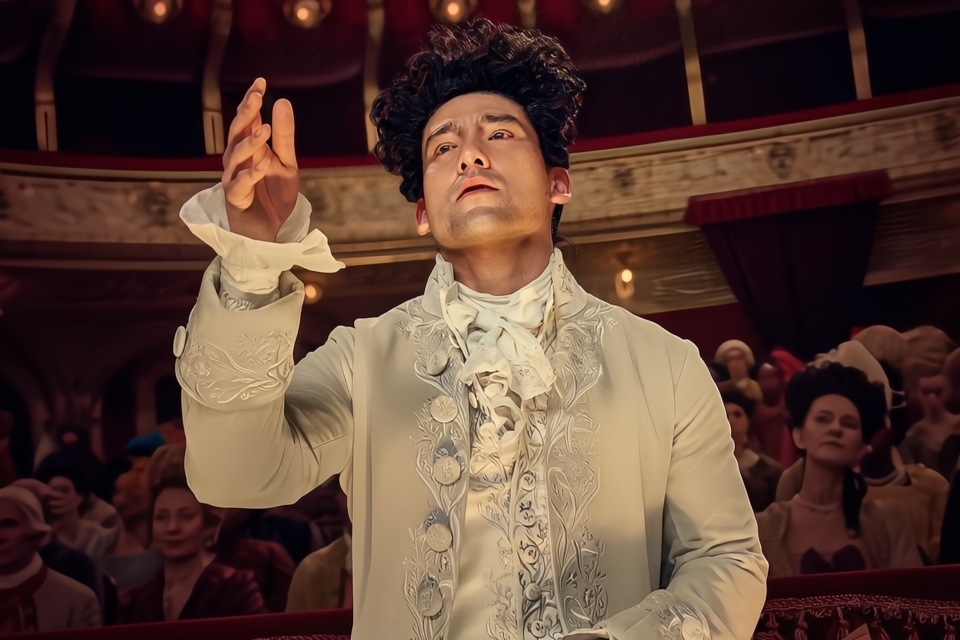
Will Sharpe’s Mozart is not the polite prodigy we’re used to seeing framed in gold leaf. This Mozart is feral. He’s obscene. He’s emotionally volatile and intellectually untouchable. Sharpe plays him like a man possessed by sound itself, someone who hears entire universes in his head and is furious the rest of the world can’t keep up. Every laugh is too loud. Every triumph feels like an insult to everyone else in the room. It’s exhilarating and exhausting in equal measure.
Then there’s Paul Bettany as Salieri, delivering one of those performances that quietly crawls under your skin and refuses to leave. His Salieri isn’t a moustache-twirling villain. He’s a deeply religious man who believes he’s earned greatness through discipline, humility, and devotion, only to watch it handed effortlessly to someone who doesn’t even seem grateful. Bettany understands that envy isn’t loud. It’s corrosive. It’s the slow realization that no matter how hard you work, someone else was simply born closer to God.
Watching these two circle each other is hypnotic. Their scenes together crackle with tension even when nothing “big” is happening. Compliments feel weaponized. Kindness feels transactional. You’re constantly waiting for the moment when admiration turns into violence, emotional or otherwise. And when it does, it’s never as clean as you want it to be.
This isn’t a story about good versus evil. It’s about genius as an unfair lottery, and the devastation that knowledge leaves behind.
What immediately sets Amadeus apart is its refusal to behave like a traditional period drama. This isn’t about immaculate manners or stately pacing. The show moves with a frantic, almost reckless energy. Scenes bleed into one another. Emotions spike without warning. Characters implode, recover, and implode again before you’ve had time to breathe.
There’s an intentional tonal whiplash here. One moment you’re watching bawdy comedy, the next you’re plunged into existential despair. On paper, that kind of tonal collision should be a disaster. In practice, it feels honest. Creative lives are rarely neat. Genius doesn’t unfold politely. It arrives screaming, takes what it wants, and leaves wreckage behind.
The series even dares to get meta with its storytelling, folding the act of creation itself into the narrative. Without spoiling specifics, the show acknowledges the myth-making process behind Amadeus as a story. It asks who gets to shape history, who gets remembered, and how much truth survives the retelling. There’s a fourth-wall-breaking finale that shouldn’t work, but somehow lands as both theatrical and unsettling. It feels like the show staring directly at the audience and asking whether we’re complicit in the legends we consume.
It’s bold. It’s risky. And it’s exactly the kind of swing more prestige TV should be taking.
I won’t pretend the series is perfectly paced. Episodes three and four lose some momentum, falling into that familiar prestige-TV valley where the narrative briefly forgets how sharp it’s been. Subplots linger too long. The intensity dips. You can feel the story treading water before its final crescendo.
But here’s the thing: when a show is this energetic everywhere else, the slowdown feels more like a breather than a failure. And when the final episode hits, it reminds you exactly why you stuck with it. The payoff is emotional, theatrical, and deeply in tune with the show’s larger ideas about art, legacy, and obsession.
If Amadeus succeeds at anything above all else, it’s in how it treats music. This is not wallpaper. This is not polite accompaniment. The music is the narrative engine. It’s the thing everyone wants, fears, worships, and resents.
Sharpe actually learned to play for the role, and the authenticity matters. You can feel the difference between a performance staged for the camera and one lived in the body. The act of composing is portrayed as both ecstatic and torturous, a compulsion that demands sacrifice. These men don’t write music because they want to. They write because not doing so would destroy them.
The series does a phenomenal job of reminding us that classical music was once radical. It wasn’t safe. It wasn’t sanitized. It was emotional violence committed with intent. By the time the credits rolled, I found myself genuinely rethinking how I listen to these compositions, hearing not just beauty but desperation baked into every note.
There is one distraction I couldn’t entirely ignore: some of the younger cast suffer from what I can only describe as “iPhone face.” Despite the gorgeous costumes and makeup, there are moments where certain actors feel unmistakably modern, like they’ve absolutely seen a group chat in their lifetime.
It’s not fatal, but it does occasionally break immersion. Thankfully, the central performances are so commanding that I stopped caring faster than I expected. When Sharpe and Bettany are on screen, the show’s emotional gravity pulls everything back into orbit.
Verdict
Amadeus is not a polite retelling of a famous rivalry. It’s a raw, chaotic, deeply modern exploration of genius, envy, and the unbearable weight of talent. It’s funny, cruel, theatrical, and emotionally exhausting in the best possible way. The series stumbles briefly in the middle and occasionally shows its modern seams, but its ambition and performances more than make up for it.
Streaming now on OSN+, Amadeus is proof that classical music doesn’t need to be “updated” to feel relevant. It just needs to be remembered for what it always was: dangerous, emotional, and capable of ruining lives.