
Following my recent deep-dive review of 1Password’s new phishing protection, I sent a set of focused questions to the team to better understand the decisions behind the feature—why it intervenes where it does, how it balances security with usability, and what problems it is intentionally not trying to solve. The responses below come from Dave Lewis, Global Advisory CISO at 1Password, and expand on the thinking, research, and real-world constraints that shaped the final design.
1Password’s built-in Phishing Protection Review
Q&A
Q: 1Password chose to intervene at the moment credentials are pasted, rather than earlier in the phishing journey. Why was that specific moment identified as the most critical point for user intervention?
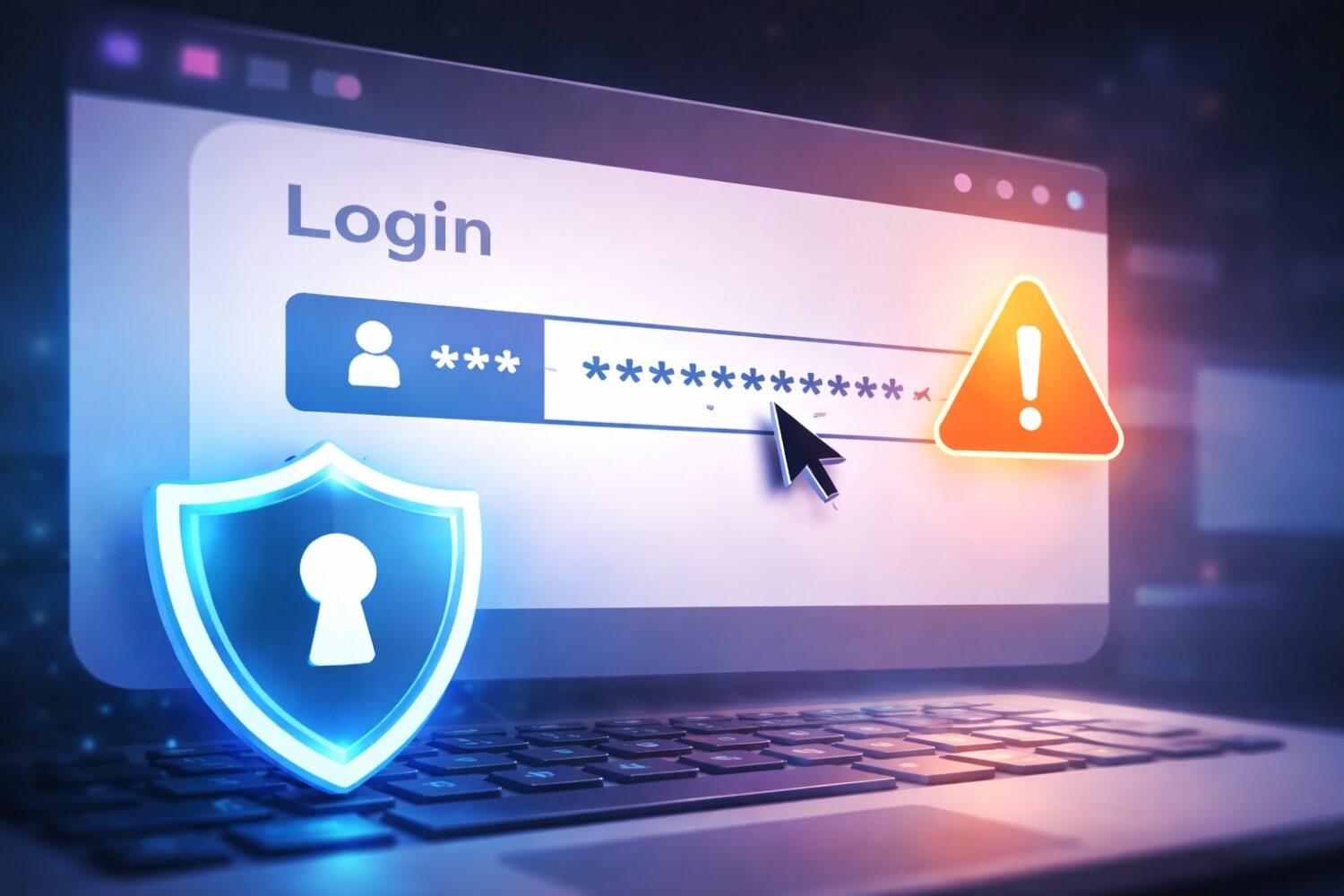
A: Because paste is the first moment with both high intent and high signal. Before that, a phishing page can look identical to a real one, and “something feels off” is too noisy to act on. The paste event is different. It is an explicit user action that usually happens when autofill does not, and it occurs right before a secret leaves your control.
We also treat user-driven actions as the security boundary. Autofill already relies on explicit user input and domain matching to reduce phishing risk, and paste is the common workaround that bypasses those protections. Catching the workaround at the moment it happens gives us a clean, defensible intervention point without monitoring everything you browse.
Q: Autofill refusal has long been a core safety feature in password managers, yet users often work around it under pressure. What did your research reveal about user behavior at that point, and how did it shape the final design?
A: When autofill does not appear, most people do not interpret that as a security signal. They read it as “the login form is broken” or “the extension is acting up.” Under time pressure, they switch to copy and paste because it is the fastest way to finish the task. Disabling autofill tends to push people toward copy and paste, which increases the risk on malicious sites.
That behavior shaped two decisions. First, we intervene at paste, not after the login fails or after an account is compromised. Second, the warning is tied to a concrete condition: pasting into a password field on a site that is not saved in 1Password. That keeps the signal strong and avoids training people to ignore constant alerts.
Q: The phishing warning is intentionally non-blocking and avoids alarmist language. What role did user trust and long-term behavior change play in deciding against hard prevention?
A: Hard blocks feel satisfying until the first false positive, then trust collapses. In real workplaces there are legitimate edge cases—new vendor domains, staging environments, unusual SSO redirects, emergency access paths. If the product “cries wolf” and prevents someone from doing their job even once, the next step is predictable: they bypass it, disable it, or start pasting somewhere else.
A calm, non-blocking warning keeps the relationship intact. It nudges the right habit—pause, check the domain, choose a safer path—without turning the password manager into a gatekeeper that people resent. Long-term behavior change comes from repeated, credible feedback at the exact moment of risk, not from a single dramatic stop sign.
An actionable next step teams can standardize internally is simple: when the warning appears, close the tab, navigate to the service from your company portal or a known bookmark, then report the original message using your organization’s phishing-report process.
Q: In workplace environments, phishing often targets internal tools, SSO flows, or identity providers rather than consumer services. How does the feature handle complex authentication chains without adding friction?
A: It triggers only at the point where a user pastes into a password field, and only when the current website is not one they have saved in 1Password. That means normal SSO chains do not get extra prompts unless the user is about to take the risky workaround on an unexpected domain.
For complex environments, domain hygiene matters. 1Password already supports controlling where a login is suggested and filled, including tightening it to an exact host when needed. That helps teams model real SSO and internal-host patterns without pushing people into copy and paste.
If you are rolling this out in an organization with multiple identity provider domains and internal hosts, the practical move is to audit shared login items and ensure the correct hosts are represented, especially for IdPs and internal admin consoles.
Q: Your research shows that employees who view phishing as “IT’s responsibility” are more likely to fall victim. How do you expect this feature to influence security culture and personal accountability over time?
A: It makes the consequence personal in a useful way. The warning appears when someone is about to hand over credentials. It is hard to outsource that moment to “IT will catch it.” Over time, repeated exposure to a consistent message—“this site is not one you have saved”—builds a reflex to verify where you are before entering secrets.
It also gives security teams a concrete behavior to coach. Instead of abstract training about “being careful,” teams can teach a simple playbook: if you see the warning, stop, verify the domain, then reopen the service from a trusted route. That shifts culture from compliance theater to real decisions made at the keyboard.
Q: Are there deliberate cases where the phishing protection does not trigger, even when credentials are being entered, in order to preserve usability or avoid false confidence?
A: Yes. The scope is intentional.
It is designed around pasting into password fields because that is a reliable, high-risk signal that can be observed without monitoring everything a user types. It does not attempt to classify every page as safe or unsafe, which would create noise and false confidence. It also does not trigger simply because credentials are being entered on a site that is already saved, because that is the path where domain matching and user-driven filling are meant to provide protection.
The expectation to set is that this is a targeted safeguard for a common bypass pattern, not a guarantee that every phishing attempt will be caught.
Q: Should users think of this feature as a single, focused safeguard, or as part of a broader shift in how 1Password approaches behavioral security inside the password manager?
A: It should be treated as a focused safeguard that reflects a broader direction. We are pushing protection closer to real user actions—like filling and pasting—where intent is clear and intervention can be precise.
That direction matters because most credential loss does not happen because someone forgot what phishing is. It happens when a workflow breaks, pressure rises, and people take the shortest path. Designing for those moments is behavioral security applied inside the product, not outsourced to a quarterly training deck.
Q: From your perspective, what does success look like for this feature a year from now—fewer incidents, changed user habits, or something more subtle?
A: Success is a measurable reduction in credential loss from copy-and-paste events on unrecognized domains. If fewer people paste passwords into sites that are not saved, fewer accounts are handed to attackers.