
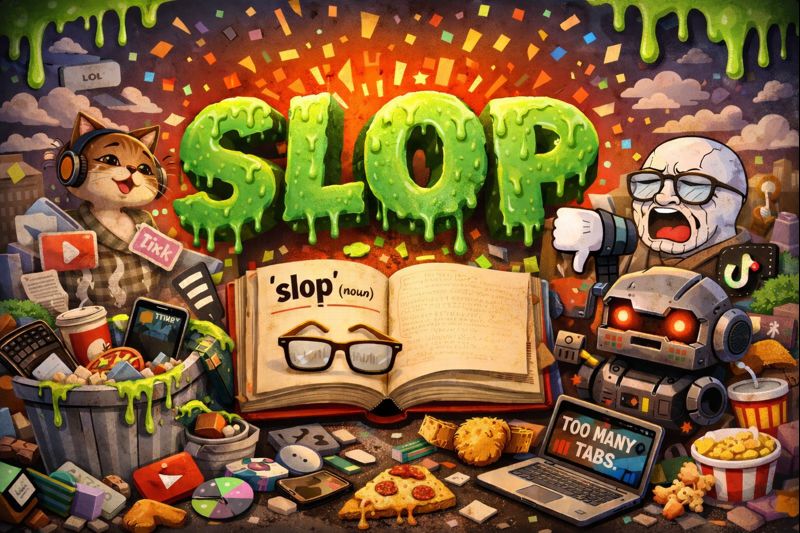
Merriam-Webster has crowned “slop” as its 2025 Word of the Year, officially giving linguistic validation to the collective eye-roll of the internet. According to the dictionary, “slop” means “digital content of low quality that is produced usually in quantity by means of artificial intelligence,” which is a very polite way of saying “why does my feed look like this.” Four letters, infinite regret.
The choice feels less like an announcement and more like a wellness check. Somewhere between autogenerated listicles, cursed AI images with too many fingers, and videos that feel like they were assembled by a toaster with Wi-Fi, the public reached a breaking point. Merriam-Webster essentially looked at the modern internet, sighed deeply, and said, yes, we have a word for that now.
Like most truly powerful internet terms, “slop” didn’t come from a boardroom. It bubbled up from online communities around 2023 and hit critical mass in 2024, according to meme trackers and search data. By 2025, it was everywhere. You could call AI art slop, content farms slop, or that one YouTube channel that uploads six videos a day with the same thumbnail slop. You could also, for reasons known only to the internet, call certain fast-casual food bowls slop. Language is beautiful.
While “slop” was the headliner, Merriam-Webster’s 2025 word list also included “touch grass,” a phrase that has been hurled across multiplayer lobbies since at least the pandemic era. The dictionary traced a recent spike to a political speech, but anyone who has ever stayed up arguing about patch notes knows this insult is ancient by internet standards. It remains undefeated as the fastest way to end an online argument.
Then there’s the absolute chaos pick: Lake Chargoggagoggmanchauggagoggchaubunagungamaugg. Yes, it’s real. Yes, it’s in Massachusetts. Yes, it can apparently show up in word games like Spelling Bee, which feels less like education and more like an ambush. Locals sensibly call it Webster Lake, proving that sometimes the bravest thing you can do is choose convenience.
Taken together, Merriam-Webster’s 2025 words paint a picture of an internet that is tired, self-aware, and deeply online anyway. We know the content is slop. We keep scrolling. We tell each other to touch grass. And occasionally, we play a weird little game with friends and remember why we logged on in the first place.