
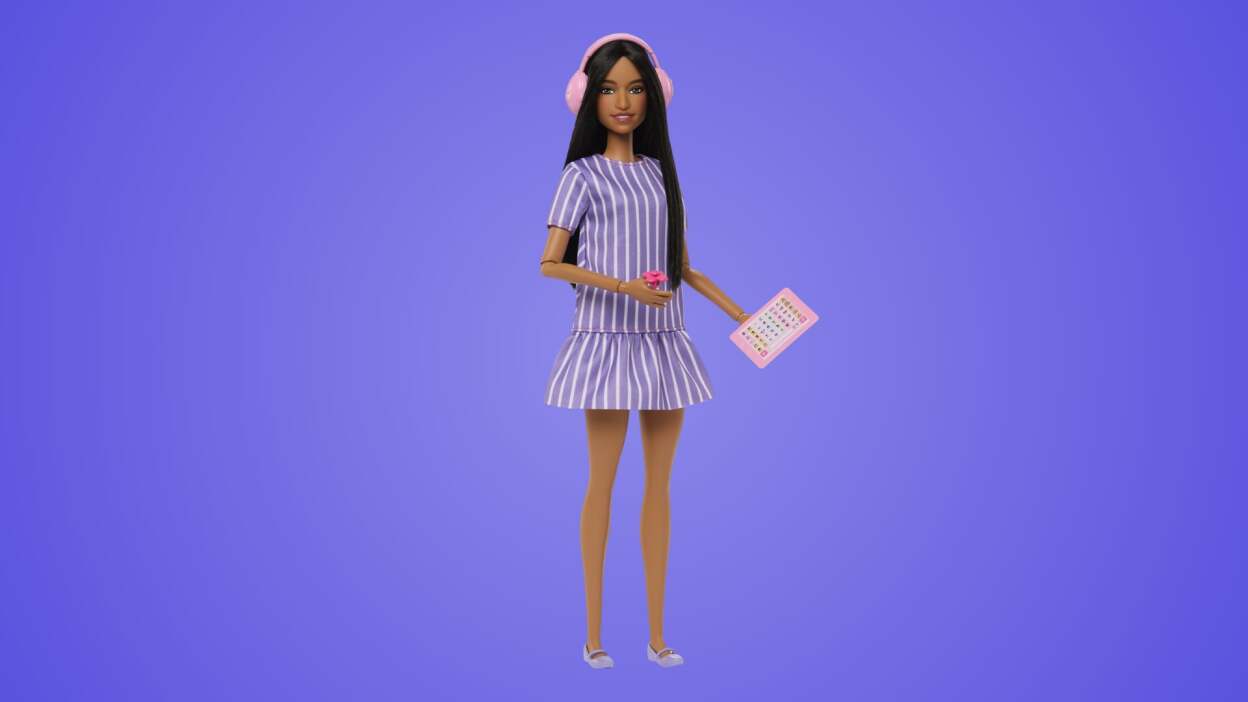
Mattel has introduced its first Barbie explicitly designed to represent an autistic person, adding a new figure to its long-running Barbie Fashionistas line. The release reflects a broader industry effort to depict a wider range of lived experiences in children’s toys, while also raising questions about how complex identities are translated into mass-market products.
The autistic Barbie was developed in consultation with the Autistic Self Advocacy Network, an organization led by autistic people that focuses on disability rights and representation. According to Mattel, the goal was to incorporate details that align with real autistic experiences rather than relying on abstract symbolism. The company says the doll is meant to give more children the opportunity to see aspects of themselves reflected in everyday play.
Visually, the doll departs in subtle but deliberate ways from earlier Barbie designs. She wears a loose-fitting lavender and white striped dress paired with flat shoes, choices informed by comfort and sensory considerations. The accessories include pink noise-cancelling headphones, a tablet displaying symbol-based communication apps, and a small fidget spinner that actually spins. These elements reference tools commonly used by some autistic people to manage sensory input or communicate without speech, though Mattel has been careful to frame them as optional supports rather than defining traits.

The doll’s physical design also includes articulated elbows and wrists, allowing for repetitive movements often described as stimming. Her gaze is set slightly off-center, a design choice the company says reflects the fact that some autistic people avoid direct eye contact. Her hair is worn loose, which Mattel links to the fine motor challenges that can accompany autism for some individuals. Taken together, these choices aim to suggest autism without reducing it to a single visual marker.
ASAN executive director Colin Killick described the doll as a positive step toward visibility, emphasizing the importance of autistic children seeing themselves represented in ways that are ordinary rather than exceptionalized. At the same time, advocates have long noted that no single product can capture the diversity of the autism spectrum, and that representation in toys is only one small part of broader inclusion.
Mattel also announced plans to donate more than 1,000 of the dolls to children’s hospitals in the United States that provide services for autistic children. While charitable gestures like this are common in major product launches, they also highlight the ongoing gap between symbolic representation and systemic support for disabled communities.
The autistic Barbie arrives at a moment when parents, educators, and manufacturers are increasingly attentive to how toys shape early understandings of difference. Whether this doll becomes a meaningful tool for some families or simply another collectible will likely depend less on the accessories she comes with and more on how conversations around autism continue beyond the toy aisle.