
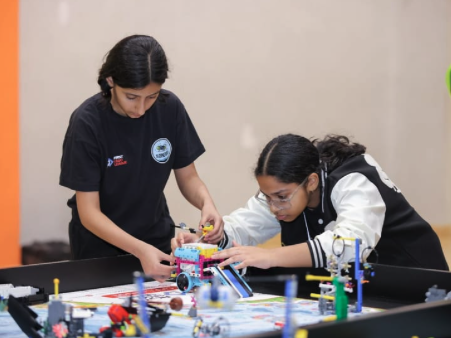
The FIRST LEGO League returns to the UAE this January, bringing with it a familiar mix of LEGO bricks, coding logic, and competitive pressure. Starting January 10, 2026, the programme will involve more than 3,000 school students across Dubai, Abu Dhabi, and Sharjah, all working toward a single objective: designing and programming autonomous robots capable of completing predefined tasks.
The UAE edition of the competition is organised by ATLAB, in collaboration with LEGO Education and FIRST. While the event aligns closely with broader national priorities around STEM education, artificial intelligence, and robotics, its practical impact is felt most directly at the classroom level. For many students, this is where abstract lessons on sensors, motors, and algorithms are tested under real constraints.
The competition runs for nearly a month, giving teams time to design, build, test, and refine their robots before the final judging sessions in early February. According to organisers, 3,134 students forming 395 teams are expected to take part this year, making it one of the larger school-based robotics programmes currently operating in the country.
FIRST LEGO League UAE is divided into two main categories. The Explore division is aimed at younger students aged six to ten. Using the LEGO Education SPIKE Essential set, participants focus on foundational STEM concepts. Rather than competing head-to-head, teams build models, experiment with simple coding, and present ideas that address real-world problems. The emphasis here is on understanding processes rather than technical precision.
The Challenge category, open to students aged nine to sixteen, is more demanding. Teams are required to build autonomous robots that complete a series of tasks within strict time limits. Success depends not only on mechanical design and coding accuracy, but also on planning, teamwork, and the ability to troubleshoot under pressure. This category reflects a more realistic introduction to engineering problem-solving, where trade-offs and iteration are unavoidable.
The competition begins on Saturday, January 10, 2026. The Challenge finale is scheduled for Saturday, February 7, followed by the Explore finale on Sunday, February 8. Final timings have not yet been released, but past editions suggest full-day judging and demonstrations.
Participation is largely managed through schools, with no individual registration currently available. Parents interested in involvement will need to confirm whether their child’s school is registered. Venues for the finales have yet to be announced, though large-scale locations are expected given the number of participants.