


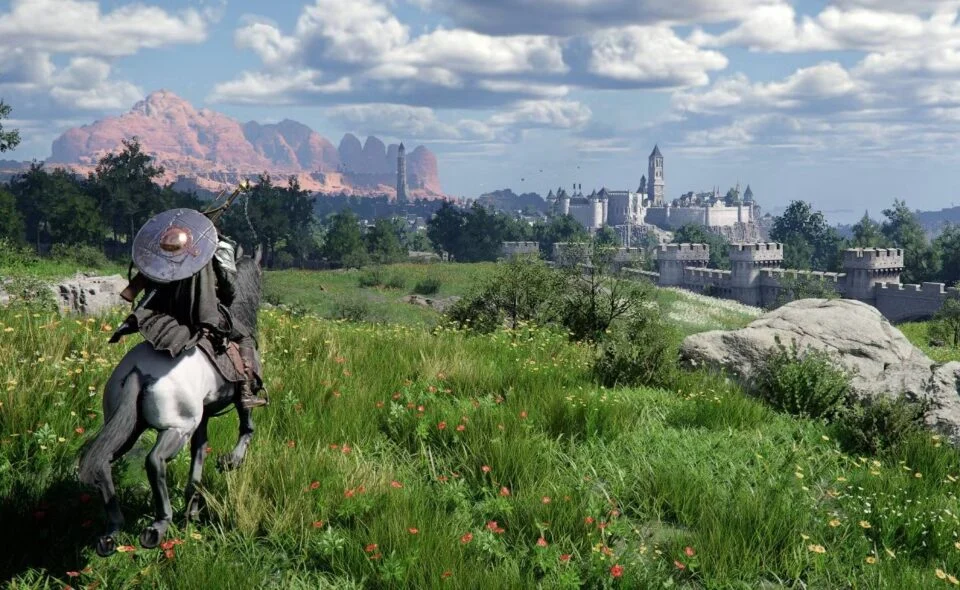
The upcoming 2026 role-playing game Crimson Desert has once again reignited a familiar debate in open-world design: how much does sheer size actually matter. During the recent New Game+ Showcase, developers from Pearl Abyssconfirmed that the game’s map will be roughly twice the playable area of The Elder Scrolls V: Skyrim and larger than Red Dead Redemption 2. On paper, that places Crimson Desert among the largest single-player RPG worlds announced to date.
Set on the continent of Pywel, the game has been in development for several years and traces its origins to technology and assets built for Pearl Abyss’s long-running MMORPG Black Desert Online. That lineage is apparent in the scale of the environments shown so far, which emphasize sweeping vistas, long-distance traversal, and densely detailed terrain. Trailers and previews have highlighted horseback travel, large-scale battles, and one feature guaranteed to catch attention: the ability to ride dragons.
The map size claim came with an important caveat from the developers themselves. Representatives stressed that scale alone is not the goal, acknowledging that a massive world without meaningful interaction risks becoming empty rather than immersive. According to Pearl Abyss, Crimson Desert is intended to focus on interactivity, with systems built around combat encounters, environmental engagement, and layered crafting mechanics designed to give players reasons to explore beyond simple sightseeing.
Still, the details remain vague. When pressed about what players will actually be doing across such an expansive map, discussion largely returned to deep crafting systems and general activities rather than specific quest structures, narrative density, or systemic depth. This lack of clarity reflects a broader trend in the industry, where developers increasingly promote square mileage as a selling point even as players grow more skeptical of its value.
In 2026, comparisons based on map size alone have limited impact. Many recent releases have demonstrated that thoughtful design can make smaller or more constrained spaces feel richer and more purposeful. Games that emphasize traversal, consequence, and environmental storytelling have shown that scale works best when paired with intention, as seen in titles like Death Stranding 2, where terrain itself becomes part of the gameplay loop.
Crimson Desert is scheduled to launch on March 19, and it may well justify its ambitious scope. The technology, visual polish, and combat shown so far suggest a technically impressive release. Whether its world feels alive or merely large, however, will depend less on how far players can travel and more on what meaning the game assigns to that journey.