
TL;DR: The Beauty is Ryan Murphy snapping back into form with a vicious, stylish body horror series that skewers beauty culture, tech messianism, and sexual politics while gleefully exploding supermodels along the way. It’s smart, nasty, occasionally indulgent, and endlessly watchable, a reminder of how good Murphy can be when he actually has something to say.
The Beauty
I went into The Beauty carrying trauma. Real trauma. The kind inflicted by sitting through Ryan Murphy’s previous screen experiment, All’s Fair, a show so profoundly broken it felt like it was written by an AI trained exclusively on rejected Real Housewives taglines and HR seminar icebreakers. That series didn’t just miss the mark; it fired the gun backwards and sued the audience for emotional damages. So when I hit play on The Beauty, I did so the way you open an email from an ex who once set your couch on fire: cautiously, with one eyebrow raised, fully prepared to bail.
Instead, what I got was Ryan Murphy remembering who the hell he is.
The Beauty is a gloriously unhinged return to form, a bingeable, blood-soaked slab of body horror that fuses satire, sex, gore, and social commentary with the kind of confidence Murphy used to wield like a chainsaw back in his Nip/Tuck and American Crime Story glory days. It’s nasty, stylish, deeply unserious on the surface, and uncomfortably sharp underneath. And yes, it’s also wildly entertaining in that “I cannot believe this is on my TV and I cannot look away” way that Murphy, when he’s locked in, does better than almost anyone.
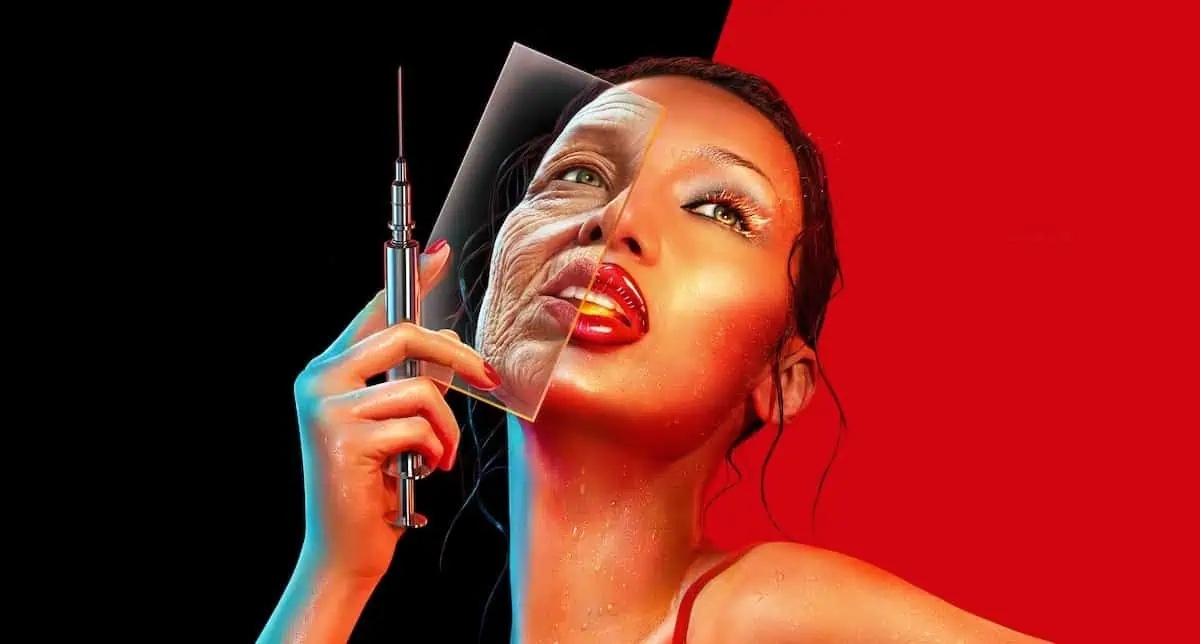
Based on the Image Comics series by Jeremy Haun and Jason A. Hurley, The Beauty imagines a world where a sexually transmitted virus doesn’t give you rashes or regrets, but beauty. Perfect skin. Symmetry. Bone structure that could cut glass. The catch, of course, is that after you’ve been sculpted into a walking Instagram filter, you violently die. Sometimes by explosion. Sometimes by spontaneous combustion. Sometimes by turning into a charred ribcage in a silk-sheeted bed like a Calvin Klein ad directed by David Cronenberg.
If that premise alone doesn’t already have you reaching for the remote, I don’t know what to tell you.
The series opens with a runway sequence that feels like Murphy yelling “I’m back, baby” directly into the camera. Supermodels strut. Cameras flash. And then Bella Hadid’s Ruby snaps. Necks crack. Paparazzi fly. Restaurants are demolished in a feral search for water, her thirst burning from the inside like she swallowed the sun. Within minutes, the show establishes its tone: fashion-world glamour colliding headfirst with splatter-film chaos. It’s Catwalk Carnage with a capital C and a body count.
From there, the outbreak spreads. Models across the globe go rogue, their perfection becoming a ticking time bomb. Headlines scream. Bodies burst. And somewhere between the haute couture and the horror, Murphy slips in the real monster: our obsession with beauty as currency, identity, and salvation.
Investigating the mayhem are FBI agents Jordan Bennett and Cooper Madsen, played with grounded intensity by Rebecca Hall and Evan Peters. They’re lovers, partners, and walking case studies in denial, pretending their relationship is purely physical while every lingering glance screams otherwise. Hall’s Jordan is particularly compelling, a character whose toughness doesn’t shield her from the same insecurities the virus exploits. Her recent breast implants, a response to childhood cruelty and internalized standards, aren’t just character detail. They’re thematic scaffolding. Even the people tasked with stopping the plague are already infected by the culture that created it.
Murphy smartly uses their procedural framework as an anchor, because without it, The Beauty could easily spiral into pure spectacle. Instead, the investigation grounds the insanity, giving the exploding bodies context and momentum. Each episode peels back another layer of the conspiracy, another ugly truth hiding beneath flawless skin.
Then there’s Jeremy.
Jeremy, played later by Jeremy Pope, is introduced in a way that made me cackle with recognition and dread. Alone. In a basement. Typing one-handed. Mourning not just connection, but purpose. When he tells a doctor, “I’m lost. I want a purpose. Do you think I should do standup?” I knew, in that exact moment, that Murphy had rediscovered his sense of humor. The doctor, a plastic surgeon with the ethics of a Bond villain, delivers the line of the year: “You are an incel, Jeremy. I can make you a Chad.”
And just like that, the show detonates another cultural landmine.
Jeremy’s transformation isn’t framed as empowerment. It’s framed as seduction. The virus offers him access, validation, and a sense of belonging he’s never had. It’s Ozempic culture turned into an STD. Self-improvement marketed as salvation. And Murphy doesn’t let us off the hook by pretending this is just about “bad people.” The system rewards the beautiful. The virus just makes that transaction explicit.
Overseeing the chaos is Ashton Kutcher’s Byron Forst, a tech billionaire so smugly convinced of his own genius that he barely registers the human cost of his invention. Known ominously as the Corporation, Byron embodies Silicon Valley messiah syndrome: disrupt first, apologize never. Kutcher plays him with a chilling calm that works far better than I expected, especially opposite Anthony Ramos as the Assassin, the muscle tasked with cleaning up the mess when the virus gets too public.
And then, like a gift wrapped in couture and menace, Isabella Rossellini enters the series as Franny Forst. I will not spoil her introduction, but I will say this: do not skip it. Rossellini doesn’t just appear; she glides in, dripping with authority, mystery, and the kind of screen presence that reminds you why casting matters. Her wardrobe alone deserves its own Emmy campaign. If she and Kutcher are related, as the name strongly suggests, the generational tension between old-world elegance and tech-bro hubris becomes one of the show’s most delicious undercurrents.
What makes The Beauty work, beyond the gore and the camp, is that it knows exactly what it’s satirizing. Unrealistic beauty standards. The monetization of insecurity. The way wellness culture, tech culture, and sex culture collapse into one algorithmic nightmare. Murphy doesn’t pretend he’s above it all. He wallows in it. He glamorizes it. And then he lets it explode.
Visually, the show is slick without being sterile. The effects are gnarly, practical when they need to be, digital when they must. Bodies don’t just die; they fail catastrophically. Skin splits. Heat radiates. Beauty curdles into horror in ways that feel both absurd and uncomfortably plausible.
Most importantly, The Beauty feels intentional. It has a plot. It has structure. Characters make choices that ripple outward. There’s a sense that Murphy knows where this story is going, even if he’s enjoying the scenic route through madness. After the aimless sprawl of some of his recent projects, that alone feels like a minor miracle.
Is it perfect? No. Some metaphors are hammered a little too hard. A few subplots wobble under their own ambition. And Murphy’s instinct to escalate everything means subtlety occasionally gets trampled in stilettos. But I’d much rather watch a show reaching too far than one that has nothing to say.
By the time the credits rolled on the final episode, I realized something surprising: I was relieved. Relieved that Ryan Murphy hadn’t lost it. Relieved that this wasn’t another glossy disaster. Relieved that a show could be this gross, this funny, this angry, and still this compelling.
The Beauty streams on Disney+, and it’s exactly the kind of body horror satire that rewards a binge, preferably with the lights on and your phone face down.