
TL;DR: The finale of IT: Welcome to Derry confirms that Marge is Richie Tozier’s mother, turning a fan theory into a devastating, franchise-defining reveal. By tying Rich’s sacrifice directly to Pennywise’s eventual defeat, the show elevates its prequel status into essential canon, delivering emotional weight, smart lore expansion, and one of the most meaningful connections in the IT universe to date.
It: Welcome to Derry
I knew IT: Welcome to Derry was going to hurt me eventually. This is Stephen King’s playground, Andy Muschietti’s sandbox, and HBO’s prestige-TV blender all working in tandem, so emotional devastation was always baked into the contract. Still, I wasn’t prepared for just how hard the finale went in confirming one of the fandom’s most whispered theories, then twisting the knife by making it retroactively tragic, mythologically crucial, and deeply personal. This wasn’t just a lore dump. This was a franchise mic drop.
By the time the final episode rolled around, I was already emotionally compromised. I’d survived the shock of the premiere, watched kids die in ways that felt uncomfortably intimate, and followed Lilly’s suffering like it was some cursed prestige drama spinoff of The Leftovers. But what really anchored Welcome to Derry for me wasn’t Pennywise doing Pennywise things. It was the new Losers. Or proto-Losers. Or pre-Losers. Whatever we’re calling this doomed batch of kids in 1962, they were the beating heart of the show, and the finale made it clear that their importance goes way beyond this season.
Let’s talk about Marge and Rich, because that’s where everything clicked into place.
When we first meet Marge, she’s honestly kind of terrible. Not cartoon-villain terrible, just painfully real in that middle-school way where social survival trumps basic decency. She ditches Lilly when her friend needs her most, trades empathy for popularity, and spends the early episodes making choices that made me groan in recognition. We’ve all known a Marge. Some of us were a Marge. What makes her arc work is that the show never excuses her behavior, but it also doesn’t lock her into it. Trauma forces growth. Derry has a way of doing that.
Rich, on the other hand, felt like he wandered in from a different, gentler story. He’s smaller, overlooked, and radiates that big-mouth energy that Richie Tozier fans immediately clocked as intentional. He talks too much, jokes through fear, and hides genuine bravery behind humor. Watching him, I kept thinking, okay, either this is a deliberate echo or the writers are being aggressively unsubtle. Turns out it was very much the former.
Their relationship is the emotional core of the season, and the show smartly lets it breathe. There’s that moment where Rich tends to Marge’s wound without judgment, a small scene that somehow says more about intimacy than most TV romances manage in a full season. Then there’s the lunch scene, all knights and maidens and goofy smiles, where Marge finally chooses him over the popular girls. In another show, this would be setup for a triumphant survival arc. In IT, it’s a death sentence.
The Black Spot fire is one of the most horrifying sequences the franchise has ever depicted, not because of Pennywise, but because of humanity. Racist violence, mob cruelty, and systemic hatred are presented as the real monsters, with Pennywise lurking more like a cosmic opportunist than the main event. Rich’s death isn’t flashy. It’s devastatingly noble. He hides Marge in a fridge, lies on top of it, and burns alive because knights protect fair maidens. I sat there staring at my screen thinking, yeah, that’s a Richie Tozier move if I’ve ever seen one.
That’s where the fan theory really took off. Rich. Richie. Similar cadence. Similar energy. Similar role in the group dynamic. Fans immediately started speculating that Marge might be connected to the Losers Club we know from the films. The finale doesn’t just confirm that theory. It weaponizes it.
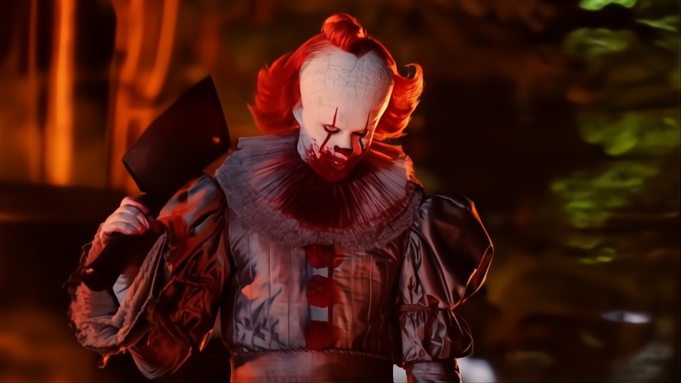
When Pennywise confronts Marge and calls her Margaret Tozier, the air gets sucked out of the room. This isn’t a cute Easter egg or a wink to the audience. This is Pennywise going full meta-horror, revealing that Marge is destined to be the mother of Richie Tozier, the very man who will one day help destroy him. Pennywise doesn’t taunt her with this information for fun. He’s furious. Time, to him, is non-linear. Past, present, future all bleed together like a corrupted timeline in a cosmic horror version of Primer. If Richie kills him in the future, then maybe killing Richie’s mother in the past solves the problem.
Seeing Finn Wolfhard’s Richie on that missing poster was like getting punched by nostalgia and dread at the same time. This is the rare kind of franchise connectivity that doesn’t feel cheap. It reframes the movies. Rich’s sacrifice isn’t just heroic in the moment. It’s foundational. Without him, Marge dies. Without Marge, Richie is never born. Without Richie, Pennywise survives. The entire IT saga hinges on a kid who never even meets the Losers Club.
That’s some high-tier mythmaking.
Bill Skarsgård’s Pennywise is at his most unhinged here, not in a loud way, but in a deeply unsettling, existential one. The idea that Pennywise experiences his own death before it happens explains so much about his behavior across the franchise. He’s not just feeding. He’s stalling. He’s trying to outmaneuver fate. And when Dick Hallorann slips into his mind and freezes him mid-kill, it’s less a victory than a temporary stalemate in a war across timelines.
Yes, that Dick Hallorann. The show quietly confirming his presence as a psychic counterweight to Pennywise is another geeky delight, tying King’s wider universe together without turning the show into Ready Player One: Horror Edition. It works because it’s subtle, thematic, and character-driven.
The funeral scene wrecked me. Marge’s speech about Rich, about knowing him for such a short time yet being fundamentally changed by him, lands with the weight of lived experience. We know she’ll love again. We know she’ll build a family. But naming her son Richie isn’t just an homage. It’s a refusal to let that sacrifice fade. Rich lives on, not as a ghost, but as a legacy.
The finale also smartly plants the seeds for what Welcome to Derry is really about long-term. Pennywise isn’t done. He’s just sleeping. The 27-year cycle looms large, and the implication that future seasons will jump backward to 1935, then further still, reframes the show as a reverse anthology. Instead of asking how Pennywise returns, we’re being asked how far back his rot goes, and how many brave, doomed people stood against him long before the Losers Club ever rode their bikes.
If IT: Welcome to Derry sticks the landing in future seasons, this finale will be remembered as the moment the franchise leveled up from great horror adaptation to full-on mythological epic. It respects the films, deepens the lore, and, most importantly, makes the horror personal again. This isn’t just about a clown in a sewer. It’s about how love, sacrifice, and courage ripple across generations.