
TL;DR: A sometimes messy but often brilliant revival, Metroid Prime 4: Beyond stumbles in its open-world hub and companion chatter but shines in its core exploration, atmosphere, and world design. Not perfect, but absolutely worth the wait.
Metroid Prime 4: Beyond
There’s a specific kind of silence that only a Metroid game can conjure. It’s the hush that creeps in between footsteps when you’re wandering through some forgotten alien ruin, waiting for a pipe to hiss or a thermal vent to flare up just so you don’t feel completely alone. It’s the soft hum of Samus’s visor, the faint echo of a door seal locking behind you, the ambient reminder that no matter how many times Nintendo straps the suit on you, you’re still one bounty hunter against a universe that doesn’t care whether you come back.
Metroid Prime 4: Beyond doesn’t always remember that silence. In fact, sometimes it talks too much, crashes its new motorbike into the middle of your solitude, and asks if you want to go scavenging in the desert again like an overeager friend who learned the word “open world” yesterday. But the miracle here — the real, pinch-yourself revelation — is that despite the noise, the awkwardness, the design detours, and the extremely 2020s “what if we had companions?” impulse, Retro Studios still found the heart of Prime again.

And for a series that’s been dormant roughly as long as my launch-model Switch fan has been screaming for help, that’s enough to make the missteps feel like sand in the suit rather than a fatal hull breach.
Viewros, Psychic Powers, and a Sense of Déjà Vu
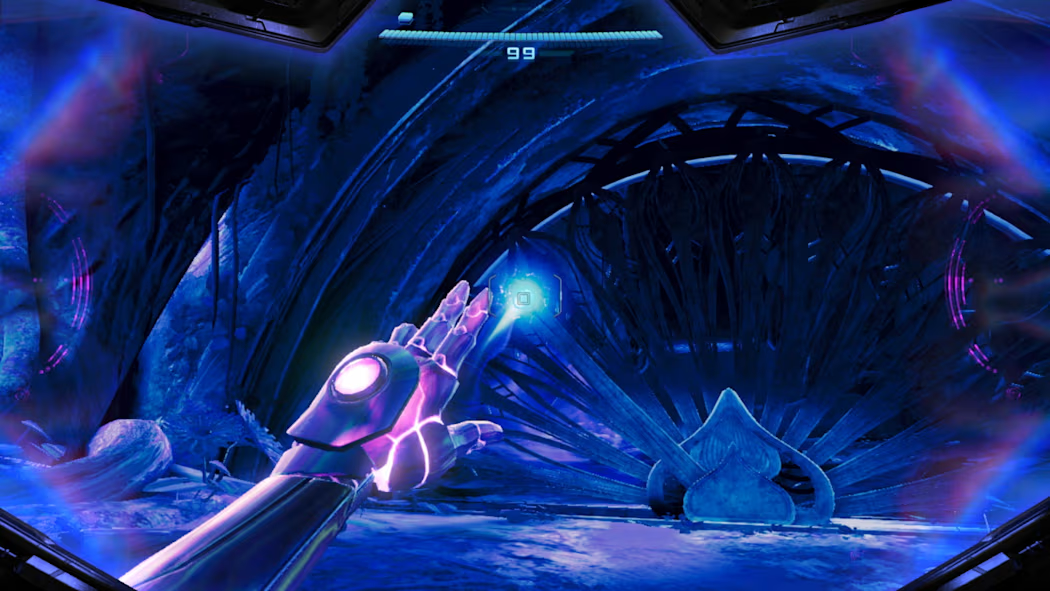
The setup is pure Metroid: Samus is alone on a mysterious planet, this time Viewros, with an ancient alien civilization whose secrets are tucked behind doors she can’t open yet. But this time she’s got a new trick — psychic abilities gifted by the Lamorn. Purple telekinetic energy. Floaty objects. Energy circuits. A whole new class of puzzles that try to shake up the series’ classic formula.
Sometimes they work beautifully. Sometimes they feel like Metroid Prime is doing an impression of a sci-fi escape room.
I enjoyed using them — I genuinely did — especially when they were woven into Morph Ball momentum puzzles or environmental manipulation that made me stop, think, and feel clever for a few seconds. But even at their best, these powers feel more like elegant remixes of things Prime has already done rather than the sort of breakthrough Dread pulled off with its movement tech.
Still, they’re fun. They’re intuitive. They fit. And more importantly, they never overshadow Samus’s essentials: the Charge Beam, the missiles, the Morph Ball, the rhythm of scanning and fighting and exploring that has defined this subseries since I was squinting at a CRT in 2002.
Combat Is Still King… Mostly
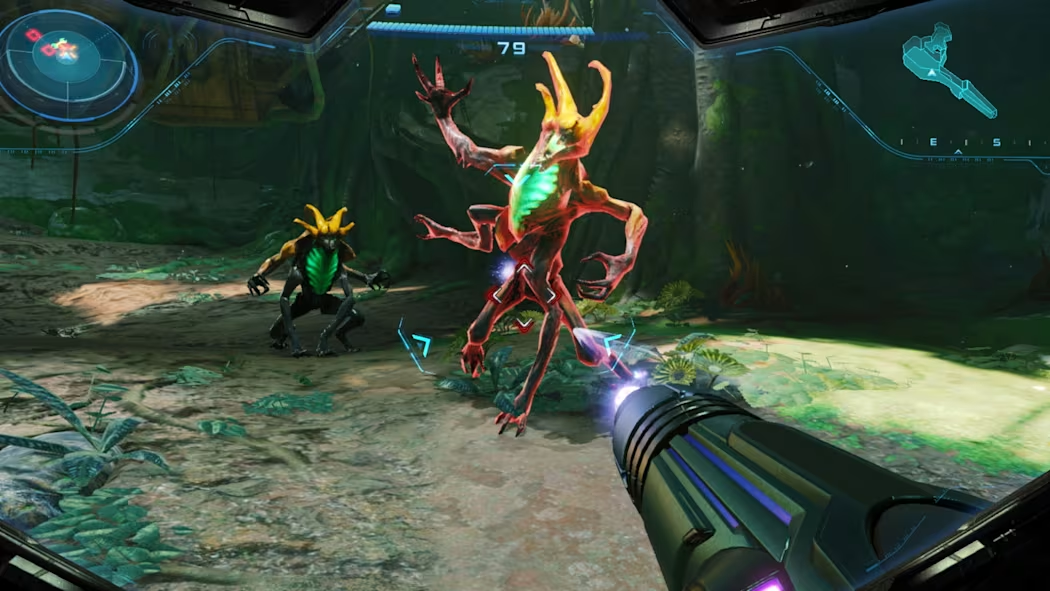
Sliding back into Prime’s lock-on combat is like slipping on an old, slightly battle-scarred glove — familiar, functional, comfortable. Samus feels faster now, more acrobatic. The new dodge adds a twitchy urgency, and the elemental beams are stylish in a way that made me feel like I was customizing my own sci-fi Swiss Army knife.
But Prime’s combat has always been great because of when it happens, not how much of it there is. It’s seasoning, not the meal. So whenever Prime 4 forgets that and tries to vibe like a mid-2000s corridor shooter — waves of enemies, repetitive firefights, loudness for the sake of loudness — the pacing stumbles.
Then a boss arrives, and suddenly everything clicks again. A giant plant thrashing petals and vines around you. Towering alien constructs that take choreography, not brute force. Prime 4’s bosses are a reminder that Retro hasn’t lost that old magic, even if the road there occasionally meanders.
About That Motorcycle…
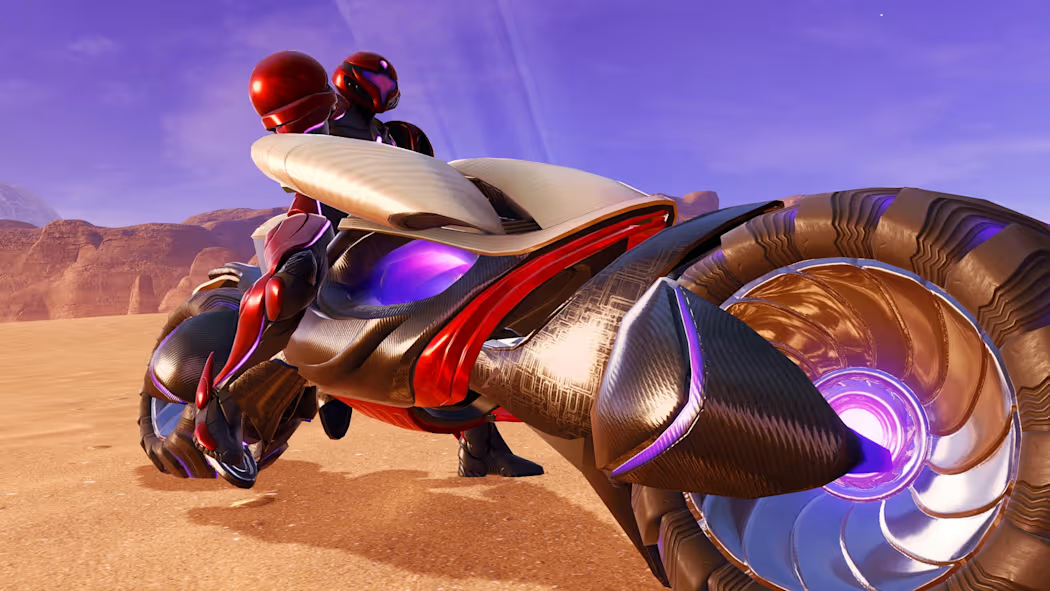
Let me say something nice first: it handles well.
Now the rest: almost everything surrounding the motorcycle feels like Nintendo tried to duct-tape Breath of the Wild’s Great Plateau philosophy onto an N64-era hub world without realizing how much nuance makes an open-world desert work.
Sol Valley — Prime 4’s big open-zone hub — is the weakest part of the game. It’s barren but not in the atmospheric, haunting way. More like “I guess we needed three minutes of traversal between these interesting places, so here’s a sandbox and some identical enemies to drive past.” And tying a major story objective to collecting green energy shards scattered around this space doesn’t help. It’s filler, and you feel it.
I don’t mind a big hub world. I mind a big hub world that doesn’t justify the time I spend in it.
The Real Journey Begins Once You Leave the Desert
Here’s the part where everything gets good again.
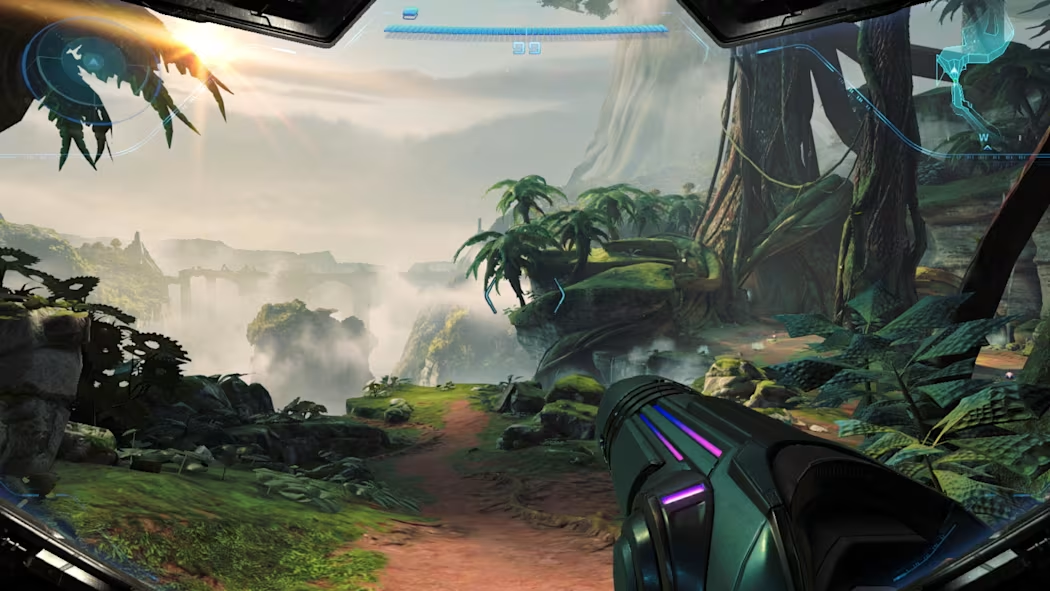
Once you’re out of Sol Valley and into the actual regions — the self-contained, richly textured, beautifully framed levels that feel like spiritual cousins to Prime 2 and 3 — the game sings. Each zone is like its own giant Zelda-style dungeon: discover, solve, upgrade, conquer. And while it’s more linear than older Primes, that linearity gives Retro the freedom to craft mood, tension, pacing, and escalation in a way that connects directly to the series’ roots.
Volt Forge, with its gothic machinery and rock-infused soundtrack, is the kind of place you linger in just to scan everything, not because you have to, but because the worldbuilding is too good to rush through. Other locations lean into horror, or action, or mystery, or that classic Metroid solitude that makes even the smallest corridor feel loaded with purpose.
This is where Prime 4 earns its name — and where it almost earns the right to stand next to its legendary predecessors.
Companions, Chatter, and the Battle Against Over-Explaining Everything
I admit it: I rolled my eyes when the companions first showed up. Metroid and quippy chatter go together about as well as lava and bare feet. And yes, the writing sometimes slips into clichés, and yes, there are moments when you wish the AI in your ear would just… not. But surprisingly, they’re not nearly as intrusive as they could’ve been.
Their presence feels limited, almost experimental — like Retro wanted to dip its toes into a more character-driven story without fully committing to breaking Samus’s hard-earned mystique. They have charm. They have some standout scenes. They’re harmless, mostly. And crucially, Prime 4 knows when to shut the door, cut the signal, and let Samus roam alone again.
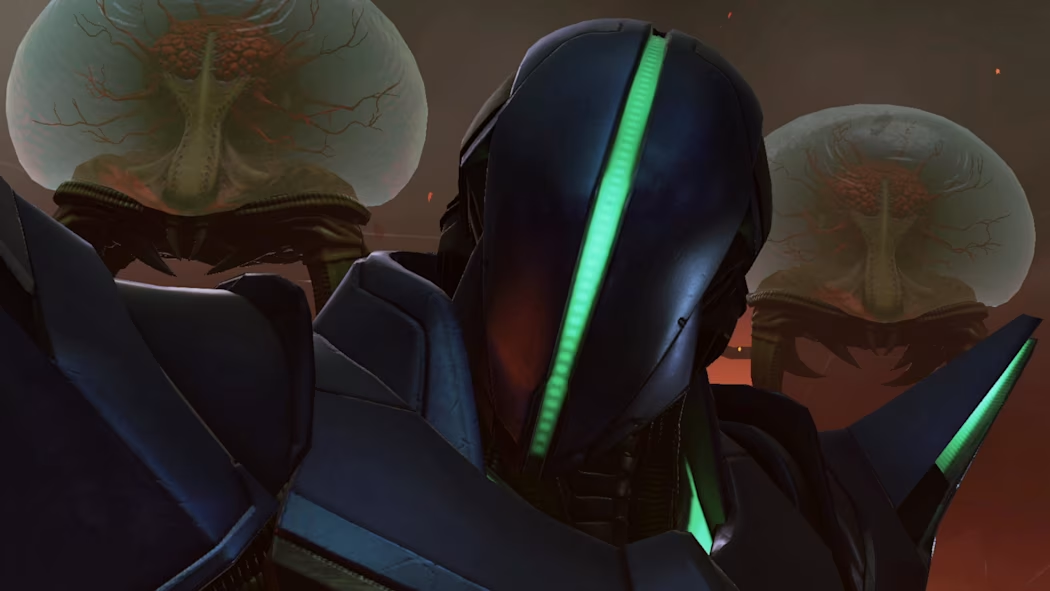
If anything, the one character I wanted more of was Sylux, whose role feels like an afterthought rather than the payoff we’ve been teased with for over a decade.
A Stunning Technical Showcase, with a Foot Still in the Past
On Switch 2, Beyond is gorgeous — genuinely one of Nintendo’s most visually striking games. The lighting, architecture, environmental detail, and atmospheric effects elevate the Prime aesthetic to a place it’s never been before. Running at 4K 60 fps (or 120 fps with a resolution trade-off), it’s easily among the smoothest, best-performing first-party games Nintendo has ever shipped.
On Switch 1? It’s fuzzier, slower to load, and less polished — but shockingly competent. You don’t lose the soul of the game by playing the old version. You just miss the glow-up.
When It Works, It’s Brilliant. When It Doesn’t, It’s Just Fine. And That’s Okay.
Metroid Prime 4: Beyond is uneven. That’s the first truth you have to accept. It’s full of decisions where you can feel Retro wrestling with a franchise legacy that fans have turned into myth. You can sense the creative push-pull: experimentation vs. conservatism, companion story beats vs. solitary exploration, open hub riding vs. classic pacing.
But the second truth is more important: when Prime 4 hits its stride — when you’re alone in a storm, visor fogging up, scanning runes older than human civilization, solving some arcane puzzle no one told you how to decipher — it’s transcendent in the way only Metroid Prime can be.
This is an excellent comeback with flaws, not a flawed game with occasional excellence.
And honestly? After fourteen years of waiting, I’ll take that any day.
Verdict
Metroid Prime 4: Beyond doesn’t fully achieve the ambitious fusion of character-driven storytelling, open-world ambition, and classic Metroid Prime atmosphere it reaches for. A lackluster desert hub, repetitive objectives, and occasionally chatty companions hold it back from matching its finest predecessors. But its highs are unmistakably, undeniably Metroid Prime at its best: breathtaking environments, elegant worldbuilding, satisfying exploration, inventive puzzles, strong boss encounters, and an unmistakable sense of mood and mystery. Even with uneven elements, this is a triumphant return for the series — flawed but fantastic, modern yet nostalgic, and absolutely worthy of Samus’s legacy.