

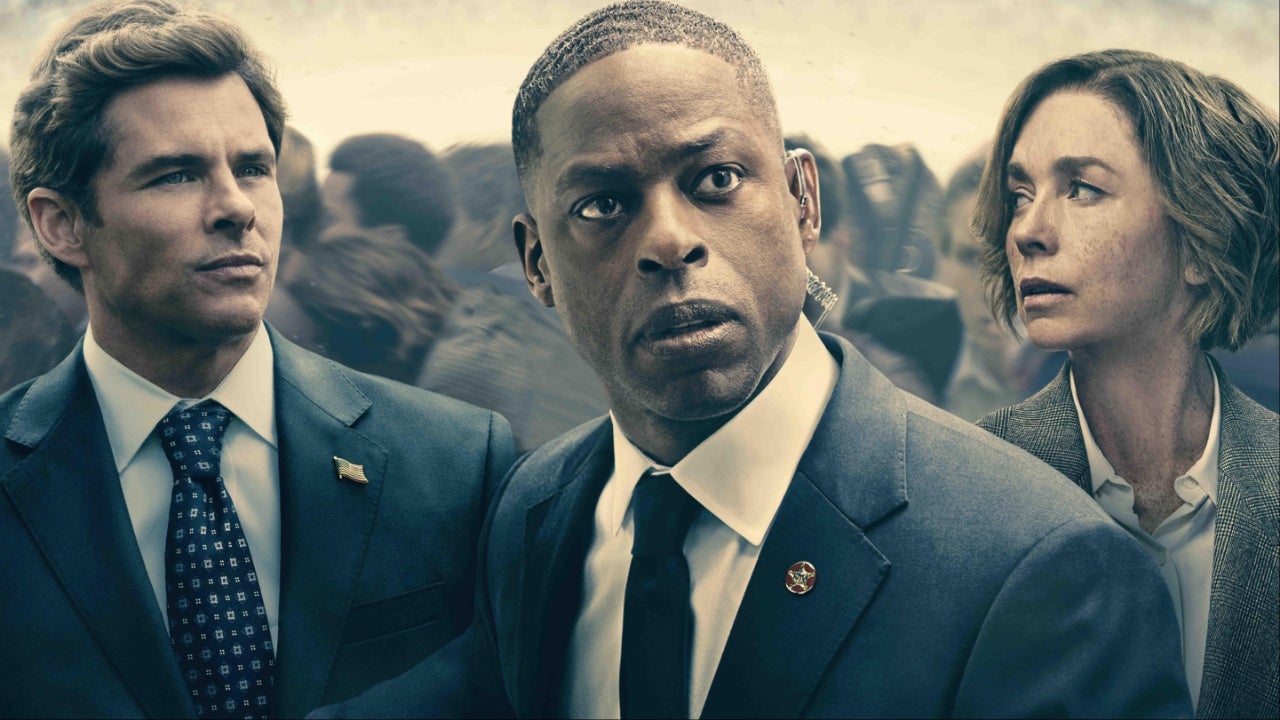
Season 1 of Paradise opens like a sleek political thriller but slowly mutates into something far more unsettling and ambitious. The story begins with Secret Service agent Xavier Collins, played by Sterling K. Brown, discovering that the President of the United States, Cal Bradford (James Marsden), has been murdered. The early episodes frame the series as a tense investigation filled with suspects, motives, and power struggles, suggesting a classic conspiracy drama. Yet the show’s real hook lies in how patiently it withholds its biggest truth.
Paradise
That truth detonates midway through the season: the world viewers thought they were watching isn’t the real world at all. The entire story takes place inside a colossal underground bunker built beneath a mountain in Colorado, housing thousands of carefully chosen survivors after an extinction-level catastrophe wiped out civilization above ground. What looked like a functioning society is actually a sealed experiment in controlled survival, designed to mimic normal life so convincingly that residents can forget the apocalypse outside.
Xavier’s investigation into the president’s death becomes the thread that unravels the illusion. As he follows clues, interrogates suspects, and revisits old alliances, he exposes tensions simmering beneath the bunker’s polished surface. Social hierarchies, hidden agendas, and secret decisions about who deserved to live and who didn’t begin to surface. Much of this hidden machinery traces back to the bunker’s architect, Samantha “Sinatra” Redmond (Julianne Nicholson), a tech billionaire whose influence over the underground city is absolute and whose secrets run deeper than anyone realizes.
The murder mystery ultimately resolves in a surprisingly human way. The killer isn’t part of a vast shadow conspiracy but a wounded insider driven by resentment and injustice tied to the bunker’s creation. That reveal reframes the season’s central idea: even when humanity survives the end of the world, it brings its flaws with it. Fear, inequality, and buried rage don’t disappear just because the sky did.
By the finale, the case is closed but the story is wide open. Xavier learns that his wife, long believed dead in the global disaster, may actually be alive on the surface. That revelation shifts the series from contained mystery to epic quest. He leaves the safety of the bunker behind and heads into the unknown wasteland above, chasing the possibility of family, truth, and whatever remains of civilization.
Season 1 ends not with resolution, but with expansion. The murder was only the first puzzle. Season 2 promises to explore the larger question now looming over everything: what kind of world survived outside, and is it more dangerous than the one humanity built underground?