
TL;DR: Avatar: Fire and Ash is a stunning, emotionally rich blockbuster that proves James Cameron still owns the theatrical experience, even if the franchise is beginning to repeat its narrative patterns. Incredible performances, an all-time great new villain in Varang, and unmatched spectacle carry the film, but familiarity and overreliance on Spider keep it from reaching the transcendent heights of its predecessors.
Avatar: Fire and Ash
I’ve been watching James Cameron movies long enough to remember when Terminator 2 melted my teenage brain and permanently recalibrated my expectations for what “blockbuster” even meant. Cameron doesn’t just make movies; he builds monuments and then dares Hollywood to try and live inside them. Titanic wasn’t just a romance, it was a declaration of dominance. Aliens didn’t sequel Alien so much as suplex it into a different genre. And Avatar, for better or worse, rewired the global box office while quietly becoming the most expensive tech demo ever disguised as a movie.
So walking into Avatar: Fire and Ash, I wasn’t just expecting spectacle. I was expecting escalation. Cameron has trained us to believe that each new entry isn’t incremental but evolutionary. Pandora doesn’t just expand; it mutates. And here’s the weird, slightly uncomfortable truth I walked out with: Fire and Ash is jaw-dropping, emotionally potent, and technically flawless… yet it’s also the first time an Avatar film feels like it’s circling familiar airspace instead of charting an entirely new flight path.
That tension, between awe and déjà vu, is the defining experience of Avatar: Fire and Ash.
Let’s get the obvious out of the way first. On a purely sensory level, Fire and Ash is unreal. This is Cameron reminding the industry, yet again, that theatrical filmmaking isn’t dead, it’s just waiting for someone who actually understands scale. The 3D isn’t a gimmick; it’s a weapon. Depth isn’t used to poke your eyeballs but to pull you into Pandora like gravity. Fire behaves differently here. Ash floats with intention. Lava flows like it’s alive. Water, which Cameron already mastered in The Way of Water, now clashes violently with heat in ways that feel tactile. I felt this movie in my chest, in my seat, in that part of my brain that still remembers what it was like seeing Jurassic Park for the first time.
Pandora remains the most convincing fictional ecosystem ever put on screen. Every frame looks like it was rendered by a god with a doctorate in biology and too much free time. The sound design alone deserves its own standing ovation. Arrows don’t just fly, they whistle. Creatures don’t roar, they communicate dominance, fear, and history. Cameron’s long-standing obsession with immersion hasn’t dulled one bit, and Fire and Ash absolutely demands to be seen in a theater, preferably one large enough to make you feel insignificant.
Narratively, Fire and Ash picks up directly in the emotional wreckage left by The Way of Water. The Sully family is fractured. Neteyam’s death hangs over every conversation like smoke that never quite clears. Jake Sully has shifted fully into hardened patriarch mode, the kind of dad who stockpiles weapons not because he wants war, but because he knows it’s inevitable. Sam Worthington continues his quiet evolution into this role, grounding Jake with weary authority rather than swagger. He feels older, slower, and more dangerous because of it.
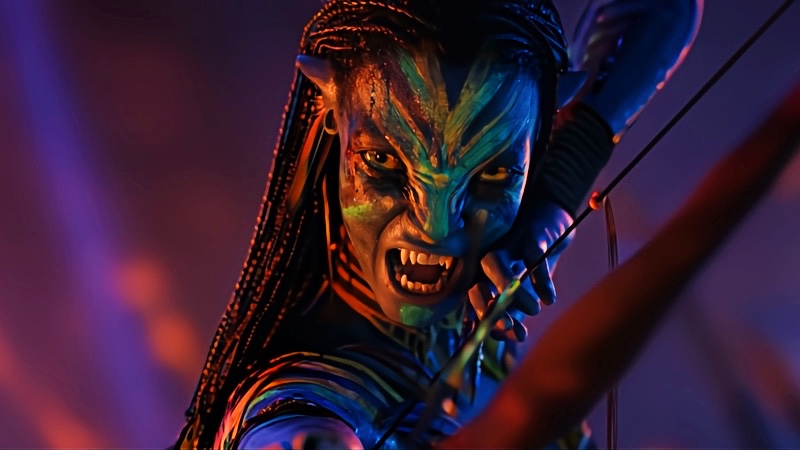
Neytiri, though, is the soul of this movie. Zoe Saldaña plays her grief like an exposed nerve. There’s rage here, yes, but also something colder and more frightening: certainty. Neytiri no longer doubts that humans will destroy everything they touch. The film doesn’t frame her anger as irrational, and that’s crucial. Fire and Ash allows her to exist in moral discomfort, where vengeance feels justified even when it’s terrifying. Watching Saldaña unleash that fury is electrifying, and at times genuinely unsettling.
The film’s central thematic engine is loss, and what it does to belief. Kiri’s growing distance from Eywa isn’t just a mystical subplot; it’s a crisis of faith. Lo’ak’s guilt eats at him in ways that feel painfully real, especially for anyone who’s ever been the kid who survived when someone else didn’t. Cameron and his writing team weave these arcs with more confidence than ever. This is the most emotionally literate Avatar film to date, and it earns its quieter moments just as much as its bombastic ones.
Then there’s Varang.
Oona Chaplin’s introduction as the leader of the Mangkwan, the Ash People, is the single best new addition to the franchise since Neytiri herself. Varang isn’t just a villain; she’s a warning. She is what happens when grief calcifies into ideology. Fire has taken everything from her, so she wields it as a tool of purification. Chaplin plays her with terrifying restraint, never twirling a metaphorical mustache, never begging for sympathy. She is righteous in her own mind, and that makes her dangerous in ways Colonel Quaritch never quite was.
Speaking of Quaritch, Stephen Lang continues to chew through this role like it owes him money. His dynamic with Varang is fascinating, built on mutual utility rather than trust. For the first time, Quaritch doesn’t feel like the apex predator in the room, and that shift injects real unpredictability into the story.
Here’s where the “major problem at its heart” comes into focus.
For all its emotional depth and technical wizardry, Fire and Ash leans heavily on structural repetition. Cameron has always been a master recycler, but this time the seams are more visible. Humans exploit Pandora. Na’vi resist. Innocent creatures are hunted as collateral damage. Replace Tulkun with a new endangered species, swap water for fire, and suddenly the echoes of The Way of Water become hard to ignore. The action is still thrilling, staged with unmatched clarity and purpose, but the narrative rhythms feel familiar enough that I occasionally found myself predicting beats before they landed.
And then there’s Spider.
If you thought The Way of Water leaned too hard on him, buckle up. Spider remains a thematic idea masquerading as a character. He represents humanity’s potential for coexistence, but the film repeatedly uses him as a plot lever rather than letting him exist as a fully realized person. Entire emotional stakes hinge on Spider’s presence, yet he often feels like a narrative shortcut rather than an organic part of the world. In a franchise this obsessed with authenticity, Spider remains its most artificial element.
That reliance exposes a larger concern: Avatar is starting to believe its own myth. Cameron’s world-building is so strong, so confident, that the franchise risks mistaking familiarity for inevitability. Fire and Ash doesn’t fail because it’s bad. It doesn’t even stumble. It simply doesn’t leap as far forward as Cameron has conditioned us to expect.
And yet, despite all of that, I was never bored. Never disengaged. Never unimpressed.
Because even when James Cameron is repeating himself, he’s still operating on a level no one else can touch. The emotional payoffs land. The action devastates. The performances elevate material that, in lesser hands, would feel formulaic. Fire and Ash may not redefine cinema the way Avatar once did, but it reinforces something just as important: no one else is even trying to compete at this scale.
As the credits rolled, I didn’t feel disappointed. I felt cautious. Avatar: Fire and Ash is a reminder that even the greatest franchises can’t rely on momentum forever. Pandora still has stories worth telling, but the next evolution needs to be conceptual, not just technological.