
TL;DR: Percy Jackson Season 1 lays essential groundwork—from divine parentage and forbidden children to Luke’s betrayal and Kronos’ awakening—that feeds directly into Season 2’s Sea of Monsters storyline. It’s the kind of faithful adaptation that rewards both longtime readers and new fans, setting the stage for a richer, wilder, more emotionally charged sophomore season.
Percy Jackson and the Olympians
Every once in a while, a fantasy show crawls out of the streaming swamp, dusts itself off, and reminds me why I spent my childhood hoarding Athena-branded bookmarks and quoting Greek myths at unsuspecting relatives. When Percy Jackson and the Olympians premiered, it felt like the universe finally apologized for those cursed movie adaptations by delivering a TV series that actually respects the source material. Now that Season 2 is cresting the horizon like a dramatic Poseidon-approved wave on December 10th, I found myself diving back into Season 1 and resurfacing with the ten story details you absolutely need locked and loaded before venturing into The Sea of Monsters.
Season 1 is basically a love letter to Rick Riordan’s The Lightning Thief, but it’s also the narrative scaffolding for everything to come. So here’s the geek-approved, memory-refresher recap—delivered with the same enthusiasm I reserve for buying limited-edition Camp Half-Blood hoodies.
The first thing to remember is that Percy Jackson didn’t ask for any of this nonsense. The kid just wanted to survive middle school without accidentally vaporizing a Fury in front of his classmates. The revelation that he’s the half-blood son of Poseidon hits him like a celestial brick. Learning your dad is the god of the sea sounds glamorous until you realize you’ve inherited hydrokinesis, the ability to breathe underwater, and an open invitation for every mythological creature to come try and murder you. I always joke that being part-Greek god is like owning a vintage car—it’s powerful, but it also breaks down constantly and everybody wants to steal it.
But Percy’s origin story comes with a darker wrinkle. The Big Three—Zeus, Poseidon, and Hades—swore ages ago that they would stop having children. Their demigod kids were simply too powerful; they tipped the scales of war and history itself. World War II? Yeah, that was them. So when Poseidon broke the pact and Percy came into the world, the Olympian political drama was already simmering like Hephaestus’ forge. Even worse, kids of the Big Three act like monster magnets. It makes sense, then, that Sally Jackson, MVP of mortal moms everywhere, married the human equivalent of sour garbage—Smelly Gabe—just to mask Percy’s divine scent. Somewhere in the cosmos, Athena was probably nodding in approval at the strategy.
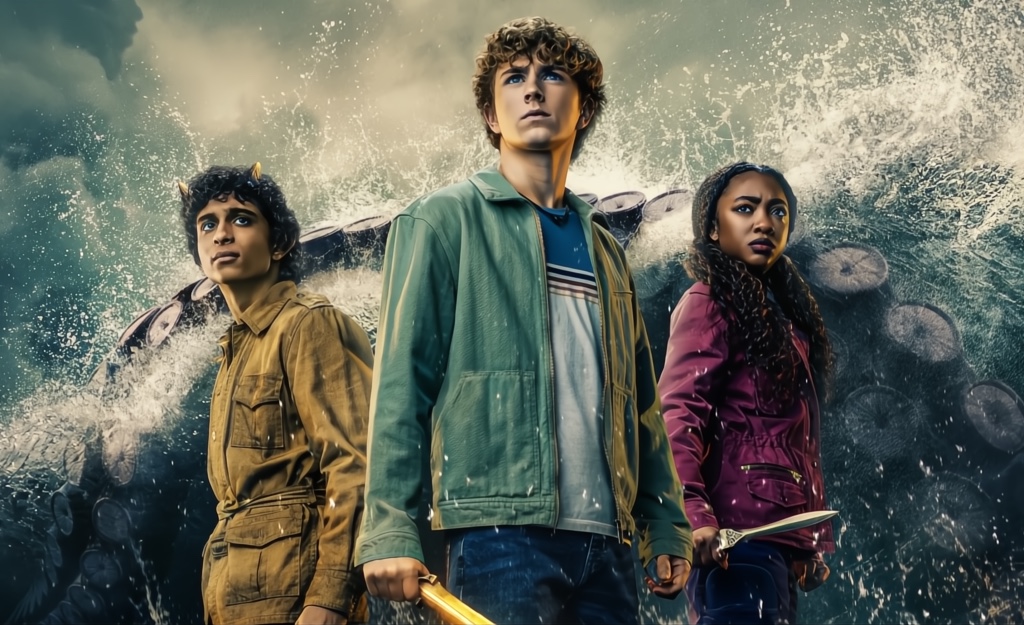
Season 1 of Percy Jackson and the Olympians reminds us that quests are the backbone of this universe. Percy’s call to adventure arrives courtesy of Zeus, who accuses him of stealing the master bolt. To avoid a divine war that would turn the planet into a celestial demolition derby, Percy sets off on a cross-country journey with Annabeth Chase and Grover Underwood. Grover, of course, is Percy’s best friend and anxious satyr protector who just wants to prove himself to the Council of Cloven Elders. Annabeth, on the other hand, is a daughter of Athena whose whole vibe is basically: I was raised on strategy, I do not have time for foolishness, and you will respect my dagger skills.
One of my favorite tweaks the show makes from the books is letting Percy choose his quest companions. It’s a subtle but meaningful way to give the kid more agency, and it adds emotional weight when he tells Annabeth he picked her because the prophecy says a friend will betray him—and she’s not his friend yet. That’s the kind of heartfelt tween logic I live for. Season 1 lays the groundwork for their evolving dynamic, and Season 2 will no doubt push them deeper into that messy, wonderful half-blood camaraderie.
Annabeth’s parentage doesn’t loom as large in Season 1 as it will later, but the show quietly sets the stage. She’s a warrior-strategist hybrid, essentially a 12-year-old general with better hair than I ever had at that age. Athena doesn’t exactly do warm hugs, so Annabeth’s relationship with her mother exists mostly in absence. But The Sea of Monsters brings Athena into sharper focus, and the casting of Andra Day has me already lining up snacks for the inevitable divine showdown.
If there’s one god the movie adaptations absolutely butchered by omission, it’s Ares. Season 1 fixes that with a vengeance—literally. Ares manipulates Percy and the gang into fetching his shield from a trap-ridden amusement park, hands Percy a cursed backpack with the master bolt tucked inside, and later gets his butt handed to him in a beach duel that proves hydrokinesis is the most underrated superpower in teen fantasy television. Ares walks away humiliated, shirtless, and holding a grudge the size of Olympus. This man will absolutely be back in the narrative, probably sharpening his sword while listening to angry rock music.
Grover’s arc, meanwhile, sets up one of my favorite parts of the entire Percy Jackson mythos: his quest to find Pan. Season 1 ends with Grover finally getting his questing license, which is adorable and momentous in equal measure. In The Sea of Monsters, Grover’s dream becomes more than just a punchline about lost satyrs—it ties directly into survival, belief, and environmental symbolism. It also means Season 2 is about to get a whole lot weirder in the best possible way.
Speaking of missing demigods, Season 1 drops one of the biggest foundational lore bombs: Thalia Grace. We never see her breathing, talking, or smiting anything, because she’s currently a pine tree. Zeus transformed her at the last second to save her from death, turning her into the magical barrier that protects Camp Half-Blood. It’s one of the series’ most haunting backstories, and Season 2 will finally bring her into the narrative as an actual person instead of arboreal security system. Casting Tamara Smart is a win; Thalia’s presence is going to crack open Percy’s entire understanding of destiny and the Big Three lineage.
And then there’s Luke Castellan—the traitor with heartbreak in his eyes and daddy issues deeper than Tartarus. Season 1 reveals that Luke stole the bolt, manipulated Ares, and orchestrated most of the chaos under the orders of Kronos, the oldest villain in the Olympian family tree. Luke’s betrayal lands hard, especially because the show invests time into portraying him as Percy’s cool older-brother figure. When Luke tries to recruit Percy to Kronos’ rising revolution, the emotional punch lands like a celestial bronze sword to the gut. Luke escapes through a portal, but his shadow lingers over everything that comes next.
Kronos, though, is the real puppet master. His whispers haunt Percy’s dreams, his influence stirs the gods into chaos, and his tattered spectral figure in the finale is the kind of nightmare fuel that would have wrecked me at age 12. Kronos may not have a physical form yet, but Season 2 will continue unfolding his long-game strategy. Titans don’t just rise—they simmer, they manipulate, and they wait for the cracks in the divine armor.
All of this funnels directly into Percy Jackson and the Olympians Season 2, which adapts The Sea of Monsters with newly confirmed castings, upgraded stakes, and the return of that warm, book-faithful storytelling fans clung to in Season 1. If The Lightning Thief was a coming-of-age road trip, Sea of Monsters is a nautical fever dream involving killer whirlpools, toxic family dynamics, cyclops lore, and one very important Golden Fleece. Even if you know the story, the ride is absolutely worth it.
By the time the premiere sails onto Disney+ on December 10, you’ll want all of these narrative beats fresh in your mind—because Season 2 is where the world of Percy Jackson expands, deepens, and starts planting seeds for the long-term Titan arc.