
TL;DR: All That’s Left of You is a quietly devastating, generation-spanning family drama that transforms the history of Palestinian displacement into an intimate, deeply human experience. Cherien Dabis delivers a film that is emotionally relentless, politically clear-eyed, and formally restrained, using one family’s story to illustrate the lifelong domino effect of occupation. It’s not an easy watch, but it’s an essential one.
All That’s Left of You
All That’s Left of You is the kind of film that sneaks up on you quietly, sits down at the kitchen table, and then proceeds to dismantle your emotional infrastructure brick by brick. I watched it expecting an earnest historical drama. What I got instead was a generational gut punch that left me staring at the end credits the way you stare at your phone after bad news, hoping the numbers rearrange themselves into something less devastating.
This isn’t just another “important” movie about Palestine. It’s something far more dangerous and far more effective: an intimate family saga that makes the machinery of occupation feel claustrophobically domestic. The politics aren’t abstract. They’re in the walls, the food, the jokes, the silences between parents and children. By the time the film reaches its final stretch, I felt like I’d lived inside this family for decades, aging alongside them, accumulating grief the way they accumulate memories—some cherished, some unbearable, all impossible to fully let go of.
From its opening moments, Dabis makes her intentions crystal clear. This is a linear, generation-spanning narrative that begins in 1948 and stretches all the way to 2022, tracing the long shadow of the Nakba not as a single historical rupture, but as a slow, compounding series of consequences. The brilliance of the film lies in how it visualizes that domino effect. Every choice made under duress creates another pressure point for the next generation, another compromise, another moral injury that refuses to heal cleanly.
The first act, set in Jaffa in 1948, is almost deceptively serene. Sharif, played with heartbreaking restraint by Adam Bakri, is a man clinging to the idea that normalcy can be negotiated with violence if you just keep your head down long enough. His family lives comfortably, tending an orange grove, sending their children to school, reciting poetry at home when classrooms are shut down. There’s a tragic irony in how gentle these early scenes feel, because we, as viewers, know exactly what’s coming. The shelling, when it arrives, isn’t shocking because it’s loud. It’s shocking because it intrudes so brutally on the banality of domestic life, shrapnel tearing through a living room like history crashing a family dinner.
One of the most devastating moments in the film comes from something almost laughably small. Sharif promises his wife Munira that when this is all over, he’ll take her to the cinema. That’s it. That’s the dream. Not wealth, not escape, just a movie theater date. When that fantasy is obliterated almost immediately, it lands harder than any speech could. This is how Dabis works. She understands that hope doesn’t usually die screaming. It dies mid-sentence.
When Sharif is forced into a labor camp and his family is sent away “for their own safety,” the film refuses to dramatize the separation in melodramatic terms. There’s no swelling score begging for tears. Instead, there’s a suffocating sense of inevitability. This is how displacement happens. Not all at once, but through a series of coerced decisions that feel rational in isolation and catastrophic in hindsight.
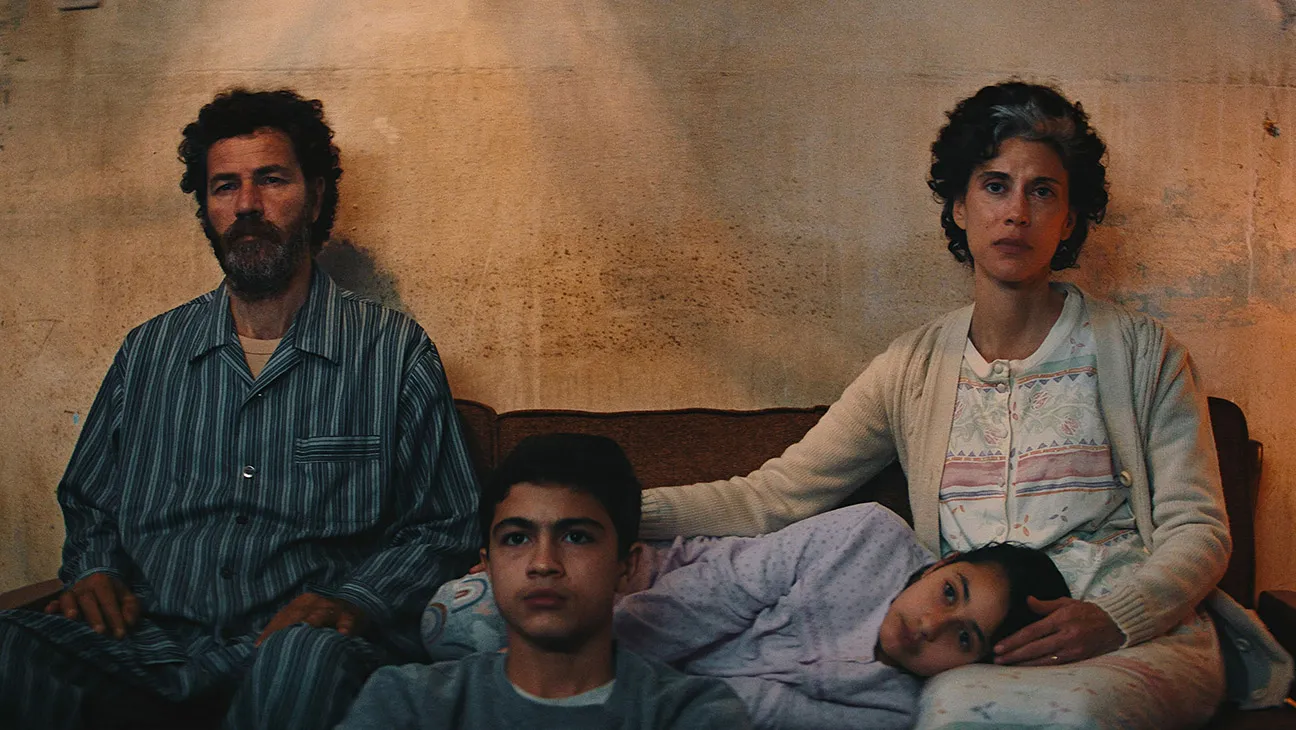
The second major chapter jumps forward roughly thirty years, and this is where All That’s Left of You really sinks its hooks in. Saleh Bakri takes over as Salim, now a schoolteacher living with his wife Hanan and their son Noor in a cramped apartment that feels like the architectural embodiment of compressed possibility. Gone are the orange groves and open spaces. In their place are narrow rooms, low ceilings, and a constant sense that life is being lived at half-volume to avoid attracting attention.
Mohammad Bakri’s performance as the aging Sharif is quietly monumental, made even more haunting by the actor’s real-life passing in late 2025. His Sharif is funny, irritable, sharp, and increasingly forgetful, cursing at the news and lamenting what he sees as the loss of his people’s fighting spirit. Memory loss becomes one of the film’s most potent metaphors. When a doctor suggests that forgetting might be a mercy, the film bristles with quiet fury. Forgetting is not relief. Forgetting is surrender by other means.
This middle section is the film’s philosophical core. Salim believes survival is a form of resistance. He wants peace, stability, a future where his son doesn’t inherit the same wounds he did. Noor, meanwhile, looks at his father with a mixture of shame and confusion, unable to reconcile gentleness with dignity under occupation. The generational tension here is painfully authentic. Dabis refuses to simplify the debate into right and wrong. Instead, she presents resistance as a spectrum, one that exacts a price at every point along it.
There’s a line delivered by an imam in the film that lodged itself in my brain and refused to leave: “Your humanity is also your resistance.” It’s a beautiful sentiment, and Dabis knows exactly how fragile it is. Humanity, in this context, requires constant negotiation. It asks parents to make impossible choices, to weigh moral purity against the survival of their children. When a tragic incident forces Salim and Hanan into a decision that would fracture lesser films, Dabis handles it with devastating restraint. No grandstanding. No easy absolution. Just the sickening awareness that every option costs something you can never fully get back.
What struck me most is how personal the film feels without ever losing sight of its collective weight. These characters are individuals, richly drawn and deeply specific, but they also function as vessels for a broader historical truth. The occupation isn’t just something that happens to them. It reshapes their interior lives. It dictates how they love, how they argue, how they parent, and how they imagine the future.
Formally, the film is restrained but gorgeous. The cinematography favors natural light and lived-in textures, making each era feel tactile without calling attention to itself. There’s a confidence here that comes from Dabis trusting her story. She doesn’t need stylistic fireworks to sell the tragedy. The tragedy is already baked into the timeline.
Some critics may bristle at the film’s directness, particularly in its early moments when an elderly Hanan addresses the camera and acknowledges the audience’s ignorance. I didn’t. In a media landscape that actively erases Palestinian history or flattens it into soundbites, clarity is not a flaw. It’s a necessity. All That’s Left of You understands that education and emotion are not mutually exclusive. In fact, they’re stronger together.
By the time the film reaches its final act, spanning into the 21st century, the accumulated weight of everything we’ve witnessed becomes almost unbearable. This isn’t misery porn. It’s something far more unsettling: a portrait of endurance that refuses to romanticize suffering while still honoring the people who endure it. When the film ends, it doesn’t offer closure so much as recognition. These lives mattered. These memories matter. That insistence feels radical in a world that keeps asking Palestinians to justify their existence in footnotes.
As Jordan’s shortlisted entry for the 2026 Academy Awards, All That’s Left of You stands alongside a wave of films reckoning with Palestinian history from wildly different angles. What sets it apart is its refusal to fragment that history. This is not a snapshot or a parable. It’s a continuum, and by laying it out so patiently, Dabis makes the cost of occupation impossible to ignore.
I didn’t leave this film feeling inspired in the traditional sense. I left feeling accountable. Accountable to remember, to listen, and to resist the easy narratives that make other people’s suffering feel distant or abstract. If cinema is a machine for empathy, All That’s Left of You is one of the most devastatingly efficient examples I’ve seen in years.