
TL;DR: A Knight of the Seven Kingdoms opens not with fire and blood, but with mud, memory, and a man just trying to prove he belongs. By focusing on the life of a hedge knight and the quiet economics of survival in Westeros, the premiere delivers a refreshingly grounded, character-driven story that feels unlike anything else in the franchise, and that’s exactly why it works.
A Knight of the Seven Kingdoms
The first thing that hit me when the premiere of A Knight of the Seven Kingdoms rolled its opening minutes wasn’t excitement in the traditional Game of Thrones sense. There were no ominous horns, no dragon silhouettes blotting out the sun, no whispered prophecies about ice, fire, or apocalyptic destiny. Instead, I was watching a tall, awkward man dig a grave in the rain, muttering a eulogy that felt more like a conversation with himself than a heroic send-off. And somewhere between that muddy hole in the ground and the quiet clink of armor straps, it clicked. This wasn’t Westeros the franchise. This was Westeros the place.
I’ve lived in this universe for over a decade now, from the early glory days of Game of Thrones to the operatic blood-and-dragon politics of House of the Dragon. I know its rhythms. I know how power corrupts, how bloodlines rot, how the Iron Throne chews people up and spits out corpses. What I didn’t know, and what A Knight of the Seven Kingdoms immediately understands, is how little all of that matters to the vast majority of people scraping by under those banners.
Set roughly ninety years before Thrones and decades after the Targaryen civil war, the series adapts George R. R. Martin’s Dunk and Egg novellas with a confidence that feels almost rebellious for modern prestige TV. This premiere doesn’t chase spectacle. It doesn’t rush to remind you what franchise you’re watching. Instead, it plants its feet firmly in the mud and asks you to care about a hedge knight with three horses, a borrowed title, and absolutely no safety net.
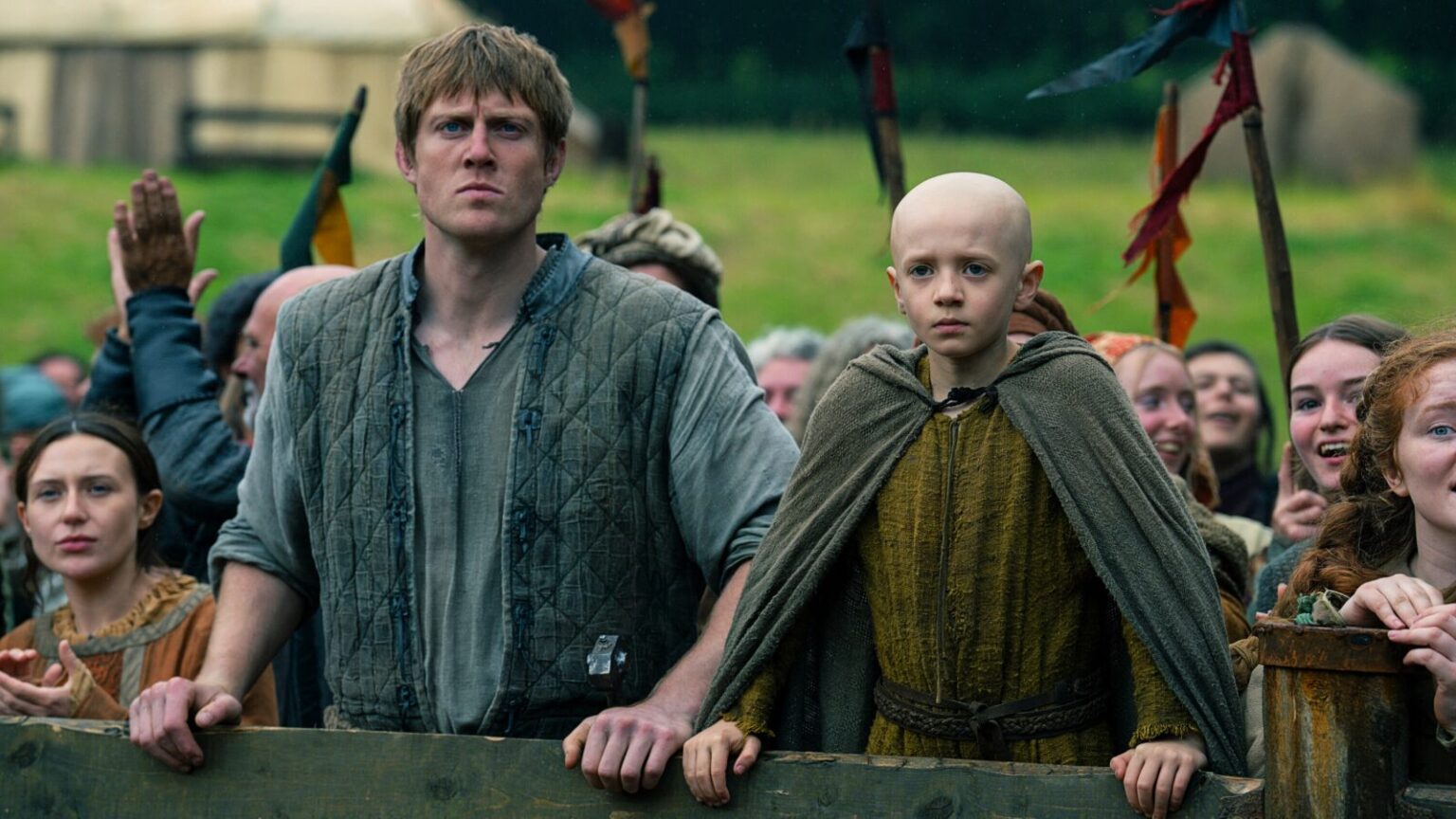
That knight is Ser Duncan the Tall, better known as Dunk, played by Peter Claffey with a performance that feels deliberately unpolished. Dunk isn’t smooth. He isn’t eloquent. He doesn’t deliver monologues that sound like they were written for a Shakespearean stage. He fumbles his words, second-guesses himself out loud, and looks perpetually terrified that someone is going to call him out as a fraud. Watching him bury Ser Arlan of Pennytree, the man who raised him and taught him what little he knows of knighthood, feels intimate in a way this universe rarely allows itself. Dunk’s grief isn’t operatic. It’s practical. Who am I now that the one person vouching for me is dead? What happens when the world asks for proof I can’t provide?
This is where the premiere quietly does something radical. It frames knighthood not as a glamorous ideal, but as a precarious gig economy job. Dunk talks through his options like someone staring at a dwindling bank account. Maybe Lannisport. Maybe the City Watch in King’s Landing. Maybe a tourney, if the gods are kind and the armor holds. It’s a far cry from watching nobles scheme over inheritance lines, and that contrast is the point. This is the underside of Westerosi chivalry, the part that smells like wet leather and desperation.
When Dunk stops at an inn and crosses paths with a mouthy stable boy who tries on his helmet like it’s a joke, the tone sharpens. Dexter Sol Ansell’s Egg is all confidence and curiosity, the kind of kid who hasn’t yet learned to fear consequences. Their first exchange crackles with the kind of chemistry that doesn’t need exposition. Egg clocks Dunk immediately, poking holes in his knightly presentation with the casual cruelty of youth. Dunk, for his part, is flustered and defensive, like someone who’s still rehearsing a role he hopes no one asks him to perform.
By the time Dunk rides into Ashford Meadow, the episode has firmly established its thesis. This isn’t a story about changing the fate of the realm. It’s about surviving the week. The tourney grounds are bustling, colorful, and quietly intimidating. Knights spar with casual skill. Banners flutter with histories Dunk only half-remembers. When the master of games, Plummer, asks for proof of knighthood, Dunk’s lie about being knighted on a deathbed suddenly feels very fragile. His entire future hinges on whether someone remembers a man who died quietly on the road.
That anxiety is the engine of the episode. Dunk needs a knight to vouch for him, but recognition is currency, and hedge knights rarely have enough of it. His attempts to reach Manfred Dondarrion land with a thud that’s painfully familiar to anyone who’s ever been told to wait outside the room where decisions are made. Even when he explains himself to a group of camp women, the teasing carries a bitter edge. They’ve seen men like him before. They know how this story usually ends.
What struck me most during these sequences is how refreshingly small the stakes feel without ever becoming boring. Dunk worries about ransom money for his horse and armor. He plans to win his first match so he can afford to lose the second. This is Westeros viewed through a balance sheet, and it’s fascinating. The franchise has never lingered on the economics of heroism before, and the premiere leans into that perspective hard.
The episode’s middle stretch, wandering through the tourney camp, is pure world-building candy. A dragon puppet belching fire becomes a reminder that myth still matters, even when the real creatures are long gone. A brief flirtation hints at the life Dunk might have if survival weren’t his only priority. And then there’s Lyonel Baratheon, the Laughing Storm, played with booming charm by Daniel Ings. His tent feels like a pressure valve release, a reminder that joy still exists in this world, even if it’s loud, drunken, and fleeting.
Dunk’s interaction with Lyonel perfectly encapsulates why this premiere works. When asked what gift he brings, Dunk panics, then admits he’s just there for the food. It’s honest to the point of absurdity, and Lyonel loves him for it. For a moment, Dunk is seen. Not as a joke. Not as an inconvenience. Just as a very tall man trying to get by. It’s a small victory, but in a story like this, it matters.
The emotional low point comes when Dunk finally speaks to Manfred Dondarrion, only to realize that Ser Arlan’s sacrifices barely register. The wound he took in service is forgotten. The name means nothing. It’s devastating, and it lands harder than any beheading ever did on Thrones because it’s so mundane. This is the reality of service without legacy. You bleed, you break, and when you’re gone, the world moves on.
By the time Dunk returns to his camp and finds Egg waiting for him like a stubborn stray cat, the premiere has earned its quiet heart. Their final conversation under the stars is simple, almost gentle. Dunk admits who he is. Egg accepts it without judgment. A shooting star streaks overhead, and for once, optimism doesn’t feel naïve. It feels earned.
What A Knight of the Seven Kingdoms does in this first episode is reframe heroism. It strips away destiny and lineage and replaces them with effort, decency, and a willingness to keep going when no one is watching. Dunk isn’t special because of prophecy or blood. He’s special because he tries. In a franchise built on grandiosity, that humility feels revolutionary.
As a longtime fan, I didn’t realize how badly I needed a Westeros story that breathes at a human scale until I watched this premiere. It’s slower, quieter, and more contemplative than its predecessors, but it’s also warmer. There’s humor here. There’s awkwardness. There’s a sense that the road itself is the point, not the throne at the end of it.