
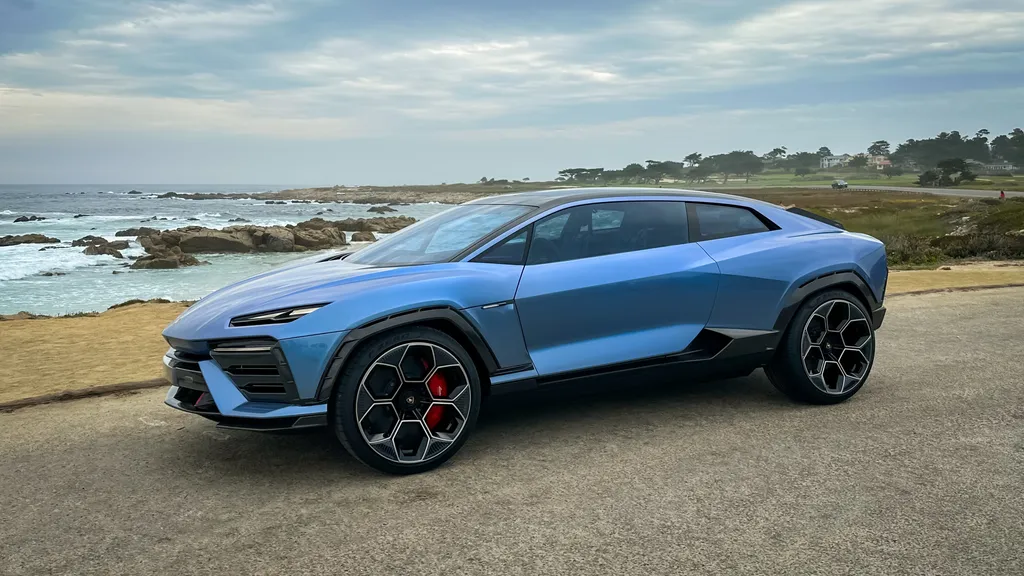
Lamborghini’s electric car era has been postponed before it properly began. The company has cancelled its first planned EV, the Lanzador, after determining that demand for a fully electric Lamborghini was, in the words of its leadership, effectively nonexistent. The model, first revealed as a concept in 2023 and pencilled in for a 2028 launch, will no longer arrive as a battery-electric vehicle. Instead, Lamborghini now intends to release a plug-in hybrid version around 2029.
In other words, the Lamborghini EV experiment ran into a fairly simple problem: Lamborghini buyers did not want one.
The Lanzador concept was introduced as a high-riding, four-seat SUV-coupe with dramatic styling and promised outputs of up to 1,300 horsepower from a dual-motor electric setup. On paper, it ticked the necessary boxes for a modern performance EV: extreme power, futuristic design, and enough torque to rotate the Earth slightly off its axis. But as impressive as those numbers sounded, they did not answer a more fundamental question. What does a Lamborghini feel like when it doesn’t make any noise?
For a brand built on theatrical V10s and V12s, silence was always going to be a hard sell. Even with artificial sound systems and advanced torque vectoring, the absence of combustion drama changes the character of the car. And for customers spending six or seven figures, character matters more than charging speed.
This shift is part of a broader pattern across the high-performance sector. Porsche has faced financial pressure linked to cooling EV demand in some markets. Bentley has delayed its full transition to electric power. Maserati recently cancelled plans for an electric version of its MC-branded supercar. Rimac, a company known for building some of the fastest electric hypercars on the planet, has acknowledged that selling ultra-expensive EVs is not as straightforward as early enthusiasm suggested.
Lamborghini’s response is not to abandon electrification entirely, but to moderate it. The company is already moving toward a fully hybrid lineup by the end of the decade. Models such as the Revuelto and Temerario combine combustion engines with electric assistance, offering lower emissions without removing the mechanical soundtrack. The Urus SUV will also continue in hybrid form, and a production car inspired by the Lanzador will now follow that template instead of going fully electric.
One brand still pressing ahead is Ferrari, which plans to unveil its all-electric Luce. It promises four seats, more than 1,000 horsepower, and a carefully engineered sound experience designed to compensate for the lack of cylinders. Whether that formula proves persuasive remains to be seen.
The cancellation of the Lamborghini Lanzador EV highlights a broader reality in the electric supercar market. While everyday EVs continue to gain traction thanks to practicality and range improvements, the ultra-luxury performance segment operates on emotion as much as technology. For many buyers, the sound of an engine is not a side feature. It is the product.
For now, Lamborghini appears to have concluded that a hybrid supercar is a more credible bridge between tightening emissions rules and customer expectations. The electric Lamborghini may still happen one day. It just turns out that even in 2026, some revolutions need a bit more noise.