


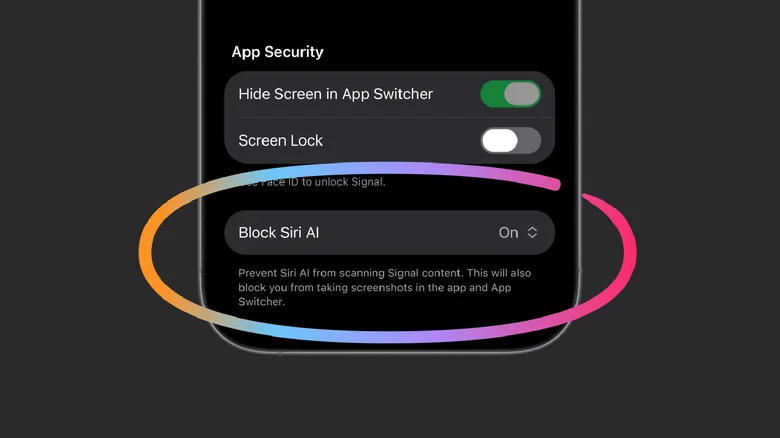

Signal is now treating the AI assistants built into phones as a threat to its users, and it’s turning off screen capture by default to keep them out. The encrypted messenger announced on Friday that it will block screenshots by default on iOS 27. On Android, it will block the screen whenever an AI assistant tries to capture it. Signal describes on-device AI agents as an existential threat to private messaging.
The reasoning makes sense. Assistants such as Apple’s Siri AI and Google’s Gemini Intelligence work by reading what’s on your display so they can answer questions with context. Signal’s encryption protects messages while they travel between phones. But once an assistant reads a decrypted chat off your screen, that content can end up on a remote server that neither you nor Signal controls. The encryption stays intact, and the AI simply reads the conversation after it’s been decrypted.
The two platforms handle it differently. iPhone users get a new “Block Siri AI” toggle that’s on by default. Android users get the same protection through Signal’s existing Screen security setting. On both, Signal shows a prompt when it detects a screenshot on iOS, or an AI assistant reading the screen on Android, and offers to turn the protection off if you actually want that.
This isn’t Signal’s first fight with operating system makers over AI. Last year it blocked Microsoft’s Recall from taking snapshots of chats on Windows 11. Third-party agents are a problem too. A Reuters investigation found that Meta’s Muse assistant could read Signal messages using permissions users granted during setup. On Android it pulled them from notifications, and on Mac it used accessibility permissions, which Signal warns can work like a skeleton key into other apps.
The limits are significant, and Signal doesn’t hide them. Your protection only covers your own device. If the person you’re chatting with has switched it off, their assistant can still read the whole conversation. Agents that read notifications or dig through stored files get around the screen block entirely. On Mac, Signal currently has no user-facing protection at all. The company says operating systems don’t give developers a way to restrict AI access without breaking core features.
That’s the real problem. Apple, Google and Microsoft are building AI deeper into their operating systems, and app developers have few ways to opt out. Signal is asking for a standard, system-level way for apps to block AI agents from reading their content. It says talks with Apple and Google are ongoing and that it’s cautiously optimistic.
If Apple and Google do build an opt-out, it could become a standard tool for banking, healthcare and other apps that handle sensitive data. If they don’t, other privacy-focused apps will likely have to rely on workarounds like Signal’s screenshot block.