


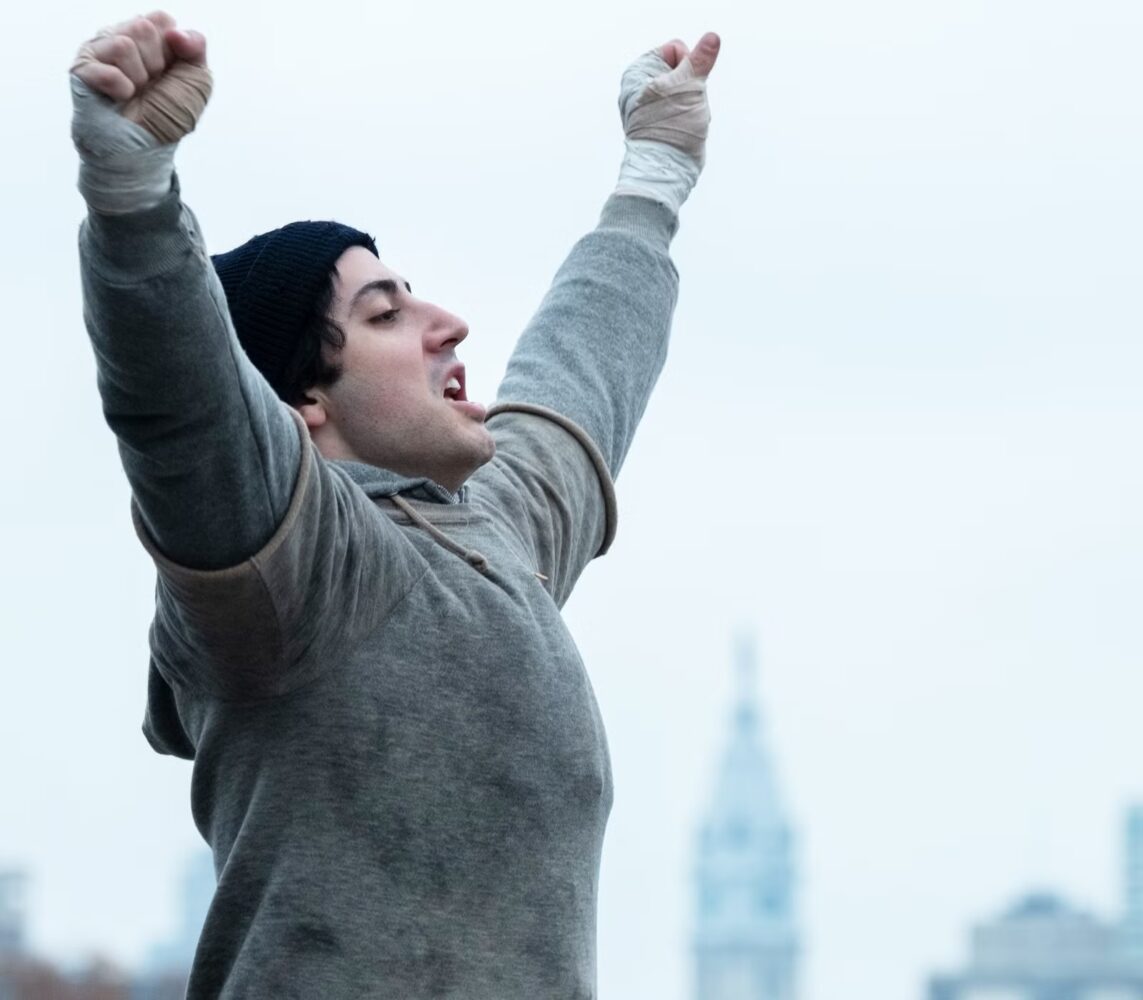

TL;DR: Peter Farrelly’s I Play Rocky is an affectionate, well-crafted look at Stallone’s gamble to star in his own script. It ends where it should, on the steps.
I’ve seen Rocky enough times that a photograph of Sylvester Stallone on the steps in Philadelphia comes with its own soundtrack. Somewhere in my head, Bill Conti’s brass starts up. I’d given considerably less thought to the legs of Garrett Brown, the man who had to climb those steps carrying a camera.
Peter Farrelly’s I Play Rocky gave me the pleasure of looking just outside a frame I thought I knew by heart. There’s a fellow up there in grey sweats having the moment of his life. A few feet away is an inventor finding out what his camera can do for an actor.
I went in knowing Stallone had held out for the lead. What I’d underestimated was how precisely he understood his value to the picture. Early on, Sly auditions for Thug #2, which tells you about as much as you need to know about the work available to a man with his face and voice.
Stallone could imagine what that thug did with the rest of his day. Maybe he kept dropping by a pet shop because he liked a girl and had thought of another joke she might enjoy. Those are the parts of Rocky I love, and Sly had a fair idea of how to play them before anybody offered him a cheque.
Anthony Ippolito makes that apparent in the scenes with Sasha Czack, played by AnnaSophia Robb. Listen to how much funnier Sly is around someone prepared to let him finish a thought. Robb gives him that extra beat, and suddenly the voice that costs him work at an audition has something close to comic timing. I could happily have spent longer with the two of them, particularly once Sasha begins to disappear into the margins of the production. She’s among the first people in the film to recognise what an audience might enjoy about this man. We get to make that discovery in her company.
That makes the negotiations over the screenplay surprisingly tense. Producers Irwin Winkler and Robert Chartoff see a picture worth making. Sly now has to convince them that some of what they liked on the page came from hearing himself play the scenes as he wrote them. How do you demonstrate that across a desk? Farrelly often keeps the camera on the people listening. I caught myself searching their faces for permission for Sly to keep going. For a few seconds, a film about one of the most famous casting decisions ever made had me worrying that he’d talked himself out of the job.
Once filming begins, cinematographer Sean Porter Campbell lets the composed frames of those early meetings give way to looser handheld camerawork. The set feels busy around Sly. Jay Duplass brings a welcome impatience to John G. Avildsen, who has a tight schedule and needs a take he can use. Watch what happens when they film Mickey’s visit to Rocky’s apartment. I know the hurt in Stallone’s voice in the original, when help finally comes from the man who could have offered it years ago. Ippolito has the extraordinary job of playing an actor who’s still trying to find that hurt. For the first time, you see exactly what Sly risked. He could win every argument in the office and still come up short when Avildsen calls action.
There’s real affection, too, in the way Campbell reconstructs the original photography. He studied frames of Rocky alongside an account of how it was shot, working backwards to figure out where the crew had placed its lights. For the recreations, he used period tungsten lamps. I love the intimacy of that exercise. One cinematographer looks at a shadow on a wall and tries to understand a decision another cinematographer made fifty years ago. Getting the light right gives Ippolito room to do something harder. Inside an image the audience already recognises, he has to let a performance feel as though it’s happening for the first time.
Then there’s Brown’s Steadicam. Mount a camera on your shoulder and run up a flight of stone steps, and the audience will learn quite a bit about your stride. Brown’s rig carried a balanced camera on a spring-loaded arm attached to his vest, smoothing out the jolts while leaving him free to follow Stallone. The emotional effect of that invention is there every time you watch Rocky. You get to make the climb with him. By the time his arms go up, you’ve shared enough of the distance to feel some small claim on his exhilaration. Farrelly’s crew put Brown’s original rig back to work for the recreation. I like the thought of somebody opening that case and giving it another day on a Rocky picture.
My favourite detail concerns a decision made in the editing room. Farrelly has described watching a cut that included the fight and realising that, emotionally, his film had already peaked on those steps. Anyone who has laboured over a sequence will appreciate how hard it is to admit that the movie may have everything it needs a few minutes earlier. The decision makes sense because we’ve seen what it took to get this particular man in front of that particular camera. By the time Sly raises his arms, the question that brought us into the cinema has its answer.
That’s why I Play Rocky needs to be watched by everyone, especially those who love cinema. It understands how much self-knowledge went into Stallone’s gamble, and it has a filmmaker’s curiosity about what happened after somebody said yes.
I’ll watch that run again for the same reason I always have. There’s something about the sight of Rocky up there that makes me feel good on his behalf.