

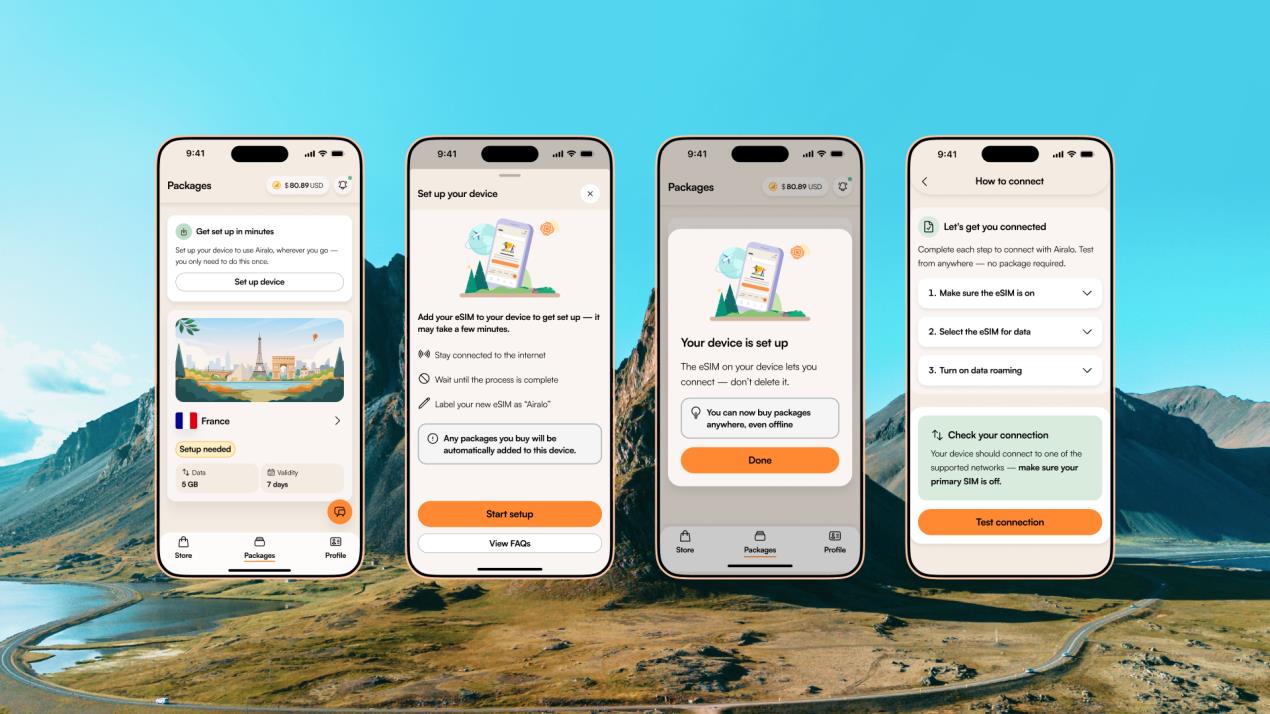
Anyone who has used a travel eSIM knows the routine: buy a plan for the next country, scan a QR code or tap through an install, then remember to switch your phone’s data line once you land. Airalo, which says it has more than 30 million customers, wants to remove that step by moving users onto a single eSIM that stays on the device for good.
Rather than issuing a fresh eSIM for each destination, the company will keep one profile installed and let travellers buy data packages onto it as they go. Airalo says this depends on its own core network, which gives it more direct control over how connections are managed instead of relying entirely on the partner networks behind each regional plan.
The change that could matter most in practice is that the Airalo app will keep working even after a data package runs out. The company says customers will be able to top up or buy a new plan without Wi-Fi or another active SIM. That deals with a familiar problem for travellers: landing with an expired plan and no way to get online to buy another one. Users will also be able to test the connection before leaving home, rather than finding out at arrivals whether it works.
Plans are being simplified as well. Airalo is offering unlimited packages of between one and 30 days in most destinations, alongside fixed 30-day plans and a 365-day global option. It has not published pricing for the new structure, which is what most buyers will care about.
The rollout started on 9 November and runs in phases for up to 12 months, so most customers won’t see the change soon. Until they are moved over, the current setup stays in place. Airalo hasn’t explained exactly how existing users will be migrated, or what happens to eSIM profiles already on their phones.
The timing is driven by a growing and increasingly crowded market. GSMA Intelligence expects eSIM smartphone connections to double between 2025 and 2026, and to reach 4.9 billion by 2030. Airalo, founded in 2019, calls itself the first and largest eSIM platform. That position is under pressure as rivals and conventional carriers push their own travel data offers, and as more phones drop the physical SIM tray entirely.
Building its own network infrastructure is how Airalo is trying to stay ahead: the company would become less of a reseller and more of an operator in its own right. That gives it more control, but it also means outages and quality problems will land on Airalo directly. Whether a single always-on eSIM actually performs better at a busy airport than the current approach won’t be clear until the rollout reaches more users.