

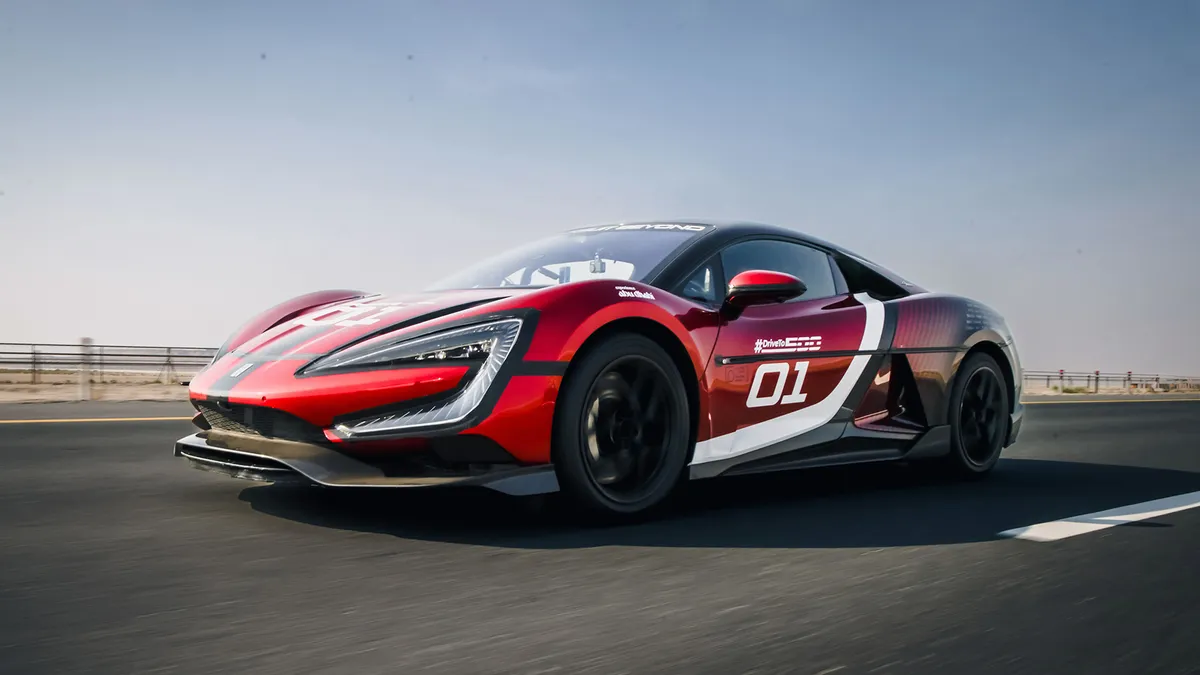
The fastest production car in the world is now electric, and it set the record on a road in the UAE. Yangwang, BYD’s luxury performance brand, says its U9 Xtreme reached 312.65 mph, or about 503 km/h, on a closed section of Abu Dhabi’s Sheikh Khalifa Bin Zayed International Road, better known locally as the E11. That makes it the first production car to pass 500 km/h. It also beats Yangwang’s own record of 308.4 mph, set in 2025.
Running a hypercar at that speed on a public road, even a closed one, presents challenges a test track doesn’t. The team had to clear sand from the surface to make sure the tyres had enough grip, a very local problem that most top-speed attempts never face. Using a public highway also gives the run more meaning than a record set on a private oval designed for the purpose.
The car is far more extreme than the standard U9. The Xtreme uses a 1,200-volt electrical architecture and four upgraded electric motors producing a combined 2,978 bhp. That’s more than double the regular U9’s 1,252 bhp, which was already substantial. For perspective, the Bugatti Veyron, once seen as the benchmark for hypercar excess, had roughly a third of that output.
There is one important caveat. Yangwang’s top speed came from a single run in one direction. Many speed records require an average from runs in opposite directions, which helps account for wind and gradient. A one-way run is still an impressive engineering achievement, but it isn’t the most strict way to measure a record, and critics will likely point that out. Bugatti and other petrol-powered rivals have faced similar questions about their own record claims, so Yangwang is not alone, but the issue still matters.
Production will be very limited. Yangwang plans to build just 30 examples of the U9 Xtreme for global sale and hasn’t announced a price. The standard U9, which is already sold in China and several other markets, costs around $200,000. That’s a relatively low price for a car with this level of performance. It also uses BYD’s DiSus-X active body control system, which can make the car jump off the ground.
The bigger story is how quickly the order has changed. Ten years ago, top-speed records were mostly fought over by European brands using large combustion engines. Now, a Chinese EV maker holds the title and continues to improve on its own record. The question now is whether established hypercar makers will respond with a properly verified two-way run, or whether this crown is now firmly in Yangwang’s hands.