

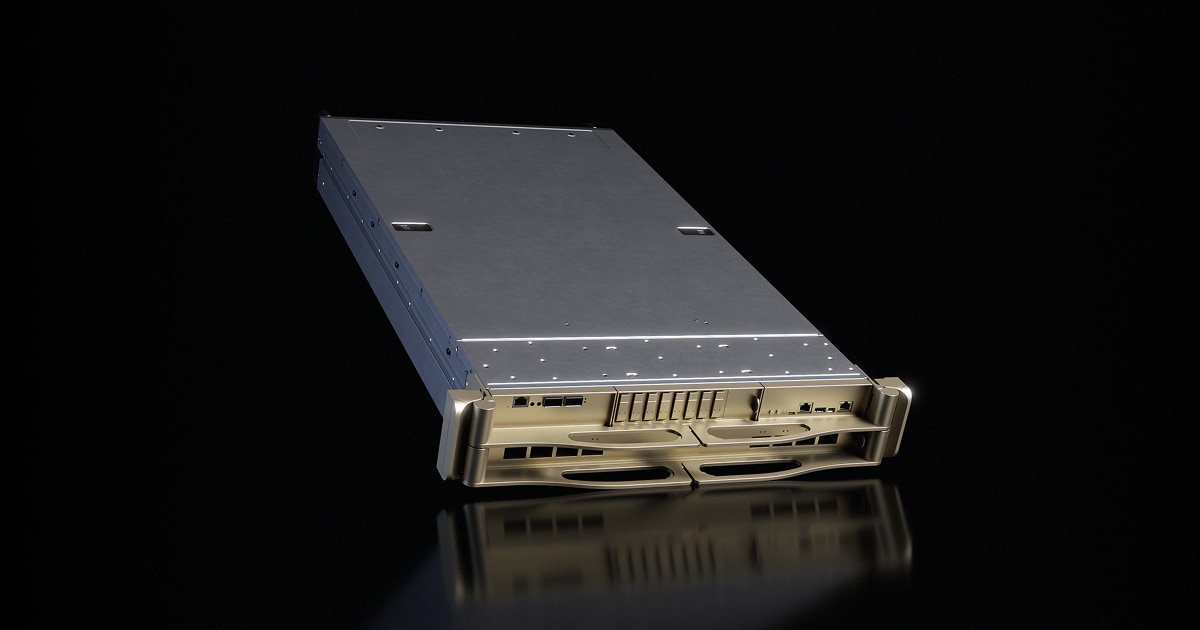
ASUS says its first servers built on NVIDIA’s HGX Rubin NVL8 platform are ready to ship this quarter. That puts the Taiwanese company among the hardware makers getting NVIDIA’s next-generation data center GPUs to customers as demand for AI infrastructure keeps climbing.
ASUS announced the systems at NVIDIA GTC Berlin 2026, in two versions built around different cooling setups. The XR R1I12B-M1BHFS is a 3U server with hybrid cooling. Its eight-GPU HGX Rubin baseboard is liquid-cooled directly at the chip, while its two Intel Xeon 6 processors stay air-cooled on a separate sled. ASUS says this layout can cut maintenance time by up to half, and the server takes either U.2 or E1.S storage.
The second model, the XR R1I12B-M1BLFS, goes further. It is fully liquid-cooled and fits into just 2U. That allows more computing power per rack and should help with power usage effectiveness (PUE), the measure of how much of a facility’s electricity actually reaches the computers. ASUS also points to a cable-less board-to-board design that it says makes installation simpler. Customers can order either model as a partial rack or a full rack.
The two models show where data center design is heading. Each new GPU generation draws more power, so air cooling on its own is struggling to keep up, and liquid cooling has moved from a specialist option to something operators now plan around from the start. Offering both a hybrid and a fully liquid-cooled system lets ASUS serve customers upgrading existing halls as well as those building new facilities.
ASUS is also offering to help with planning before any hardware arrives. It is using NVIDIA’s DSX Sim Blueprint to build digital twins, which are virtual models of an AI data center that cover compute, networking, storage, power, cooling and the building itself. Working with Schneider Electric, AVEVA and IBM, ASUS says customers can test configurations, find bottlenecks and adjust efficiency before committing money to a build. As AI factory projects run into hundreds of millions of dollars, simulating the whole facility first is becoming a serious selling point.
ASUS also brought products for smaller-scale work to the show. These include the Ascent GX10 and ExpertCenter Pro ET900N G3, both built on Grace Blackwell, along with the ProArt GR1X Mini PC and the ProArt P16 laptop for developers and creators.
ASUS has not released pricing and asks interested buyers to contact its regional sales teams. Rubin is now arriving in shipping hardware, so the next question is how quickly ASUS and its rivals can deliver it in volume, and how many data centers already have the cooling to run it.