

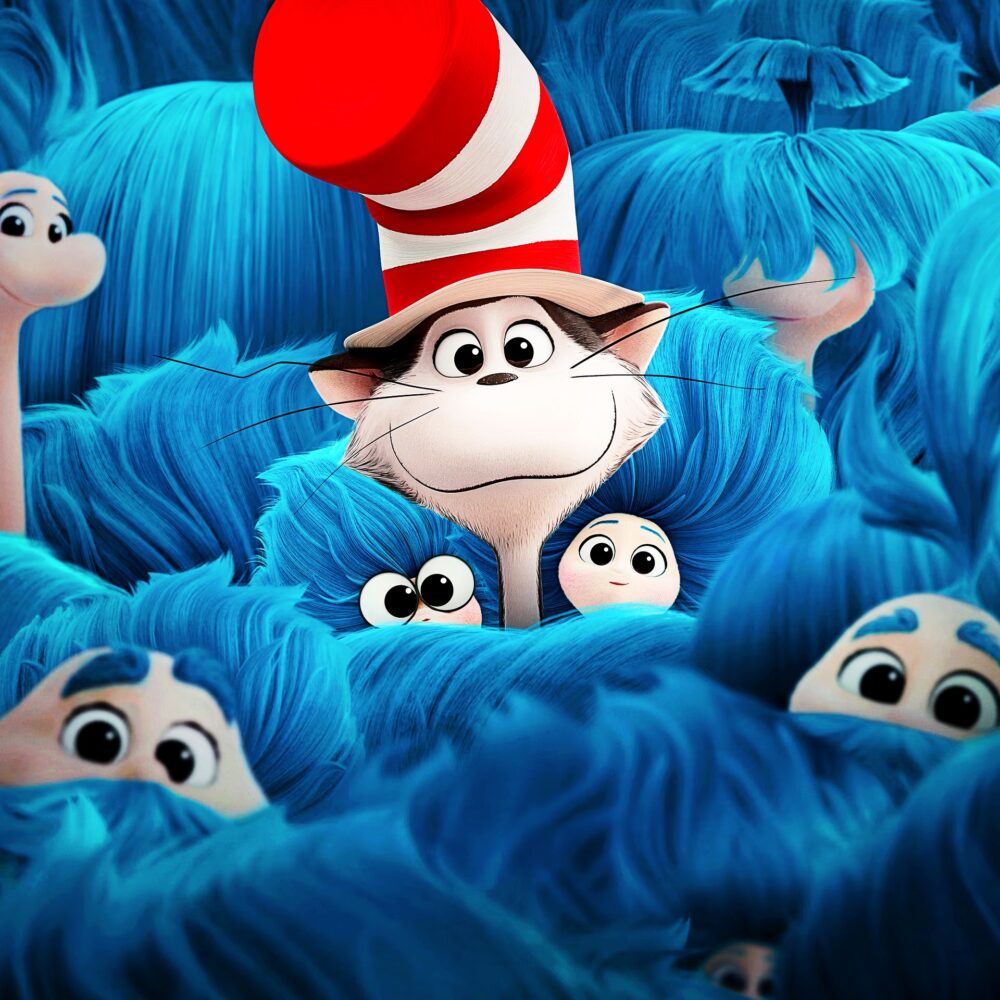
TL;DR: The Cat in the Hat review in brief: Bill Hader and a hilarious Matt Berry lead a colourful, clever Dr. Seuss reboot that easily beats the 2003 version, though too many subplots make its final stretch drag.
Warner Bros. is giving Dr. Seuss’s striped-hat menace a second big-screen shot, and this time the studio has traded live-action prosthetics for full animation. That alone feels like a mercy, because the 2003 Mike Myers version still lingers in the collective memory as a cautionary tale about what happens when a picture book gets the wrong kind of makeover. The new animated The Cat in the Hat, hitting cinemas on November 6, is a much more confident film. It knows the original book is far too slim to fill a feature, so it treats Seuss’s premise as a launchpad rather than a blueprint. The core idea survives: a fantastical Cat shows up uninvited to shake bored kids out of their gloom. Almost everything else is new, for better and for worse.
Writer-directors Erica Rivinoja and Alessandro Carloni bring an interesting mix of credits to the table. Rivinoja’s background includes South Park and Borat Subsequent Moviefilm, while Carloni worked on Kung Fu Panda 3, and you can feel both influences here. There’s a sly, slightly subversive comedic streak running underneath a polished family adventure. That combination gives the film more personality than I expected from a studio IP revival. It also, unfortunately, creates a script that keeps adding ideas long after it should have started tidying up.
Two distinct worlds give the animation real identity
The smartest creative choice in this Cat in the Hat movie is visual. The Cat’s home turf is a bright, wonky, gravity-optional realm where nothing quite sits at a right angle, which feels like Seuss’s illustrations stretched into three dimensions. It’s run like a workplace, with the Cat as an employee of an imagination-boosting operation whose staff recite the company rules in rhyme. That rhyming gag is a lovely nod to the source, and it’s voiced by a supporting cast including Giancarlo Esposito, Bowen Yang, and Quinta Brunson. Crucially, the film doesn’t linger in the office setting for too long. It uses the corporate framing as seasoning, not the main course.
Contrast that with the apartment where teenage Gabby (Xochitl Gomez) and her younger brother Sebastian (Tiago Martinez) are adjusting to a new city alongside their mom, Carmen (America Ferrera). Their world is rendered in more grounded, muted tones, giving the Cat’s arrival a genuine sense of colour bleeding into grey. It’s a simple visual storytelling trick, but it means the fantasy actually feels like an escape. When the story later dives into the family’s unopened moving boxes, which become sprawling worlds where toys, drawings, and household objects spring to life, the animation gets to really show off. Watching musical instruments and even flat-pack furniture instructions develop personalities is the kind of inventive silliness that reminded me why this property deserves animation in the first place.
Bill Hader and Matt Berry carry the comedy
Bill Hader voicing the Cat is the obvious selling point, and he justifies the casting. He brings his trademark quick-fire comic instincts and vocal agility, and he makes the Cat charming without tipping into grating. If I have one reservation, it’s that this Cat is more lovable coach than true troublemaker, so some of the character’s original edge has been filed down. Still, Hader keeps scenes moving, and his delivery sells jokes that might otherwise fall flat. Compared with Myers’ infamous take, it’s a night-and-day improvement.
The real scene-stealer, though, is Matt Berry as Waffles, the family goldfish who gains the power of speech courtesy of the Cat. Anyone who has watched What We Do in the Shadows knows Berry can make reading a grocery list sound like Shakespearean thunder, and pairing that booming voice with a tiny, furious fish is comedy gold. Every exasperated outburst works. Beyond the voice talent, the humour is consistently solid, mixing broad slapstick for younger viewers with layered gags that will hit parents a little harder. It’s not quite Pixar-level wit, but it lands often enough to keep adults engaged.
Too many side quests drag the third act
Here’s where the film stumbles. The plot hinges on the Cat bringing along a gadget that can rewind recent events, then promptly losing it, and that simple quest structure should have been enough. Instead the script piles on a creature called the Something hunting the heroes, the Cat’s job hanging by a thread after one too many screw-ups, and a nosy landlord voiced by Paula Pell who is looking for any excuse to evict the family. Each subplot is fine in isolation. Layered together, they feel like an RPG quest log that never stops filling up.
The film runs just under two hours, which is a long sit for this audience, and the third act is where you feel every minute. Energy dips noticeably as the story juggles its competing conflicts toward a resolution, and I found myself wishing someone had cut at least one storyline entirely. It’s a classic case of overcorrecting for thin source material. Seuss wrote a book you can read in ten minutes; the filmmakers seem determined to prove there’s a feature here, and they prove it a little too hard.
The Things are chaotic fun and blatant merch bait
Thing One and Thing Two, two of Seuss’s most iconic creations, get a major upgrade here into a whole horde of similar critters that the Cat unleashes on the apartment. Their scenes deliver pure, destructive mayhem with the energy of Rabbids let loose in a living room. They’re fun, kids will love them, and they’re easily some of the most memorable sequences. You can also practically hear the toy aisles being restocked. To its credit, the film is sharp enough to make a meta joke about that exact franchise ambition, which earns it a little goodwill.
Verdict
The Cat in the Hat is a big step up from the 2003 misfire and a genuinely funny, inventive animated movie when it’s firing on all cylinders. Its two-world visual design, its playful rhyming nods to Seuss, Bill Hader’s likeable Cat, and Matt Berry’s gloriously overdramatic goldfish give it real charm. The weaknesses are hard to ignore: too many overlapping subplots, a runtime that stretches thin, and a third act that sags noticeably. Families with young kids will find plenty to enjoy, and parents will get more laughs than expected. Seuss purists may still miss the book’s simple anarchy, but this is a warm, clever adaptation worth catching in cinemas.