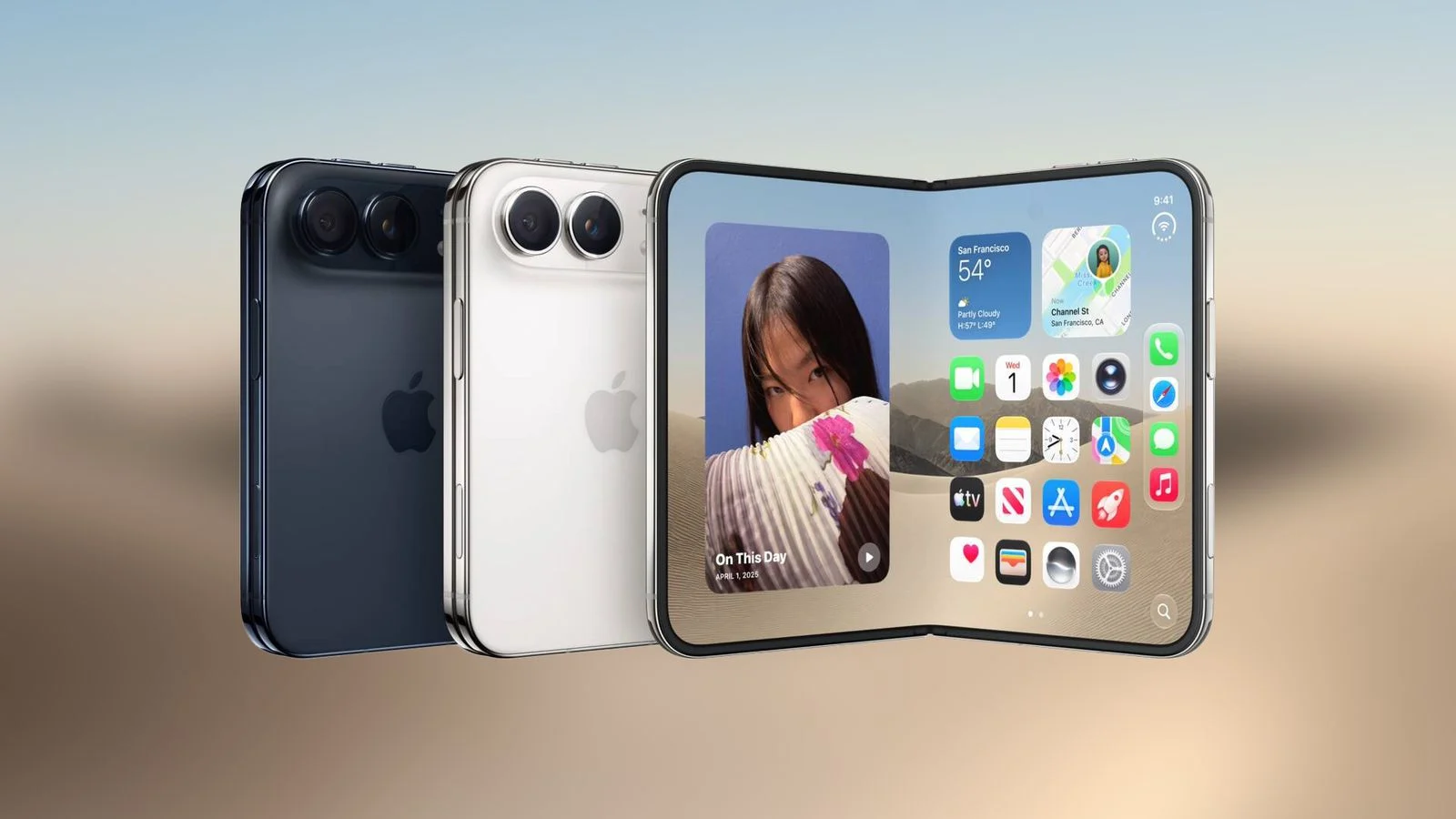
Apple’s first foldable iPhone carries a bigger battery than many expected, and the way the company fit it inside says a lot about the compromises behind folding hardware. A regulatory filing Apple submitted in the European Union lists the iPhone Duo’s total capacity at 4,883mAh, split across two separate cells rather than the single pack used in every other iPhone.
The larger cell is rated at 2,962mAh and the smaller at 1,921mAh, with one in each half of the device. This is new for an iPhone, but it is standard practice for book-style foldables. A hinge running down the middle leaves no room for one continuous battery, so manufacturers spread capacity across both panels. Placing the cells this way also helps balance weight, which matters on a phone that opens like a paperback.
On paper, the numbers put the iPhone Duo in a respectable position. It beats the iPhone 18 Pro on raw capacity while falling short of the iPhone 18 Pro Max. Against other foldables it also holds up well. Samsung’s Galaxy Z Fold 8 Ultra reaches 5,000mAh, but it does so with silicon-carbon anode cells, a chemistry that stores more energy in the same space. Google’s current foldable sits slightly below Apple at 4,806mAh. If Apple is still using conventional lithium-ion cells here, getting this close to Samsung is a reasonable packaging result.
Capacity alone does not tell you how long a phone lasts, though. The iPhone Duo has a 7.6-inch inner display, and powering a tablet-sized panel uses far more energy than a standard phone screen. People who stay mostly on the smaller cover display will probably get much better endurance than those who unfold the phone for video, reading or multitasking. Apple has not published detailed runtime figures, so the gap between this and the non-folding Pro models will not be clear until the phone has been tested independently.
Charging may make up for some of that uncertainty. Apple says the Duo can go from empty to 50% in about 20 minutes with a compatible 60W adapter. A compatible MagSafe charger reportedly reaches the same point in around 30 minutes, slightly slower than the iPhone 18 Pro manages wirelessly. For a device that is likely to drain faster when used heavily, quick top-ups could matter more than the size of the battery.