
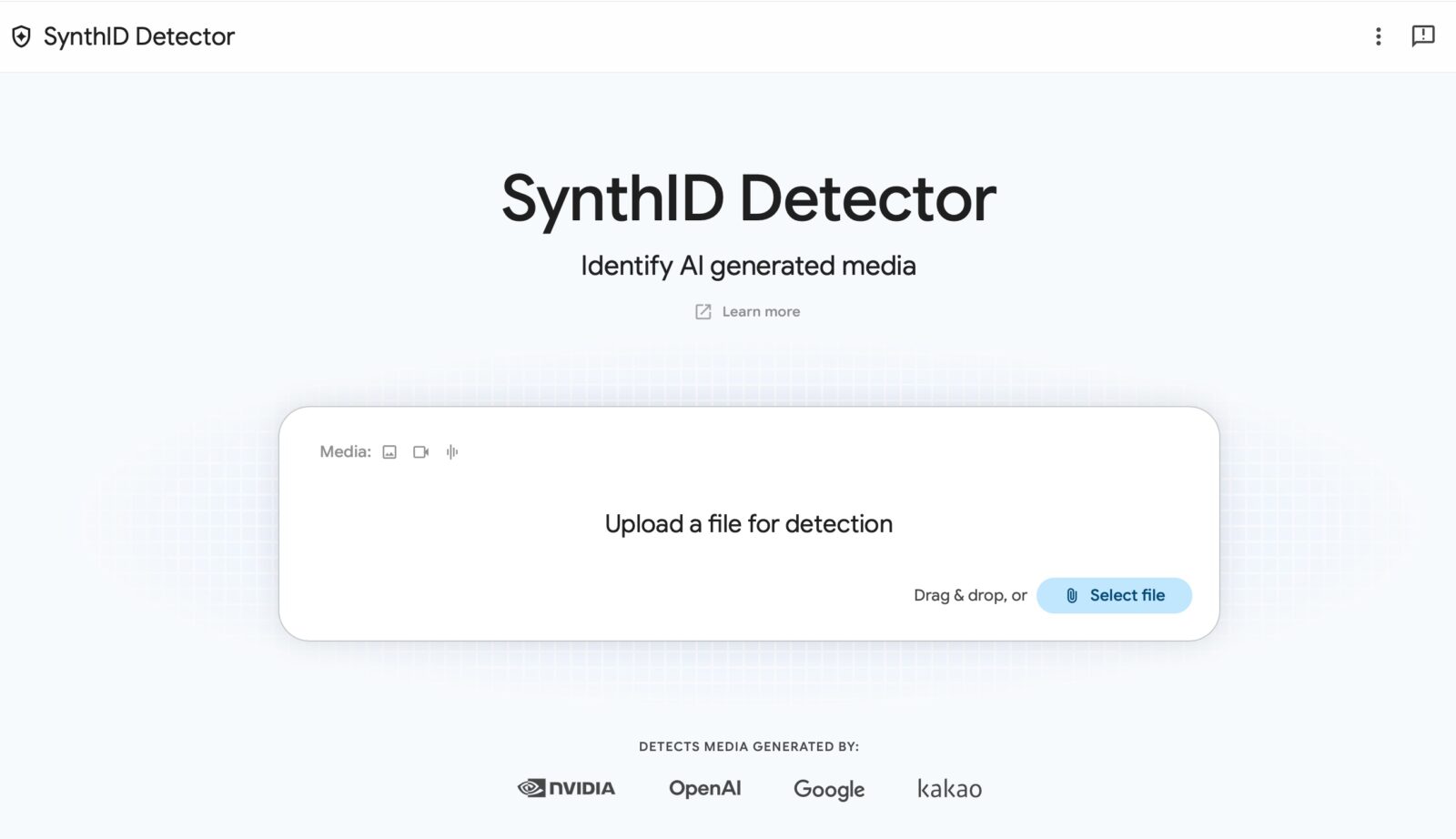
Spotting AI-generated media has turned into a guessing game, and the clues people relied on are mostly gone. Mangled hands, warped text and glassy-eyed faces have largely disappeared as image and video models have improved. Google is now offering a more systematic answer. SynthID Detector, its tool for checking whether a file carries an invisible AI watermark, is open to the public at synthid.com, after a long stretch where access was limited to journalists.
The idea behind SynthID has been around since Google DeepMind introduced it in 2023. Instead of slapping a visible label on generated content, the system embeds an imperceptible signal inside the image, video or audio itself. That signal is meant to survive the cropping, compression and screenshotting that would strip ordinary metadata. Google could already read these markers inside Circle to Search and the Gemini app, along with C2PA content credentials, but those features kept detection inside Google’s own products. The standalone website brings it to anyone with a browser.
Coverage is broader than the name suggests. Besides Google’s own models, the detector recognises watermarked output from OpenAI, NVIDIA and Kakao. Support for images created or edited with Apple Intelligence tools such as Image Playground is coming soon. ElevenLabs has also committed to adopting SynthID in its synthetic audio, which matters given how convincing voice cloning has become. Checks are free, but you’ll need to sign in with a Google, OpenAI or Apple account first.
The limitation is built into the approach. A watermark detector can only find watermarks that are there. Content from models that don’t use SynthID, open-source generators running on someone’s own machine, or files where the marker has been deliberately stripped will all pass as clean. A negative result proves nothing, and anyone treating this as a universal lie detector will be misled.
The tool is also vague about what it actually finds. It doesn’t separate a fully synthetic image from a real photo that had a background tweaked by AI, and it doesn’t point out which parts of a file were altered. For fact-checkers, that difference is often the entire story.
Meta’s own experimental checker shows how fragmented the field still is. It identifies images from Meta’s latest Muse Image models but can’t read output from rivals or even from Meta’s older models. Verifying a suspicious clip could easily mean running it through several tools from competing companies.
Google deserves credit for opening the doors and bringing rivals into its scheme. Still, real progress depends less on any single detector and more on whether the industry settles on one watermarking standard before synthetic media outruns everyone’s ability to check it.