
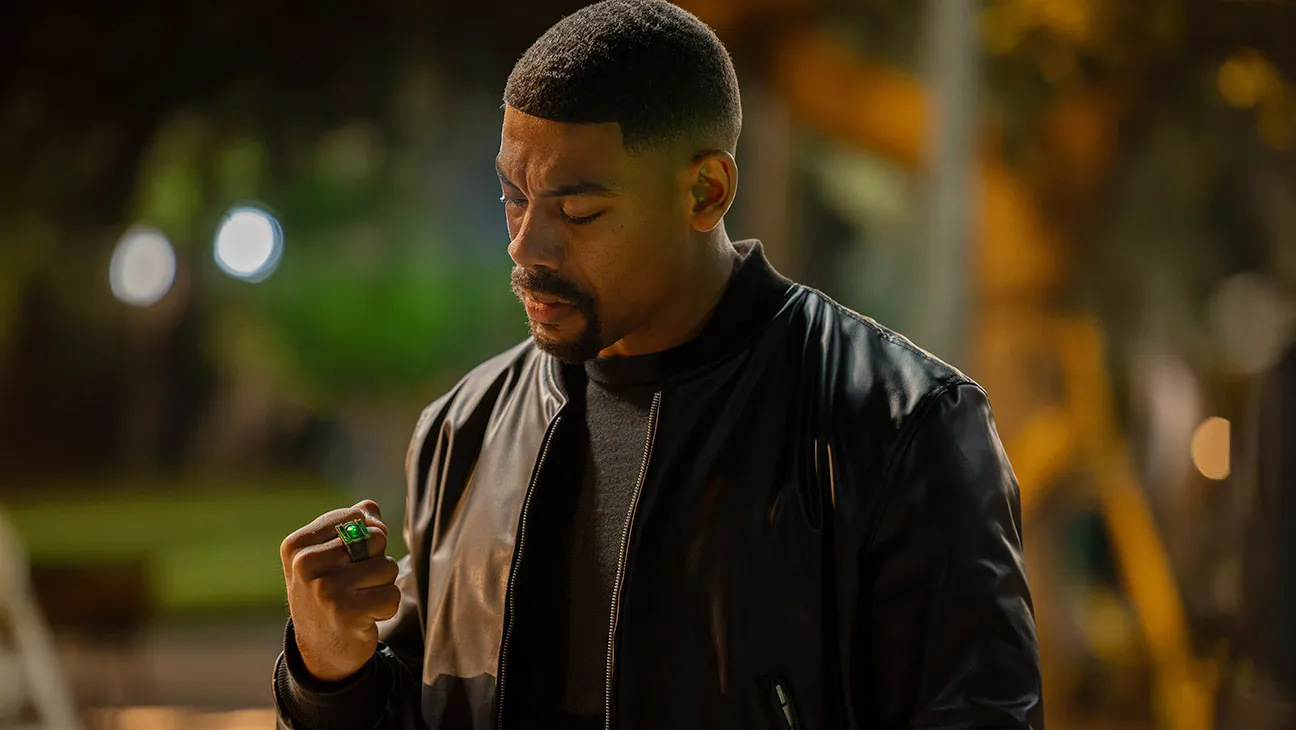
The two Green Lanterns sat down to talk about the finale, and what came out wasn’t really about rings, aliens or a bullet in Hal Jordan’s head. It was about trust, a lot of feelings, and two actors still a little choked up about it.
Here’s the thing nobody expected from HBO’s big DC cop-show-in-space: it turned out to be a love story. Not the romantic kind. The “two stubborn men slowly learn to say what they mean” kind. And by the time Hal and John finally say “I love you” in the finale, the show has earned every bit of it.
Kyle Chandler (Hal Jordan) and Aaron Pierre (John Stewart) joined a press conference moderated by The Ringer’s Mallory Rubin the day after the finale dropped. Pierre was openly emotional. Chandler admitted to a tear. Nobody tried to sell us a season two. Honestly? Refreshing.
A love story, actually
Pierre says the Hal and John dynamic only worked because both actors got vulnerable fast. The shoot ran around 116 days, with 12- to 14-plus-hour days, and if the central pairing fell flat, he says, “we were going to be in a lot of trouble.”
The two couldn’t be more different on paper, and Pierre thinks that was deliberate casting. Different countries, different upbringings, different journeys. What they found instead was “far more in common than anything else”, and a friendship he calls “a brotherhood that is not a given in these situations.”
Then he went somewhere most actors don’t on a press junket. He spent a solid chunk of his answer shouting out the crew: catering, transport, wardrobe, lighting, sound. “There is a village behind us,” he said, adding he hopes they’re at home feeling proud. It reads less like PR and more like a man still processing a wrap party.
Chandler kept it shorter, and hit harder. Watching the last scene that morning felt, he said, like winning a state championship (a very Coach Taylor comparison, we’ll allow it). He also brought up something personal: he lost his father at 14. Playing the mentor half of the Hal and John bond meant he “was able to do what my father would have done for me.” Try reading that without your eyes getting a bit Green Lantern-glowy.
Two Hals, one heart
Chandler played a lot of Hals this season: the 2016 version, the 2026 version, a younger Green Lantern in old newsreel footage, and the Halogram, the snarky holographic Hal who hangs around John. That’s a career arc squeezed into eight episodes.
His take on how they connect is surprisingly neat. The Halogram is Hal’s subconscious, so the two were “never fully separated.” Real Hal spent his life going through the experiences but “could never pluck that string.” The Halogram learned alongside him, and in the end, could.
He pointed to the finale moment where Hal asks what the last thing Kerry said to him was, John answers, and Hal says “I love you too.” For Chandler, that line “sums up Hal. It sums up Halogram.” He also credits the writers for keeping the show’s moral core from getting preachy: “It could get very over the top, but they never allowed it to.”
Building John Stewart backwards
Pierre doesn’t do half-measures on fandom. Given the choice of any superhero, past, present or future, he says he’d pick John Stewart every time. The reason: John wasn’t born with powers. “He is just like any of us,” and yet “so mighty.”
The most interesting bit of the whole press conference is his acting puzzle. In his reading, the John Stewart fans know really shows up from episode 5 onward. Episodes 1 to 4 are “the boy before he becomes the man,” so he had to reverse-engineer him.
That was harder than it sounds, because Pierre the fan kept reading early scripts thinking “John wouldn’t let that slide.” He had to remind himself that this John, despite being an elite Marine sniper, was still new to the hero business. “He’s green, no pun intended.” (The pun was absolutely intended. We respect it.)
The payoff, he says, is that by episode 5 John has earned his confidence: being assertive, taking educated risks. His hope from day one was that viewers would finish the show wondering where to send their own Green Lantern Corps application.
What to watch for on a rewatch
Asked which scene plays differently now that we know the ending, both had clear answers.
Pierre wants viewers to clock how John, in the first four episodes, quietly accepts he isn’t ready yet and leans in anyway, without arrogance. For him, that’s the character’s real superpower: “not being fearless” but acknowledging fear and pushing through it. Fitting, for a show whose finale tells us not to be afraid of being afraid.
Chandler picked the long car conversation in episode 4, where Hal tells John “I really did trust you.” No jokes, no Hal swagger, just a straight line he played for real. Rewatch it knowing where these two end up and it lands like a gut punch.
Trust, and the other person in the scene
If you were hoping for twist gossip, Chandler gently crushed that dream. It’s been over a year since filming, he only just watched the finale, and he admitted he was still catching up on the twists himself. The big one, of course, was how Hal ended up with a bullet in his head.
He used the moment instead to praise the rest of the cast, singling out Kelly and Nathan, and the world built by showrunner Chris Mundy and team. “They allowed us to play,” he said.
Rubin brought up a Damon Lindelof idea that the most satisfying answer to a mystery is another person. Chandler boiled the whole creative team down to one word: trust. Trust, kindness and respect for people “as people.” Or as his dad used to say, “they’re good people.”
Pierre took the Lindelof line and ran with it. Both he and Chandler are, by his own admission, obsessive note-takers who do “unnecessary homework.” But once on set, “everything had to be about the other person.” Make a scene about yourself, he says, and it collapses “like a cake that you take out of the oven too early.” Chandler liked the Lindelof quote so much he closed the session calling it a good bumper sticker.
An invitation, not a lecture
One submitted question compared Lanterns to Watchmen as a story about Black identity and political division in America. Pierre wouldn’t speak for the wider superhero genre, only this show. What it does well, he said, is give insight into different lived experiences, John’s and Hal’s alike.
That works two ways. People who share that experience feel “seen” and “heard,” and those who don’t get access points to empathise. His summary is the best one-line review of the season anyone has offered: “It felt like an invitation to a conversation.” Chandler’s reaction: “Good answer, good answer, good answer.”
On fan reaction, neither of them is very online. Chandler has no social media at all, though his wife did show him a fan-made video of him and Pierre singing together, which he found hilarious. Pierre has Instagram but not the app on his phone.
What’s hit Pierre hardest is strangers stopping him in public, “from every walk of life,” to tell him how the show moved them. “If I could put those moments in a bowl, I would,” he said, before a couple of joyful, very much unbleeped swear words. He called Lanterns one of the proudest moments of his career, “no matter what happens next.”
24 hours with the ring
The closer: if you had a Green Lantern ring for a day, what would you build?
Chandler went full Twilight Zone. Anyone out to do harm would fade semi-transparent or lose the power of speech until they’d earned it back. He briefly added switching off every TV, then immediately walked it back. “We want the TVs,” he said, especially if HBO is involved. Smart man.
Pierre, who’d been eloquent for 45 minutes, simply couldn’t pick. He compared it to being told to choose your meal at a buffet, right now. Honestly, the most relatable answer of the day.