
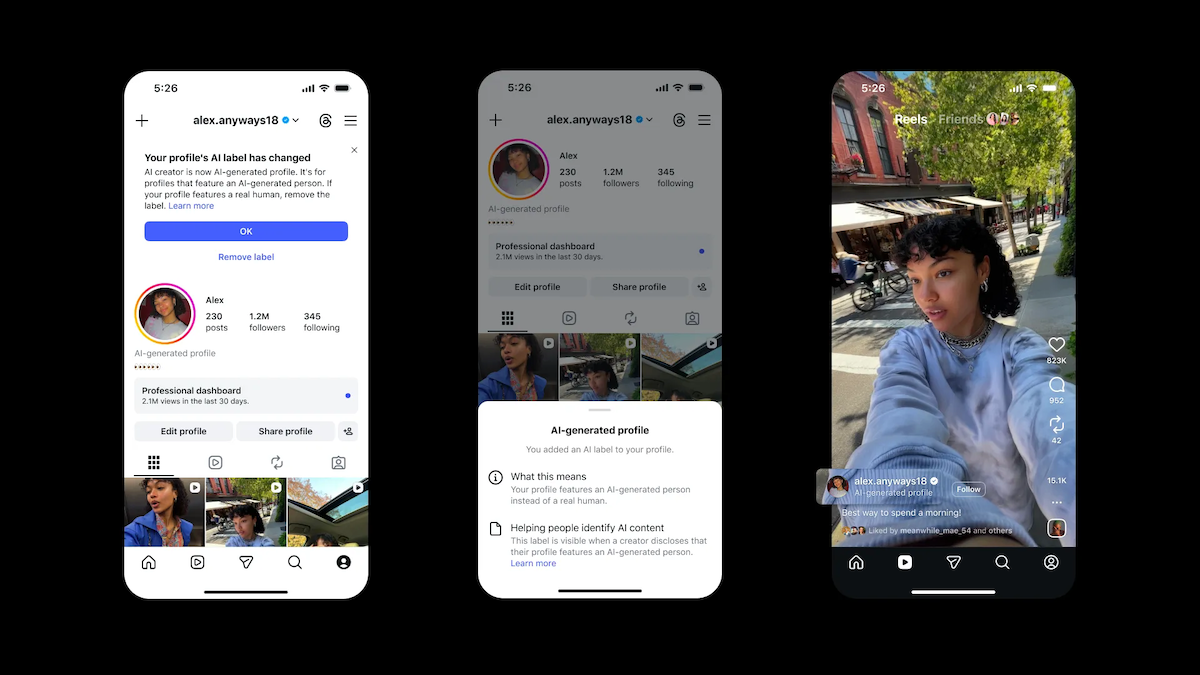
Instagram is putting AI influencers on notice. The platform is introducing clearer labels for profiles built around artificial people and says accounts that fail to disclose their AI-generated identities could have their reach reduced.
The change replaces Instagram’s existing “AI creator” designation with a more explicit “AI-generated profile” label. It applies when the person presented by an account has been generated or substantially created using artificial intelligence. The important distinction is that Instagram isn’t trying to flag every piece of content that has touched an AI tool.
Using generative AI to edit an image, improve a caption, produce graphics or make other creative adjustments won’t require the profile-level disclosure. Instead, Instagram is targeting accounts where the apparent human identity itself is synthetic.
That distinction matters as AI influencers become increasingly convincing. A virtual character openly presented as fictional is one thing; an account designed to look like an ordinary human being without making its artificial nature obvious creates a much murkier problem. Users can encounter the profile, follow it or receive messages without immediately realizing there is no real person behind the face.
Instagram says users have complained about precisely that experience. Its response is effectively to make disclosure part of distribution: accounts that correctly identify an AI-generated person won’t be penalized simply for being synthetic, while those that avoid the label may find their content reaching fewer people.
That approach could prove more effective than another easily ignored badge. Social platforms run on recommendation algorithms, and visibility is currency. Reducing distribution gives creators a practical incentive to disclose AI identities without Instagram having to ban virtual influencers outright.
The problem extends beyond harmless fictional celebrities. AI-generated personalities have already appeared in more sensitive areas, including health and wellness, where synthetic doctors and other apparently authoritative figures have been used to promote supplements and make health-related claims. AI influencer networks have also been associated with promotional campaigns where the artificial nature of the personalities wasn’t immediately apparent.
The policy arrives during a broader period of scrutiny around Meta’s handling of AI-generated content and user identity. Instagram recently faced criticism over an AI image feature involving other people’s likenesses, which Meta subsequently removed after objections over how public Instagram content could be used.
None of this solves the harder enforcement question. A disclosure rule works neatly when creators cooperate, but identifying sophisticated synthetic identities automatically — and doing so without incorrectly punishing real creators who heavily edit their appearance — is considerably more complicated.
Still, Instagram’s decision signals an important shift. The issue is no longer simply whether AI-generated influencers should exist on social media. They already do. The emerging battle is over whether platforms can make sure users know when the seemingly human personality competing for their attention was never human in the first place.