

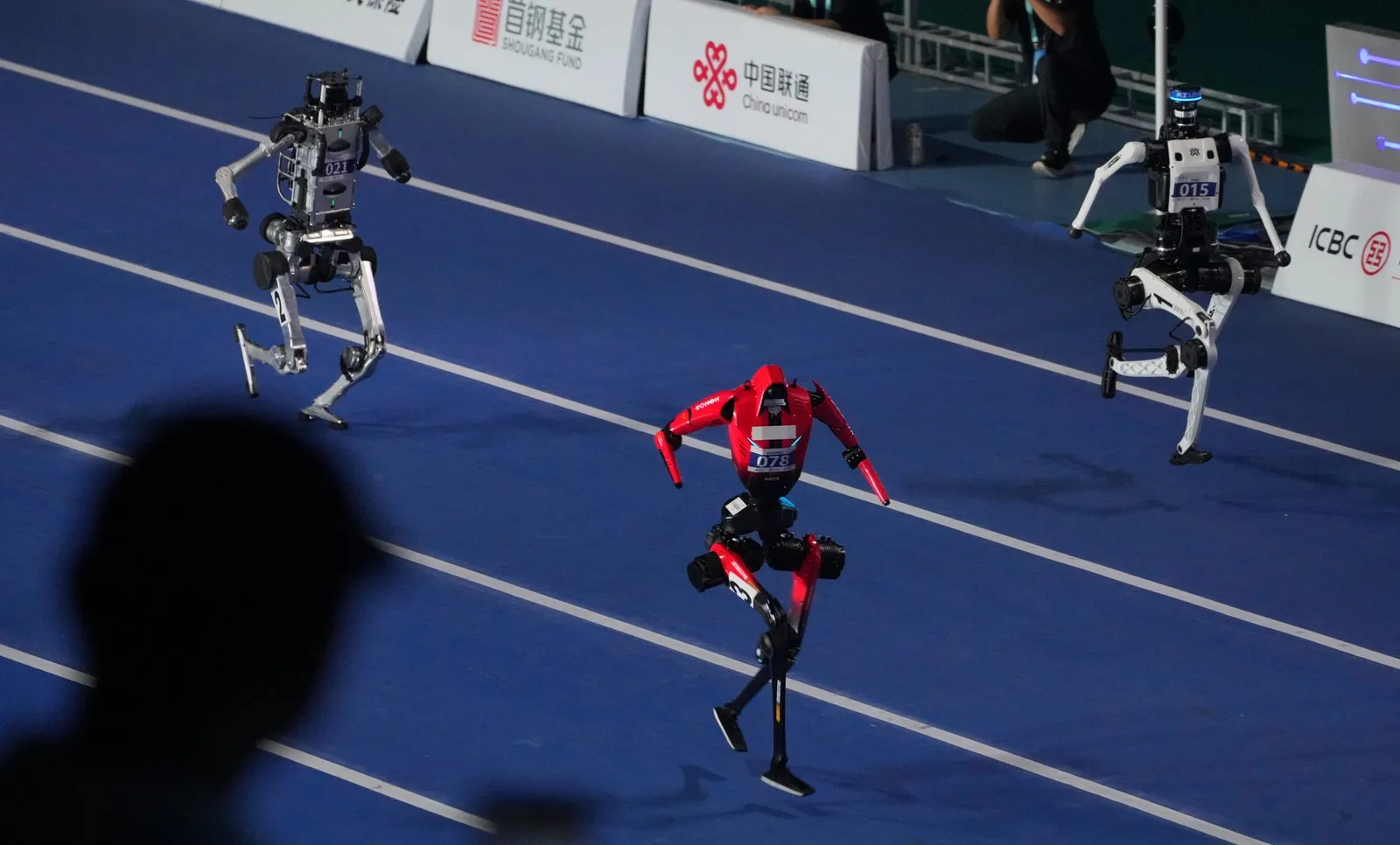
A Chinese humanoid robot has crossed a symbolic threshold in the rapidly developing robotics race, completing a 100-metre practice run in 9.32 seconds — faster than Usain Bolt’s long-standing human world record.
The robot, named Lightning, recorded the time ahead of the second World Humanoid Robot Games in Beijing. Bolt’s official 100-metre world record remains 9.58 seconds, set at the 2009 World Athletics Championships in Berlin, meaning Lightning covered the distance 0.26 seconds faster.
That comparison needs some context. Lightning’s performance does not replace Bolt’s athletics record, which applies to human competition under World Athletics rules. A robot also operates with fundamentally different mechanical and physiological constraints. The significance here is instead how quickly humanoid machines are becoming capable of sustained, high-speed movement.
The progress is particularly striking given the state of robot athletics only a short time ago. Humanoid running demonstrations have traditionally exposed the limitations of bipedal machines: maintaining balance at speed, coordinating joints and recovering from changes in stride are difficult engineering problems. Robot races have often been as notable for falls and awkward movement as for outright speed.
Lightning is reportedly developed by Chinese smartphone maker Honor and has already demonstrated its endurance. In April, the robot completed a 21-kilometre half-marathon in Beijing in 50 minutes and 26 seconds. For another eye-catching comparison, Uganda’s Jacob Kiplimo holds the men’s human half-marathon world record at 57 minutes and 20 seconds.
Again, those numbers aren’t directly comparable as sporting achievements, but they illustrate the changing capabilities of humanoid robotics.
Engineers also modified Lightning ahead of the Beijing competition. The robot previously stood 169 centimetres tall with 95-centimetre legs, but Chinese state broadcaster CCTV reported that its legs were extended by 10 centimetres to 1.05 metres for the World Humanoid Robot Games. Longer legs can potentially alter stride length and running dynamics, highlighting an advantage machines have over human athletes: their physical dimensions can be redesigned around a task.
The World Humanoid Robot Games provide a showcase for exactly this kind of experimentation. Technology companies and university teams, many of them Chinese, use the event to demonstrate robots performing increasingly demanding physical activities. The competition also reflects China’s broader push into humanoid robotics, where improvements in motors, batteries, control systems and artificial intelligence are allowing machines to move with greater speed and autonomy.
Still, beating a human running time shouldn’t be confused with achieving human-level physical intelligence. A fast sprint on a prepared course is a narrowly defined challenge. Humanoid robots intended for factories, homes or public environments must also navigate unpredictable terrain, manipulate objects safely, operate for long periods and respond reliably when something goes wrong.
Lightning’s 9.32-second run is therefore less interesting as a robot-versus-human victory than as an engineering milestone. The more important race is happening between robotics teams themselves, as machines that struggled simply to stay upright increasingly begin to move at speeds that would have seemed implausible only a few years ago.