
TL;DR: Fortnite Chapter 7 Season 4: Override combines Sonic, Mega Man and other gaming crossovers with new weapons, Sprites, map changes, Cheat Codes and match-altering Overrides. Learn the revised map and loot pool first, then experiment with the season’s deeper mechanics as the meta develops.
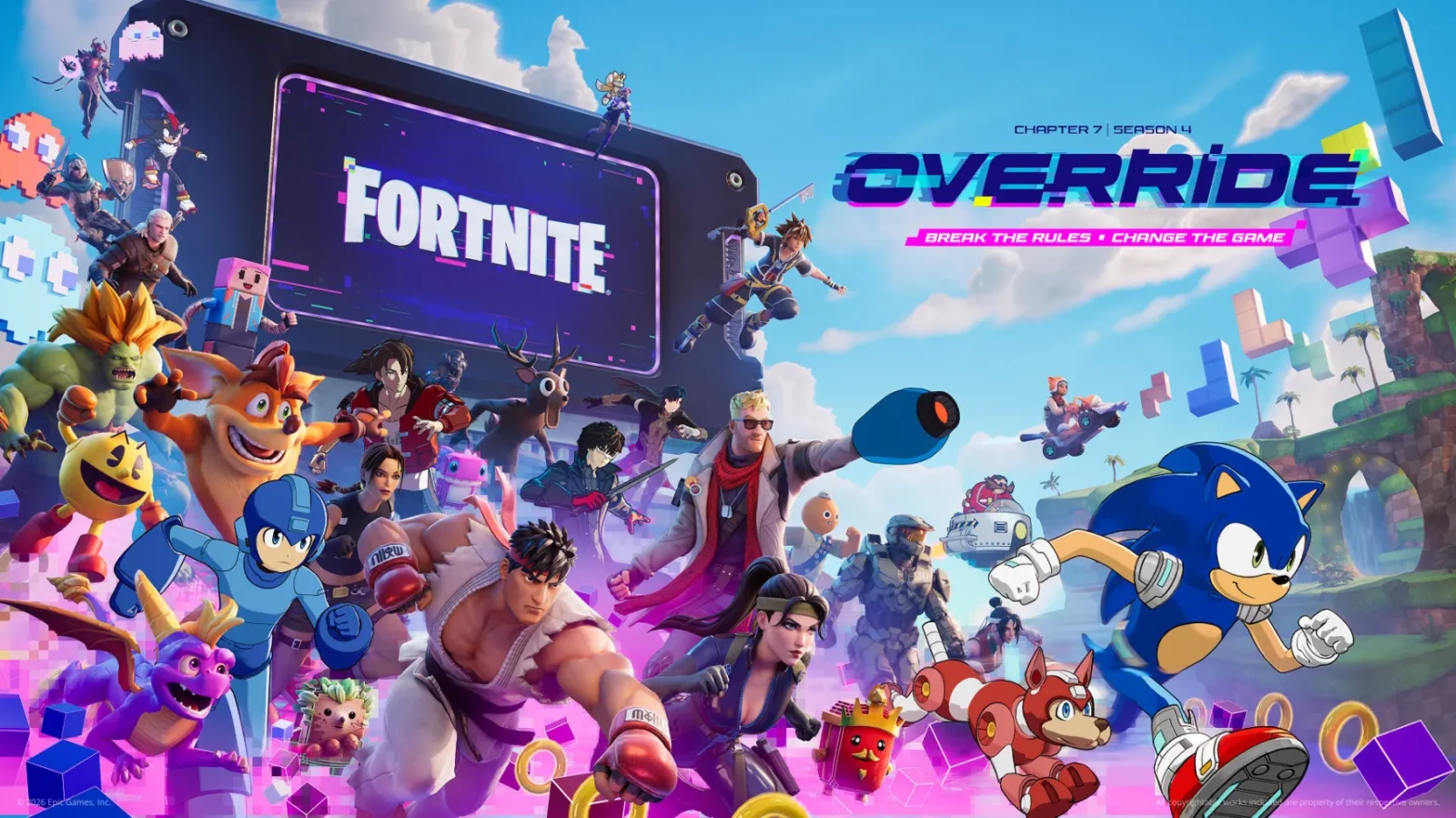
Fortnite has spent years evolving from battle royale into something closer to a giant interactive pop-culture theme park. Chapter 7 Season 4, officially called Override, pushes that idea even further by turning gaming history itself into the theme.
Sonic the Hedgehog, Mega Man, Tetris-inspired scenery, new weapons, Sprites, map changes and game-altering Overrides all arrive as part of the season. More importantly, Epic hasn’t limited the concept to cosmetics. Override leans into cheat codes, power-ups, hacking and deliberately rule-breaking mechanics, which gives the season more personality than simply dropping famous characters into the Item Shop.
It is chaotic, nostalgic and extremely Fortnite.
Overrides are the season’s most important new mechanic
The headline addition is the Override system.
Overrides grant powerful bonuses during matches, affecting things such as movement, stamina, healing, weapon performance, loot and survivability. Some can influence everyone in the lobby, while Squad Overrides provide team-specific advantages with additional risks.
That makes them more interesting than ordinary stat boosts.
A speed increase can change how quickly players rotate between locations. Infinite stamina can dramatically improve mobility. Better headshot damage or faster weapon handling can turn an otherwise ordinary fight into a very unpleasant surprise.
Fortnite has experimented with perks, medallions and temporary abilities before, but Overrides fit the season especially well because they feel like somebody activated a cheat menu halfway through Battle Royale.
Early in the season, I wouldn’t obsess over finding the supposedly “best” Override. Fortnite’s metagame changes quickly, and powerful-looking abilities often become more situational once players understand their limitations.
Experiment first. Tier lists can come later.
Sonic finally gets the full Fortnite treatment
Sonic the Hedgehog is one of Override’s biggest attractions, and thankfully Epic has done more than simply turn Sega’s mascot into another costume.
Green Hill Zone appears on the Island, complete with the visual language and high-speed movement associated with Sonic. The collaboration also extends into gameplay through themed equipment and Sprites.
That’s exactly how Fortnite crossovers work best.
A skin is fun, but a playable location or mechanic gives the collaboration much more character. Green Hill Zone also happens to suit Fortnite remarkably well. Loops, slopes and speed-focused terrain feel naturally compatible with sprinting, sliding and Fortnite’s generally questionable relationship with physics.
Sonic is also one of the main faces of the season’s pass, making him immediately accessible rather than hiding the biggest attraction behind weeks of progression.
Tails joins the season in Sidekick form, extending the Sonic presence beyond the main outfit.
The Battle Pass still gives Fortnite originals room to breathe
Sonic may dominate the marketing, but Fortnite Chapter 7 Season 4 doesn’t abandon Epic’s own characters.
The pass also features original additions including Phantom, Grace Crowne, Mali, Bastian, Kitty Wins, Geno and Wrixel.
That’s important because Fortnite works best when licensed characters and original designs coexist. If every season became nothing but recognizable crossover characters, the game would eventually start resembling a licensing catalogue with shotguns.
Characters such as Wrixel are particularly interesting because customization tends to give Fortnite cosmetics longer-term appeal. Players may initially arrive because they want Sonic, but flexible original characters are often the ones that stay in locker rotations once the novelty wears off.
As always, don’t judge the value of a Fortnite pass purely by its headline skin.
Look at the entire reward pool and ask how much of it you’ll actually use. Fortnite lockers are already full of excellent cosmetics that haven’t seen daylight since approximately six minutes after they were unlocked.
Mega Man helps make the new loot pool much stranger
Fortnite collaborations become far more exciting when their weapons escape the cosmetics menu.
Mega Man’s iconic arm cannon fits that philosophy perfectly. Instead of simply dressing as famous gaming characters, players can use equipment inspired by them during matches.
That’s where the season’s gaming theme becomes genuinely entertaining.
Fortnite’s standard rifles, shotguns and pistols provide a familiar foundation, while crossover weapons add controlled chaos. The challenge is making them powerful enough to feel special without creating a situation where every final circle revolves around whichever player found the season’s mandatory superweapon.
More gaming collaborations are expected throughout the season, including properties such as Kingdom Hearts, Cyberpunk: Edgerunners, Persona 5 Royal, Crash Bandicoot and Spyro the Dragon.
Fortnite’s original arsenal is evolving too. Midas’ Masterpiece, for example, rewards accurate shooting with extremely high headshot potential.
For precise players, that’s exciting.
For everyone else, it’s another opportunity to land an incredible shot on the wall directly beside an opponent.
Sprites are becoming more than seasonal collectibles
One of the smartest decisions in Override is keeping Sprites relevant rather than immediately replacing them with another temporary mechanic.
Sprites now feel increasingly like part of Fortnite’s identity.
New crossover versions provide useful abilities. Sonic’s Sprite improves movement speed, Tails offers aerial mobility, while Shadow can help manage weapon reloads.
That turns Sprites into small strategic choices rather than decorative companions.
Players who favor aggressive rotations may naturally prefer movement bonuses. Others may value aerial mobility or passive weapon management more highly.
There is no universally perfect option because usefulness depends heavily on playstyle.
More importantly, continuing the Sprite system gives Epic an opportunity to build depth across seasons instead of introducing a mechanic, spending months developing it and then launching it directly into the live-service void.
Fortnite has enough moving parts already. Sometimes keeping a good idea is more interesting than inventing another one.
The Fortnite map has become a giant gaming motherboard
Green Hill Zone may be the most recognizable addition, but Override’s map changes go far beyond Sonic.
The Island now incorporates gaming imagery, arcade references and areas designed to resemble electronic hardware. Tetris-inspired structures appear across parts of the map, while Pac-Man imagery continues the broader retro-gaming theme.
It is a surprisingly effective way of tying wildly different franchises together.
Mega Man, Sonic, Cyberpunk and Kingdom Hearts don’t naturally belong in the same world, so Epic needs a visual theme strong enough to contain the chaos. Hacking, circuitry and gaming hardware provide that connective tissue.
Tetris is especially perfect for Fortnite’s environment because its geometric shapes already resemble exaggerated building materials.
Of course, spotting giant tetrominoes will probably awaken the same universal instinct that has haunted players for decades: desperately wondering where the long piece is when you actually need one.
Green Hill Zone will probably be chaos at launch
Every Fortnite season produces at least one location that becomes a magnet for terrible decisions.
Green Hill Zone has all the ingredients.
It’s new, recognizable and tied to one of gaming’s most famous characters. That means plenty of players will immediately drop there, turning peaceful exploration into a frantic competition for whichever person finds a usable weapon first.
That isn’t necessarily bad.
Hot drops are excellent for quickly learning a location because repeated fights reveal loot routes, escape paths, elevation changes and movement opportunities much faster than relaxed exploration.
But if your goal is surviving deep into matches or completing challenges efficiently, quieter landing spots may be smarter while Green Hill Zone remains the season’s tourist attraction.
Sometimes the best tactical decision in Fortnite is simply allowing everybody else to fight over the shiny new thing.
Cheat Codes complete the Override theme
The hacking concept extends beyond conventional Battle Royale bonuses.
Override introduces Cheat Codes and Lobby Hacks, pushing the season further into old-school gaming culture.
Cheat codes have an almost mythical history in games. Long before DLC, battle passes and premium currencies became normal, players shared secret combinations at school, wrote them in notebooks and searched gaming magazines for ridiculous unlocks.
Fortnite tapping into that memory is a clever thematic choice.
It also encourages community discovery. Instead of every new reward appearing as another notification inside a menu, secrets can become something players actually discuss, hunt for and share.
That collaborative element may end up being one of the season’s most memorable ideas.
Fortnite has always been strongest when players feel as though strange things are happening around them, rather than simply being handed another checklist.
The collaborations are ridiculous, which is exactly why they work
Override’s crossover lineup reads like somebody opened several decades of gaming history and pressed shuffle.
Sonic, Mega Man, Kingdom Hearts, Persona, Cyberpunk, Crash Bandicoot and Spyro are all associated with the season in different ways.
Trying to decide whether any of those characters “fit Fortnite” is pointless at this stage.
Fortnite is the thing they fit into.
Epic has spent years establishing the Island as neutral ground where completely incompatible fictional universes can coexist without explanation. Darth Vader can meet superheroes, musicians and cartoon characters while somebody drives past in a sports car.
Nobody asks why anymore.
The interesting part of Override is how widely it spreads its gaming nostalgia. Retro arcade references sit alongside classic console mascots and much newer franchises.
It effectively turns Fortnite into an interactive gaming museum.
Except the exhibits are armed.
Returning players should focus on the fundamentals first
If Override is bringing you back to Fortnite after a break, don’t try to understand every new system immediately.
Learn the updated map first.
Knowing where players rotate, where fights usually happen and how the new locations connect is more valuable than memorizing every Override bonus.
Next, experiment with the loot pool.
Weapon statistics only tell part of the story. Recoil, handling, reload speed and practical accuracy matter just as much as headline damage numbers.
A weapon can look fantastic on paper and still become expensive inventory furniture if you can’t consistently hit anything with it.
After that, spend time understanding Sprites and Overrides.
Those mechanics become much easier to evaluate once you’re comfortable with the basics.
And expect everything to change. Fortnite seasons rarely remain identical from launch to finish. Balance updates arrive, strategies evolve and players inevitably discover interactions Epic probably didn’t expect anyone to find quite so quickly.
Override understands what Fortnite has become
There’s something wonderfully strange about Fortnite dedicating an entire season to gaming itself.
Sonic represents decades of platforming. Mega Man brings another piece of classic gaming history. Tetris and Pac-Man reach even further back into the medium’s DNA.
Yet Epic isn’t treating those franchises like museum exhibits.
It is remixing them.
That’s ultimately what Fortnite does best.
The game doesn’t preserve pop culture carefully behind glass. It throws everything together, adds weapons, introduces questionable physics and asks players to see what happens.
Override feels particularly successful because its nostalgic references aren’t merely decoration. They’re connected to locations, movement systems, weapons, Sprites and match mechanics.
Whether every idea remains balanced throughout the season is another question entirely.
But Fortnite is often most enjoyable when its systems are just unpredictable enough to encourage experimentation.
Bottom line
Fortnite Chapter 7 Season 4: Override succeeds because its gaming theme goes deeper than recognizable skins.
Sonic and Mega Man provide the obvious excitement, but the season’s more meaningful additions are its new mechanics. Overrides reshape matches, Sprites add useful abilities, crossover weapons make the loot pool more unpredictable and the redesigned Island turns gaming nostalgia into something players can actually explore.
Returning players should prioritize map knowledge, movement and weapon familiarity before worrying about which Override or Sprite is supposedly essential.
Regular players, meanwhile, get a substantial seasonal remix rather than a cosmetic refresh.
And for anyone who grew up with Sonic, Mega Man, Tetris, Pac-Man and the era of mysterious cheat codes, Override feels like Fortnite converting several generations of gaming history into one enormous playground.
It’s ridiculous.
That’s exactly why it works.