
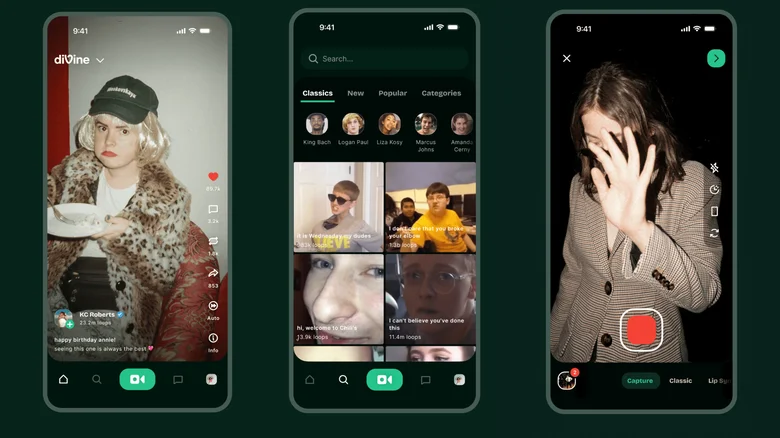
Divine, the social video platform attempting to recapture some of Vine’s six-second magic, has opened registrations to everyone after spending its first three months behind an invitation system. The wider launch gives the young network its first serious test: whether nostalgia for an earlier era of social media can translate into a sustainable community in 2026.
The project isn’t an official Vine revival, but the similarities are deliberate. Divine revolves around six-second looping videos and has restored more than two million clips from Vine’s archive. Those older videos sit in a dedicated classic feed, effectively giving newcomers access to a substantial slice of the culture that helped make Vine influential before Twitter shut the service down in 2017.
There are some notable connections to Twitter’s history. Divine was created by Evan “Rabble” Henshaw-Plath, an early Twitter employee, and has received funding from Twitter co-founder Jack Dorsey. According to Divine, Dorsey does not hold equity or ownership in the company.
Underneath the retro presentation is a considerably more modern technical approach. Divine is decentralized and built using Nostr, the open-source communications protocol that Dorsey has also supported. That puts the platform alongside a broader movement toward decentralized social networks, where developers are experimenting with ways to reduce dependence on a single company controlling identities, content and distribution.
Divine is also taking a particularly aggressive position on generative AI content. New videos must be captured through the app’s own camera rather than uploaded from elsewhere, while AI-detection technology provides another layer of verification. The idea is to create a feed dominated by original human-made videos rather than recycled clips and AI-generated material.
That could help Divine establish a recognizable identity at a time when major platforms increasingly overlap in features and content. TikTok, Instagram and YouTube all compete heavily around short-form video, but their feeds frequently contain reposted material alongside increasingly sophisticated AI-generated media. Divine’s restrictions create a clearer boundary, though they could also make posting less convenient.
Creator economics may prove an even bigger challenge. Vine produced creators whose influence spread well beyond the platform, but its inability to build a compelling monetization model contributed to tensions with some of its biggest personalities. Henshaw-Plath has acknowledged that successful Divine creators will eventually need ways to earn money, although the platform has yet to settle on exactly how those systems will work.
The timing is interesting. Interest in simpler, earlier forms of social networking has been resurfacing, accompanied by renewed discussion around platforms such as Myspace and smaller services attempting to recreate the less polished feel of early social media. Divine is betting that some users want more than another algorithmically optimized infinite video feed.
Opening registration removes the biggest barrier to finding out. Six-second loops and millions of archived Vines provide Divine with an immediate identity, but nostalgia can only attract users initially. Whether they stick around will depend on whether Divine can build a creator community that feels genuinely different from the platforms it is trying not to become.