

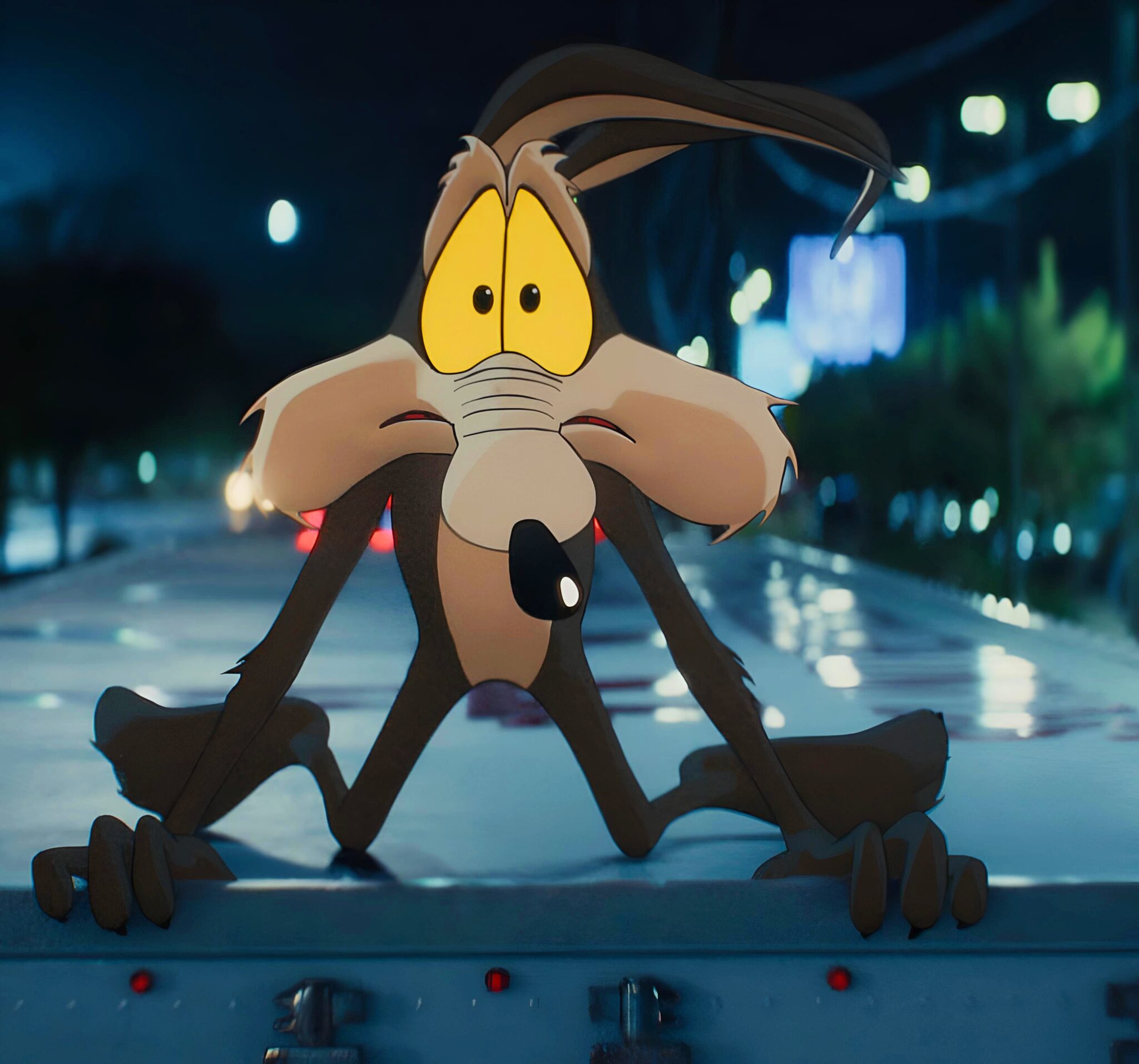
TL;DR: Coyote vs. Acme turns Wile E. Coyote’s endless failures into a smart, affectionate courtroom comedy packed with cartoon chaos, sharp performances and unexpected heart. It’s nostalgic without becoming trapped by nostalgia and proves the Looney Tunes still have plenty of dynamite left in the crate.
Coyote vs. Acme
There is something beautifully ridiculous about asking audiences to emotionally invest in Wile E. Coyote after decades of watching him flatten himself with machinery ordered from a company whose quality-control department apparently consists of a mailbox in the desert. Yet Coyote vs. Acme understands that the character’s endless suffering has always contained something strangely relatable beneath the anvils, rockets and catastrophically unreliable contraptions. Directed by Dave Green and written by Samy Burch, the film takes that tiny emotional truth and somehow stretches it into a courtroom comedy without sanding away the glorious stupidity that makes Looney Tunes work. The result is a surprisingly affectionate, frequently hilarious hybrid of live action and animation that remembers these characters don’t need reinventing. They just need filmmakers willing to play by cartoon physics.
The setup sounds like something conceived during an unusually productive late-night argument between animation nerds: Wile E. Coyote has finally had enough of Acme. After years of purchasing products that explode, collapse, misfire or otherwise convert his body into an accordion, he decides the corporation should answer for its merchandise. Enter Kevin Avery, played by Will Forte, a personal injury lawyer whose career has settled comfortably into mediocrity. Representing a silent animated coyote against a gigantic corporation isn’t exactly the professional resurrection he expected, but Coyote vs. Acme quickly turns their unlikely partnership into the engine of the entire movie.
What makes the premise work is that Green doesn’t treat the courtroom concept as an excuse to abandon the cartoons. Legal procedure becomes another playground for Looney Tunes logic, with corporate bureaucracy sitting comfortably alongside ridiculous Acme inventions and visual gags. There is an actual mystery driving proceedings, and the film gives its human characters enough motivation to keep the plot moving when nobody is being launched through a wall. Crucially, however, it never behaves as though adding narrative sophistication means becoming embarrassed by its source material. This is still a universe where physics negotiates its contract scene by scene.
Turning Wile E. Coyote into an emotional protagonist could have gone horribly wrong. Nobody needs a gritty monologue explaining the childhood trauma behind ordering rocket-powered roller skates. Instead, Coyote vs. Acme finds something far simpler in him: persistence pushed beyond all reasonable limits. His desert home, accumulated plans and endless history of failure suddenly look different when viewed outside the rhythm of a six-minute cartoon. He isn’t merely chasing the Road Runner anymore; he’s trapped inside a routine that has consumed virtually everything else.
The movie gets considerable mileage from that realization without transforming Wile E. into a completely different character. His partnership with Kevin works because both are stuck, albeit in wildly different circumstances. Forte is especially good at playing men whose confidence appears to have been assembled five minutes before they entered the room, and that anxious comic energy makes him an ideal human counterpart to Coyote’s obsessive determination. Their relationship gradually develops genuine warmth, but the screenplay knows when to puncture sentimentality before things become suspiciously inspirational. In a movie containing industrial-strength cartoon explosives, emotional restraint might be its most unexpected achievement.
Live-action performers sharing scenes with cartoon characters have a difficult job because pushing too hard can make everything exhausting, while playing proceedings too realistically can drain the fantasy from the room. Will Forte finds the sweet spot, but John Cena arguably has the most immediately enjoyable assignment as Buddy Crane, Acme’s aggressively polished legal muscle. Cena has become remarkably comfortable weaponizing his own physical presence for comedy, and here his oversized confidence feels perfectly calibrated for a corporation that would presumably sell a customer a catapult and then blame gravity when something went wrong.
Lana Condor brings a more grounded energy as a young lawyer whose idealism hasn’t yet been beaten into submission by the profession, giving the legal storyline some necessary sincerity. Meanwhile, Luis Guzmán, Martha Kelly and P.J. Byrne demonstrate how valuable properly cast supporting roles can be in a comedy. None needs to seize the movie from its leads because their reactions, pauses and peculiar little character choices keep scenes alive around the edges. Coyote vs. Acmeunderstands an old Looney Tunes rule particularly well: sometimes the funniest thing isn’t the explosion but the expression immediately before somebody realizes they’re standing on the dynamite.
Dave Green approaches the Looney Tunes material with visible affection, but Coyote vs. Acme doesn’t feel trapped inside a museum dedicated to animation history. The familiar ingredients are everywhere—impossible gadgets, elaborate setups, escalating disasters and the eternal confidence of characters who should absolutely know better by now—but the comedy has a contemporary rhythm. Some jokes arrive as elaborate physical sequences, others hide in props and backgrounds, and several depend on allowing uncomfortable silence to hang around just long enough to become funny. The variety prevents the feature-length format from becoming an exhausting parade of nostalgic references.
The Acme products are naturally comedy gold because they allow the filmmakers to invent new absurdities while remaining completely faithful to the mythology. The production design has fun imagining what happens when a company responsible for Wile E. Coyote’s catalogue of disasters expands beyond the desert, while the animation/live-action integration keeps the Tunes feeling like inhabitants of this world rather than effects pasted over it. There is fan service here, certainly, but most of it functions as seasoning instead of the entire meal. Longtime Looney Tunes fans will spot plenty of affectionate details, while newcomers don’t need an animation-history degree to understand why any of this is funny.
The legal battle also gives Coyote vs. Acme somewhere surprisingly fertile to point its satire. Acme isn’t merely the manufacturer of suspiciously dangerous gadgets anymore; it becomes the embodiment of corporate machinery capable of turning obvious absurdity into procedure, paperwork and plausible deniability. That’s an almost alarmingly natural fit for Looney Tunes. These cartoons have always delighted in authority figures losing control, elaborate systems collapsing and confident characters discovering that the universe has placed a rake directly in front of their next step.
That element became even more fascinating because of the film’s famously troubled road to release, which saw Warner Bros. Discovery initially shelve the completed project before Ketchup Entertainment ultimately stepped in to bring it to audiences. It’s difficult to separate that history entirely from a movie about a small figure fighting an enormous company, even though the story itself wasn’t conceived as commentary on what later happened to the production. Some meta touches acknowledge the cosmic joke without allowing industry drama to swallow the movie. Somehow, Wile E. Coyote escaping a corporate vault feels completely appropriate. Survival through repeated catastrophic failure is basically his résumé.
Feature-length Looney Tunes remains an inherently tricky proposition, and Coyote vs. Acme occasionally reveals the machinery required to keep its premise moving. The courtroom mystery and corporate conspiracy provide narrative momentum, but there are stretches where the plotting becomes more functional than inspired. When the movie has to connect its major comic sequences, you can sometimes feel the screenplay laying track in front of itself. A few jokes also lean harder on recognition than invention, particularly when familiar characters or franchise references enter the picture.
Those weaknesses rarely become serious because the film moves confidently and understands the importance of changing comedic gears. A visual gag is followed by dialogue, an absurd character beat gives way to action, and sincerity is usually interrupted before it becomes sticky. More importantly, the film doesn’t make the mistake of assuming nostalgia automatically earns affection. Its strongest moments come from creating new situations that feel compatible with decades-old characters rather than simply pointing at familiar ones. That distinction separates a worthwhile franchise revival from ninety minutes of intellectual property waving at the audience.
Verdict
Coyote vs. Acme works because it recognizes that Wile E. Coyote was already a compelling character; generations of viewers were simply too busy laughing at the falling boulders to notice. Dave Green’s film gives that eternal failure a surprisingly sturdy emotional foundation while surrounding it with courtroom satire, excellent comic performances and enough cartoon destruction to keep things appropriately unhinged. Will Forte makes an ideal partner for the world’s most determined predator, while John Cena, Lana Condor and an excellent supporting ensemble understand exactly how seriously—or unseriously—to play this universe.
The occasional connective tissue is less exciting than the major comic set pieces, and not every nostalgic appearance earns the same laugh. Those are minor dents in an otherwise wonderfully confident Looney Tunes movie, however. Fans who grew up with Wile E. Coyote will find plenty to love, younger audiences can enjoy the chaos without decades of context, and anyone exhausted by cynical franchise resurrection may be pleasantly surprised by how much personality is here. After spending most of his existence falling off cliffs, Wile E. Coyote finally gets a feature worthy of the climb.