
TL;DR: The End of Oak Street combines dinosaurs, 1980s suburbia, family dysfunction, and gloriously terrible property values into a funny, thrilling old-school adventure that occasionally stumbles emotionally but rarely forgets to entertain.
The End of Oak Street
Some neighborhoods have noisy construction. Others have that one guy who starts mowing the lawn at 7 a.m. The End of Oak Street has dinosaurs, which admittedly makes the homeowners association feel like a relatively minor concern. David Robert Mitchell’s wonderfully strange action-adventure takes an already dysfunctional suburban family, drops their entire neighborhood into a prehistoric ecosystem, and watches as domestic problems become considerably less important once something with several hundred teeth starts examining the residents as potential snacks. Set in 1982 and starring Anne Hathaway, Ewan McGregor, Maisy Stella, and Christian Convery, the film is an unapologetically old-school blockbuster that understands a beautiful cinematic truth: dinosaurs are still awesome, especially when they’re standing somewhere dinosaurs absolutely should not be.
Welcome to Oak Street, please ignore the T. rex
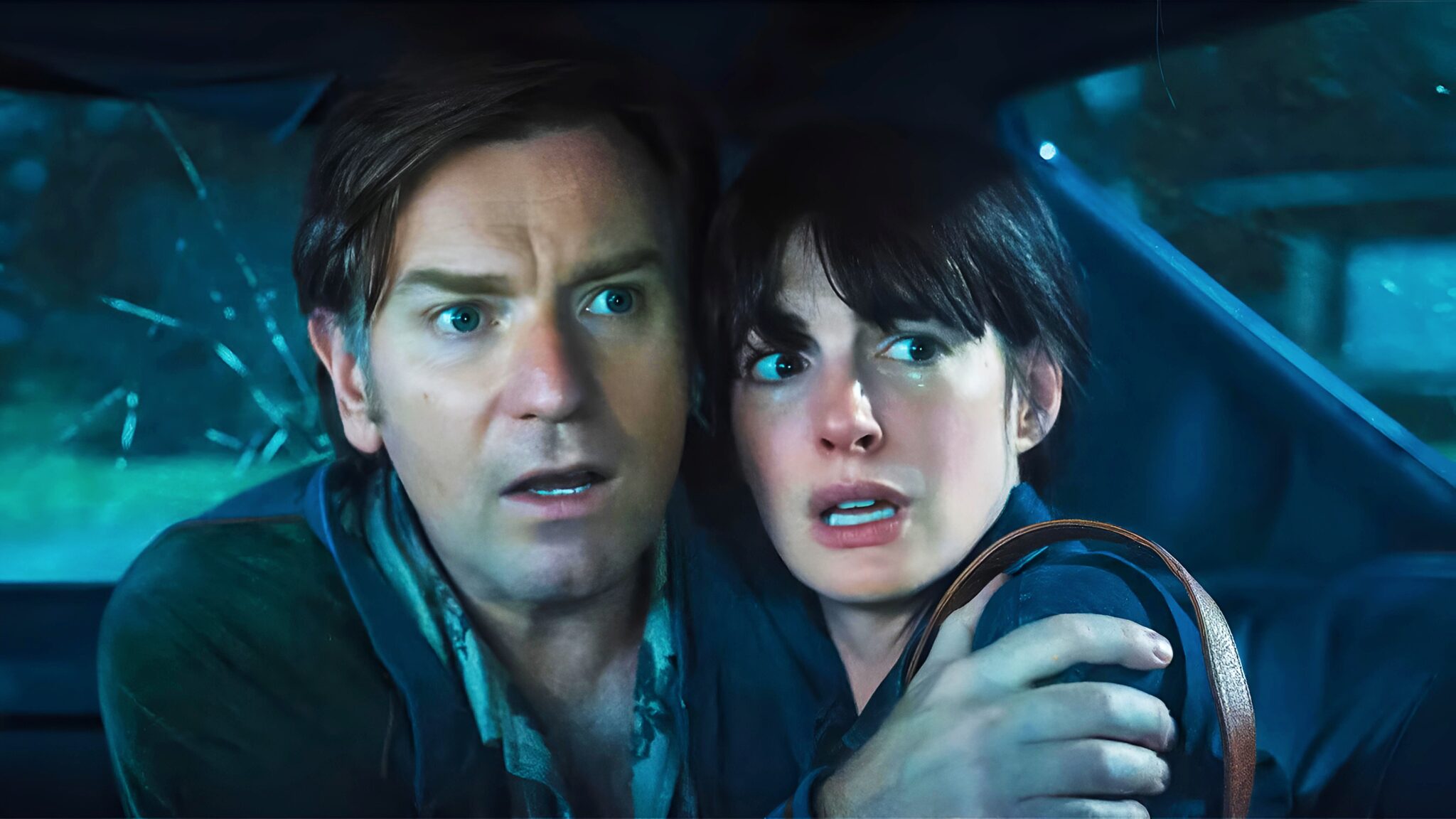
The Platt family isn’t exactly thriving when we meet them. Denise, played by Anne Hathaway, and Greg, played by Ewan McGregor, are struggling through a marriage that has accumulated enough emotional baggage to require its own station wagon, while their children Audrey and Brian are stuck absorbing the tension. Denise can imagine a future outside the marriage, whereas Greg’s financial difficulties and battered confidence have left him increasingly disconnected from the family. It is messy, uncomfortable, and painfully recognizable, right up until their suburban neighborhood travels through a wormhole and ends up surrounded by prehistoric wildlife. Suddenly, arguing about the family finances feels slightly less urgent because there is now a legitimate possibility of being eaten while collecting the mail.
That absurd collision between everyday suburbia and prehistoric danger gives The End of Oak Street its best comic and cinematic energy. Mitchell doesn’t need to invent another dinosaur theme park, secret cloning program, evil corporation, or scientist who apparently learned nothing from the previous eight scientists. Instead, houses, garages, backyards, bicycles, and station wagons become pieces of a survival arena where humans have unexpectedly discovered they are nowhere near the top of the food chain. The premise is refreshingly easy to understand: stay alive, protect the family, and preferably avoid anything capable of swallowing a Labrador without chewing. There is an elegant simplicity to the setup, allowing the movie to spend less time explaining its mythology and considerably more time making suburban America the worst Airbnb location in natural history.
Dinosaurs are scary again, which is exactly how it should be
The dinosaurs themselves are treated less like obligatory blockbuster attractions and more like actual animals occupying an ecosystem that the Platts have rudely crashed into. Mitchell lets them behave unpredictably, which immediately makes encounters more exciting because they aren’t simply waiting around to perform their signature roar for the trailer. People die, sometimes rather unpleasantly, and the film is happy to remind us that humans are essentially soft, slow mammals with absolutely terrible survival stats when compared with enormous prehistoric predators. Yet the violence rarely becomes excessively grim. There is a mischievous streak running through many of the encounters, giving the movie enough bite to generate suspense without transforming it into The Texas Chainsaw Massacre: Cretaceous Edition.
Putting dinosaurs in suburbia also solves one of the biggest problems facing modern creature movies: scale becomes instantly understandable. We know how large a driveway is. We know how high a garden fence should be. We know a family sedan is not designed to withstand a dinosaur deciding it looks interesting. That familiarity makes every creature feel larger and more dangerous without requiring characters to constantly announce measurements like terrified paleontologists presenting a PowerPoint. Mitchell gets plenty of mileage from simply placing something enormous at the end of an otherwise ordinary residential street. It taps into that wonderful childhood nightmare of looking through your bedroom window and seeing something impossible outside, except this time the impossible thing can crush the neighbor’s Buick.
Anne Hathaway clearly received the survival memo
Anne Hathaway is the movie’s greatest weapon, although several dinosaurs would probably dispute that ranking. Denise could easily have become the standard blockbuster mother whose responsibilities involve screaming names and waiting for someone else to formulate a plan, but Hathaway gives her far more authority. Denise is angry, exhausted, resourceful, protective, and impressively functional considering her neighborhood has just undergone the most catastrophic relocation imaginable. Hathaway sells the character’s frustrations before the prehistoric madness begins, which makes her competence during the crisis feel completely natural. She doesn’t suddenly transform into an action hero because the screenplay needs one; the dinosaurs simply provide circumstances dramatic enough for everyone else to notice that she was already the most capable person in the room.
Ewan McGregor has the trickier assignment because Greg begins the movie in a far less flattering position. His financial problems have damaged his confidence, and that insecurity has gradually made him less reliable as a husband and father, although McGregor keeps him sympathetic enough that you never actively root for a velociraptor to solve Denise’s marital problems. Maisy Stella and Christian Convery, meanwhile, prevent Audrey and Brian from becoming generic “movie children” whose only purpose is wandering into danger after being specifically told not to wander into danger. Together, the four actors create a believable family rhythm filled with irritation, affection, resentment, and instinctive loyalty. That chemistry becomes crucial because without it, The End of Oak Street would simply be expensive dinosaur delivery with some humans included for portion control.
Dinosaurs cannot fix every marriage problem
The family drama is also where the movie occasionally trips over its own enormous prehistoric feet. The central idea is obvious but effective: a family already separating emotionally gets thrown into a situation where staying together becomes a literal survival requirement. There is nothing wrong with that setup, and frankly, most relationship counselors would probably agree that fleeing a hungry dinosaur encourages excellent communication. The problem is that the screenplay occasionally assumes mortal danger can perform years of emotional repair at blockbuster speed. Denise and Greg have legitimate problems before the neighborhood goes prehistoric, and while nearly being eaten certainly changes one’s perspective, it doesn’t automatically make unpaid bills, resentment, disappointment, and marital frustration disappear.
Greg’s emotional arc particularly asks the audience to accept some fairly rapid rehabilitation. His journey toward becoming more dependable works because McGregor gives the character enough vulnerability to make his growth appealing, but Denise is still doing a significant amount of the emotional heavy lifting while also handling a disproportionate share of the practical “please stop the dinosaurs from killing us” workload. The movie is so eager to keep moving that several quieter relationship beats feel compressed between survival sequences. As a result, the eventual emotional payoff is warm rather than devastating, and the family resolution feels more blockbuster-efficient than psychologically airtight. Then again, nobody bought a ticket to watch Greg and Denise spend 45 minutes discussing conflict resolution while a Stegosaurus patiently waits outside.
The 1980s called, and thankfully they brought practical-looking chaos
There is no escaping the Amblin DNA running through The End of Oak Street. The 1982 setting, suburban streets, kids caught in extraordinary circumstances, family problems, bicycles, danger, humor, and impossible creatures invading everyday life practically arrive wearing a Steven Spielberg fan-club badge. J.J. Abrams’ presence as a producer makes the influence even more obvious, particularly given how enthusiastically Super 8 chased a similar flavor of childhood wonder and danger. Fortunately, Mitchell doesn’t treat nostalgia like a checklist where simply placing an old television beside some wood-paneled furniture earns applause. The period setting contributes to the movie’s personality while also conveniently removing smartphones, GPS, social media, and the possibility of someone immediately posting “DINOSAUR IN MY DRIVEWAY!!!” before becoming the first viral sensation of the Cretaceous period.
More importantly, the movie remembers what made those older adventures work beyond their hairstyles and production design. The spectacle is attached to ordinary characters, the geography matters, danger feels physical, and the story doesn’t require audiences to complete franchise homework before sitting down. There are no cinematic-universe flowcharts, multiversal variants, legacy cameos emerging through portals, or mysterious characters whose only purpose is setting up Oak Street: Extinction Protocol in 2029. The movie’s elevator pitch is basically “family versus dinosaurs,” and that simplicity feels almost rebellious in modern blockbuster filmmaking. Sometimes cinema really can be that straightforward. Put interesting people somewhere dangerous, release several extremely large reptiles, and make sure the audience cares which species reaches the closing credits.
Not Jurassic Park, and smart enough to know it
Any new dinosaur movie automatically finds itself standing beneath the enormous shadow of Jurassic Park, a film that permanently rewired audience expectations for what dinosaurs could look and feel like on screen. The End of Oak Streetwisely avoids trying to recreate that sense of discovery because that particular cinematic lightning bolt already struck in 1993. Instead, Mitchell gets his thrills from displacement. The dinosaurs aren’t exhibits or escaped attractions; the humans are the intruders who have accidentally deposited suburban civilization into an ecosystem where nobody cares about mortgage payments, zoning regulations, or whether Greg has finally sorted out his career. That reversal gives the movie enough identity to avoid feeling like Jurassic Park with different paperwork.
The smaller scale also works beautifully in its favor. Rather than constantly escalating toward bigger dinosaurs, bigger explosions, and increasingly ridiculous reasons for people to stand near dinosaurs despite decades of evidence suggesting this is a terrible hobby, The End of Oak Street keeps the stakes personal. A creature stalking one family through recognizable domestic spaces can generate more tension than another CGI army demolishing a city because we understand exactly what those spaces mean. Mitchell recognizes that spectacle becomes memorable when audiences have something human to cling to inside it. The film isn’t reinventing dinosaur cinema, but it finds enough personality, humor, danger, and suburban absurdity to carve out its own wonderfully toothy corner.
A blockbuster that remembers fun is allowed
Perhaps the most refreshing thing about The End of Oak Street is that it wants audiences to have a good time without treating them like they have forgotten how stories work. There is genuine danger, but not suffocating misery; family drama, but not two hours of people staring sadly through rain-covered windows; nostalgia, but not enough to make the entire movie feel like someone shaking an action-figure collection at you. Mitchell balances those ingredients with an appealing lightness, allowing the film to be funny without constantly inserting jokes into moments that should remain tense. The humor mostly comes from the fundamental absurdity of ordinary suburban life colliding with creatures that existed millions of years before anyone invented cul-de-sacs, lawn sprinklers, or passive-aggressive notes from the homeowners association.
That balance gives the film considerable charm even when its emotional writing isn’t quite as evolved as its dinosaurs. The End of Oak Street knows exactly what kind of movie it wants to be: a crowd-pleasing standalone adventure where recognizable people encounter something impossible and spend the next couple of hours desperately trying not to become fossils themselves. It doesn’t need to dismantle the genre, apologize for enjoying dinosaurs, or explain why audiences should still find giant prehistoric animals exciting. They are giant prehistoric animals. The case was closed approximately 65 million years ago. Mitchell simply builds a fun human story around them, throws in enough family dysfunction to provide emotional stakes, and lets prehistoric chaos do what prehistoric chaos does best.
Verdict
The End of Oak Street is an enormously likable reminder that blockbuster filmmaking doesn’t always need a universe, a roadmap, or seventeen interconnected post-credits scenes. David Robert Mitchell takes a wonderfully clean premise—suburban family meets prehistoric nightmare—and turns it into an energetic adventure with genuine danger, playful humor, strong creature spectacle, and enough emotional investment to make the humans more interesting than dinosaur lunch. Anne Hathaway is terrific, Ewan McGregor brings vulnerability to a deliberately flawed character, and the film’s 1980s atmosphere delivers nostalgia without completely drowning in it. The marital storyline could use another evolutionary stage, but viewers craving dinosaurs, family adventure, and good old-fashioned cinematic chaos should find plenty to enjoy on Oak Street, even if moving there would absolutely destroy your insurance premiums.