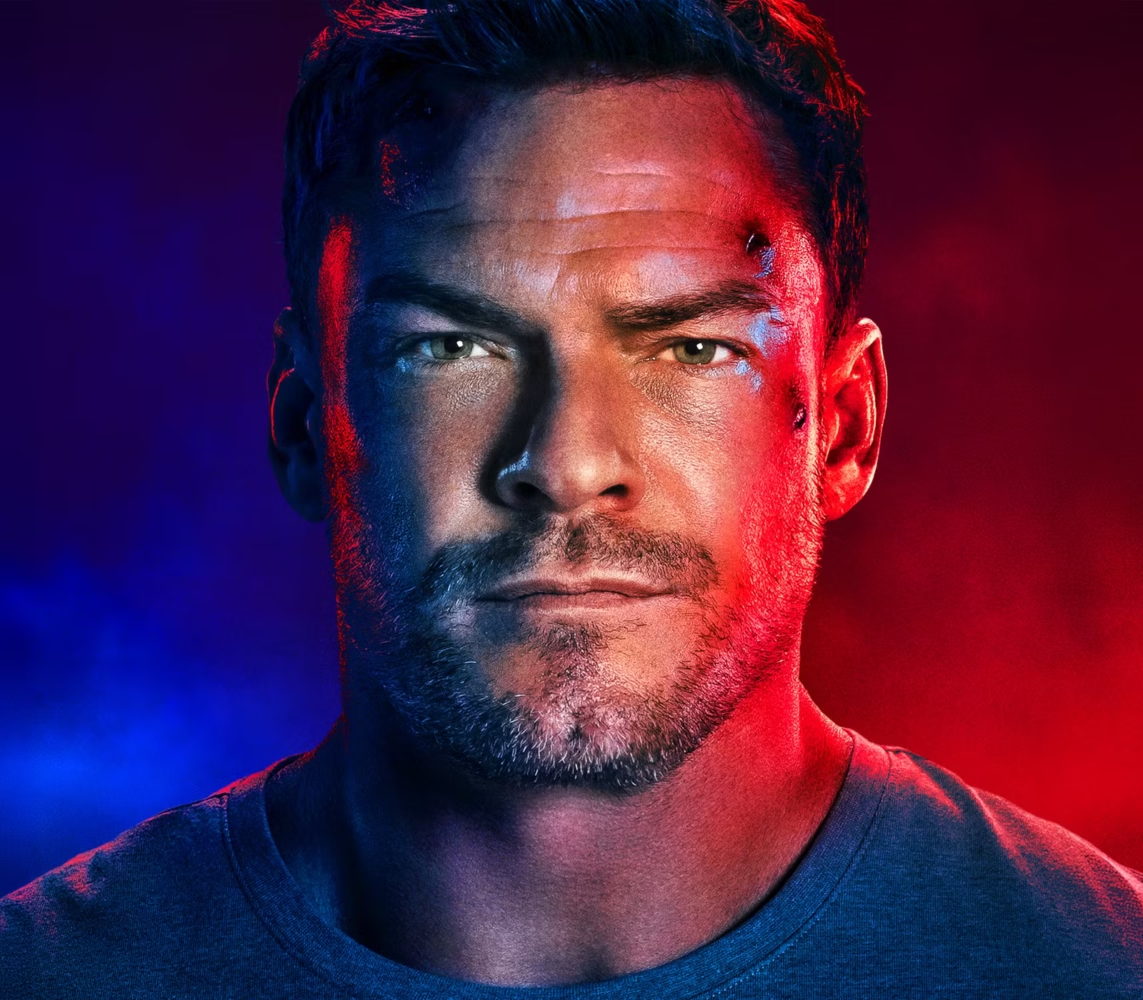
TL;DR: Reacher Season 4 sends Alan Ritchson’s human battering ram into a darker, twistier neo-noir mystery where punches hurt, loyalties wobble and victory no longer feels guaranteed. It is occasionally overcrowded, but the sharper tension, brutal action and newly vulnerable Reacher make this one of the show’s strongest seasons.
Reacher Season 4
Four seasons in, Reacher could easily be running on muscle memory. Alan Ritchson walks into a new town, notices something everyone else missed, irritates several dangerous people, and eventually rearranges those people’s skeletons with the efficiency of someone assembling extremely violent IKEA furniture. It is a formula, certainly, but a very good one. Reacher Season 4 understands that keeping that formula alive does not require abandoning it; it requires putting Jack Reacher somewhere his usual certainty becomes less comforting. Adapting Lee Child’s 2009 novel Gone Tomorrow, the new season surrounds its enormous hero with paranoia, political intrigue and shifting loyalties, then does something unexpectedly refreshing: it lets him look genuinely vulnerable. The result is a darker, nastier season that still delivers everything fans came for while finding new pressure points beneath all that muscle.
The season opens in Philadelphia, where Reacher boards a nearly empty subway and notices a distressed woman whose behavior immediately sets off his internal alarm bells. His attempt to intervene ends tragically, leaving him with the sort of unanswered question he is psychologically incapable of ignoring. That investigation soon expands beyond a single death, pulling Detective Tamara Green (Sydelle Noel), her partner Shaun Docherty (Kevin Corrigan), grieving brother Jacob (Christopher Rodriguez-Marquette), journalist Russell Plum (Kevin Weisman), political figures and intelligence interests into an increasingly dangerous hunt involving a highly coveted flash drive.
That setup gives Reacher Season 4 a different texture from the series’ previous adventures. There is less of the comfortable rhythm of identifying a monster and marching toward him, and more uncertainty about who knows what, who is manipulating whom and whether the obvious explanation deserves to survive another episode. The storytelling occasionally becomes busier than it needs to be, with enough factions and competing agendas to make you wish Reacher carried a conspiracy corkboard alongside his toothbrush. Yet the confusion mostly works in the season’s favor because Jack is forced to investigate rather than simply dominate. His greatest weapon has always been his brain, despite the show understandably enjoying the other, considerably larger weapons attached to his shoulders.
Ritchson remains perfectly calibrated for this character. Reacher is funny because he rarely tries to be funny, intimidating because he never needs to announce that he is intimidating, and strangely charismatic because his bluntness strips every conversation down to its essential components. By now, Ritchson understands exactly how much can be communicated through a stare, a pause or the faint suggestion that somebody has just said something so stupid that Reacher is reconsidering the future of the species. Season 4 wisely preserves those qualities while putting considerably more pressure on the man underneath them.
Most importantly, Reacher no longer feels physically invincible. He is still built like someone entered a cheat code during character creation, but the fights carry more consequence this season. Opponents hurt him, exhaustion registers and victories can feel expensive. That shift matters because action becomes dramatically boring when the audience knows the hero is effectively indestructible. Reacher has always compensated with satisfying choreography and wonderfully direct brutality, but Season 4 adds suspense by making its protagonist work harder for survival. The violence remains gloriously unpleasant when required—this is hardly Jack Reacher’s peaceful conflict-resolution seminar—but bruises now feel like part of the story rather than temporary decorations between episodes.
The action gets meaner, bigger and considerably less comfortable
Anyone primarily watching Reacher to see Ritchson turn criminal organizations into orthopedic case studies will not leave hungry. Season 4 contains some of the series’ most ambitious action, including an extended pursuit through Philadelphia that trades superheroic spectacle for mounting panic. Instead of treating Reacher as an immovable object waiting for enemies to bounce off him, the sequence makes movement itself the source of tension. The city becomes hostile terrain, escape routes disappear and the usual confidence of watching Reacher control a room is replaced by the unnerving sight of him having to react.
That harder edge runs throughout the season. The violence is bloody without becoming weightless, and several confrontations flirt with horror-film nastiness in the way they build toward impact. Crucially, the action rarely feels detached from the mystery. Every broken door, chase and bone-rattling confrontation seems to push Reacher deeper into an environment where violence creates consequences rather than conveniently resolving them. There is still considerable guilty pleasure in watching bad people discover that threatening Jack Reacher was an exceptionally poor career decision, but the season is less interested in effortless power fantasy. It wants the audience wondering how much punishment even this particular human tank can absorb.
The rotating supporting cast has always been one of Reacher’s smartest structural advantages, allowing each season to create a new ecosystem around its wandering protagonist. Sydelle Noel makes Detective Tamara Green a particularly effective counterweight, bringing enough authority and determination to prevent her from becoming another character standing nearby while Reacher solves everything. Kevin Corrigan brings a contrasting energy as Docherty, while Christopher Rodriguez-Marquette gives Jacob an emotional vulnerability that the broader conspiracy desperately needs. With political players including Marc Blucas’ John Sampson and Kathleen Robertson’s Elsbeth Sampson, alongside Agnez Mo and Anggun as Lila and Amisha Hoth, the season has plenty of personalities competing for attention.
That abundance is simultaneously one of the season’s strengths and weaknesses. There are fascinating characters here who inevitably receive less breathing room because the plot keeps accelerating, and some relationships could have benefited from another quiet scene before the next crisis arrives. Maria Sten’s Frances Neagley is also notably absent, and longtime viewers will feel the missing chemistry. Reacher works perfectly well as a lone wolf, but Neagley has become one of the few people capable of challenging him without disrupting the character’s mystique. Her absence inadvertently demonstrates how valuable that relationship has become.
The most interesting evolution is tonal. Reacher Season 4 leans heavily into neo-noir without suddenly pretending it is a different television series. The Philadelphia setting, institutional mistrust, political machinery, deceptive characters and general sense that everybody has entered the story carrying at least one secret create an atmosphere noticeably gloomier than the show’s earlier small-town conspiracies. There is fatalism hanging over the investigation, particularly because its starting point is a tragedy Reacher cannot reverse no matter how many answers he eventually finds.
That darkness gives the season emotional weight, although occasionally it pushes hard enough that Reacher’s usual pulpy escapism becomes harder to locate. The franchise works because it balances grim crimes against the primal satisfaction of watching an extraordinarily competent man impose order on chaos. Here, chaos refuses to cooperate quite so politely. Some viewers may miss the cleaner pleasures of previous seasons, but the discomfort is largely worthwhile. Four seasons into an action franchise, repetition is the bigger enemy than experimentation, and this is Reacher testing how far its familiar machinery can travel into murkier territory without losing its identity.
Verdict
Reacher Season 4 succeeds because it does not mistake escalation for simply adding bigger explosions and more disposable villains. Instead, it attacks the fantasy at the center of the series: the comforting assumption that Jack Reacher always understands the room and can overpower whatever is waiting inside it. Alan Ritchson remains enormously entertaining, the new ensemble gives him plenty of personalities to bounce against, and the season’s vicious action delivers exactly the kind of crunch fans expect. The increasingly tangled conspiracy can become overstuffed, Neagley’s absence leaves a noticeable gap, and some supporting characters deserve more attention than they receive. Even with those flaws, this is a confident evolution of the Prime Video series—bleaker, more paranoid and dangerous enough to remind us that watching an unstoppable man struggle is considerably more exciting than simply watching him win.