

Spotify is introducing a new label for music profiles that represent AI-generated performers rather than real people, adding another layer of disclosure as synthetic music becomes increasingly common across streaming platforms.
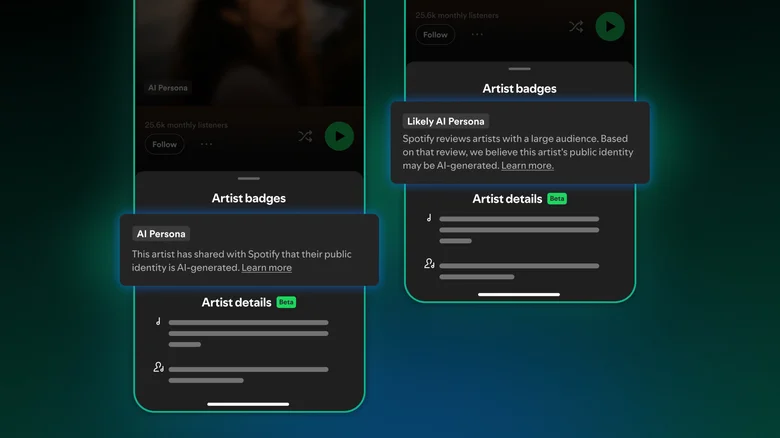
Starting August 11, accounts can identify themselves as an “AI Persona” through Spotify for Artists. The designation is intended for profiles that appear to represent human musicians but are instead built around generative AI identities. Spotify will also attempt to identify these accounts itself, using a combination of automated systems and human review.
When Spotify determines that an account may represent an artificial artist, it can apply a “Likely AI Persona” label. Artists will be notified before or when the designation is applied and will have access to an appeals process if they believe Spotify has incorrectly classified their account.
Listeners should begin seeing the labels from mid-September. Spotify says the initial rollout will focus on its mobile apps, where the disclosure will appear on artist profiles, in search results and alongside tracks within playlists.
The more significant change, however, happens behind the scenes. Music associated with AI Persona accounts will not be included by default in Spotify’s personalized recommendation systems. That could limit how easily synthetic artists are pushed into algorithmically generated listening experiences, where users may otherwise have little indication of who — or what — created a track.
Spotify’s approach reflects a broader problem facing streaming services. Generative AI has lowered the technical barrier to producing large quantities of music, while increasingly convincing artificial voices, images and biographies can make fictional performers difficult to distinguish from human musicians. The issue becomes particularly complicated when AI-generated tracks are distributed through the same channels and presented in much the same way as traditionally produced music.
Labeling doesn’t solve that problem, but it does give listeners more information before deciding whether to engage with an artist. It also avoids treating all uses of artificial intelligence as identical. AI can be involved at many stages of music production, from mastering and restoration to songwriting and fully synthetic vocals. Spotify’s Persona designation appears more narrowly focused on artist identities presented as people despite being AI creations.
The policy also highlights Spotify’s increasingly complicated relationship with generative AI. The company has been developing systems intended to improve transparency around AI-generated material while simultaneously adding more AI-powered features to its own service. That tension isn’t unique to Spotify; much of the technology industry is trying to encourage AI adoption while developing safeguards for the content those systems produce.
The effectiveness of Spotify’s labels will depend heavily on detection. Determining whether an online performer is genuinely human isn’t always straightforward, particularly when creators deliberately obscure how their music was made. False positives could also create problems for legitimate artists, making the appeals process an important part of the system.
For listeners, the visible badge is only one part of the change. Keeping identified AI Personas out of personalized recommendations by default could have a much larger impact on how synthetic music travels through Spotify — and whether listeners encounter fictional performers without actively looking for them.