

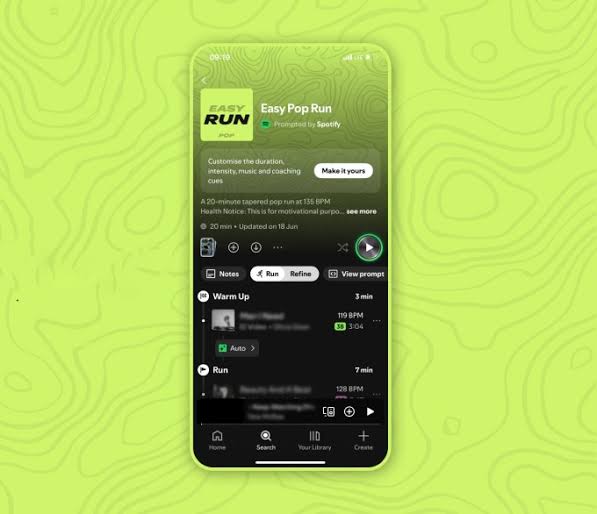
Spotify has added a dedicated Running Mode to its mobile app, available only to paid subscribers. The feature generates playlists that follow a structured workout profile—warmup, intervals or pyramid efforts, recovery, and cooldown—while selecting tracks according to preferred genre and a target beats-per-minute range. Audio prompts appear at phase changes, offering brief form reminders rather than live feedback.
Access sits inside a new Fitness Hub section. Users choose from roughly two dozen presets or build a session from scratch, then select a music style and optionally enable a discovery slider that leans toward unfamiliar tracks. A target cadence can be locked in, and the system attempts to match or slightly adjust song tempo to that number. Generation takes about two minutes; once complete, the playlist can be reordered or edited before the run begins.
The approach is not entirely novel. Runners have long sought BPM-aligned music through manual playlists, third-party apps, or services such as Nike Run Club that already pair coaching cues with curated tracks. What Spotify adds is tighter integration with its existing catalog and a relatively simple interface for defining effort structure. In testing, a pyramid session set to 180 bpm produced a coherent arc for most of the run, starting slower, peaking near the requested tempo, and then easing off. One cooldown track arrived at 210 bpm, an obvious mismatch that stood out precisely because the rest of the pacing logic held together.
The spoken cues themselves remain pre-scripted according to the chosen profile. They do not respond to real-time pace or heart-rate data. Still, the reminders—loosen the stride, unclench the fists, keep the effort snappy but controlled—echo the practical advice many coaches give and can help runners develop a more consistent internal metronome. Locking attention to the kick drum on a well-matched track proved effective for holding cadence, at least when measured against a separate GPS watch.
Limitations are clear. The feature requires a premium subscription, generation is not instantaneous, and occasional tempo outliers still slip through. It also cannot replace structured training plans or the richer sensor feedback available from dedicated running platforms. Yet for subscribers already living inside Spotify’s library, the mode offers a low-friction way to practice pacing without building playlists by hand or switching apps mid-run. Whether it becomes a lasting training aid or simply another seasonal experiment will depend on how consistently the algorithm matches requested tempos and how much the coaching language evolves beyond its current set of stock phrases.